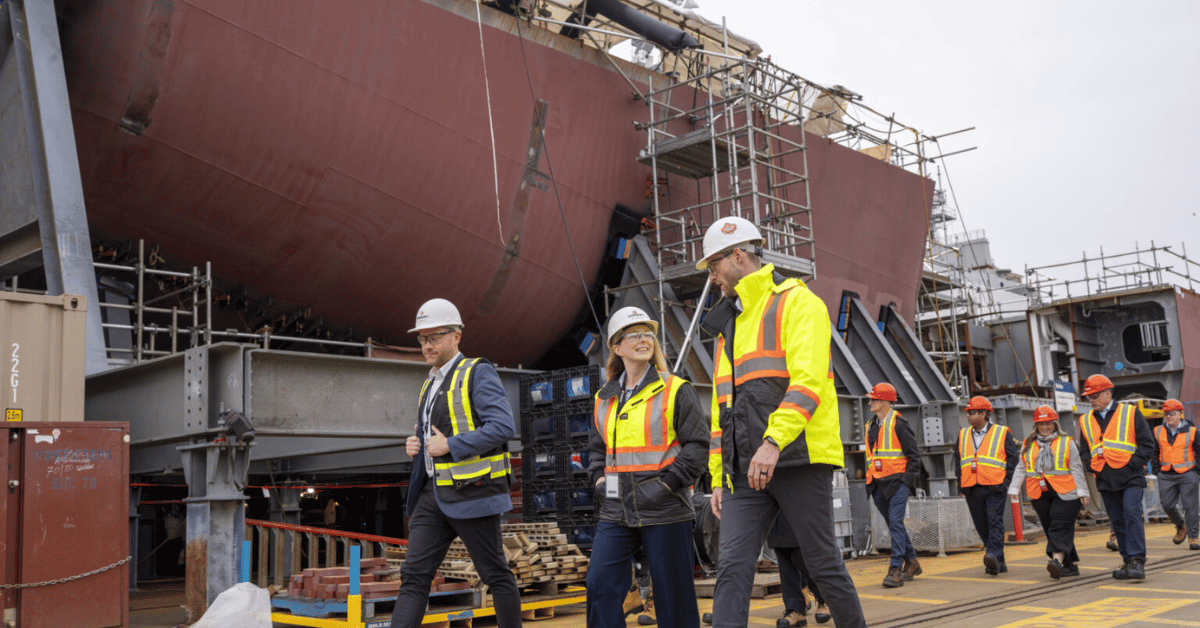
When a government contract worth $182 million for Canadian steel to build six polar-class icebreakers is framed as a supply-chain story, we risk missing the real news: this is a calibrated investment in sovereign capability, not just a procurement win. Seaspan's agreement with Algoma Steel and Stigterstaal Canada to supply up to 24,000 metric tonnes of domestic structural steel for the Canadian Coast Guard's multi-purpose icebreakers represents the largest order of polar-class steel in Algoma's history. For our readers tracking the intersection of industrial policy and ocean stewardship, the practical meaning is clear: Canada is building the physical infrastructure to operate in the Arctic with vessels that are designed, welded, and supplied from within its own borders. This is not symbolic. It is a measurable commitment to a domestic supply chain that can sustain long-term shipbuilding, Arctic security, and the kind of integrated data ecosystem that vessels like these will eventually feed into.
We have seen what happens when maritime operations lack that kind of structural backing. A Drifting Tanker With 11,000 Tonnes of Sunflower Oil Prompts Measured Response recently highlighted how quickly a single point of failure at sea can escalate without robust support systems, a reminder that the ships themselves are only part of the equation. And on the technology front, Validated engine retrofits cut methane slip on three LNG carriers show that retrofitting existing platforms with proven solutions can yield immediate, peer-reviewed emissions reductions. Seaspan's icebreakers, equipped with advanced diesel-electric propulsion and Polar Class 4 capability, are being built from the keel up with that same principle: validated engineering, not speculative promises. The steel itself, produced in Sault Ste. Marie, processed by Stigterstaal, and welded by a workforce trained to handle Arctic-grade thickness, represents a closed loop of empirical quality control.
What matters most here is the precedent for future procurement. Seaspan's orderbook includes up to 16 vessels, and this agreement establishes a template for how Canadian-made materials can be integrated into complex shipbuilding programs under the National Shipbuilding Strategy. The $3 billion in contracts already awarded to more than 880 Canadian companies suggests the multiplier effect is real. But the open question for readers is whether this model can scale beyond icebreakers, whether the same integrated approach can be applied to research vessels, ocean observation platforms, or the kind of real-time climate monitoring hardware that the Arctic urgently needs. Algoma's CEO called this the largest polar-class steel order in the mill's history; the next step is to see if that capacity becomes a baseline rather than a peak.
The specific detail to watch is the 4,000 metric tonnes of steel plate per vessel. That number is not arbitrary. It represents a standardized requirement that suppliers can now plan around, reducing uncertainty in a sector where lead times and material quality often determine project viability. If this partnership proves that domestic steel can meet the metallurgical demands of polar-class construction without cost overruns, it will shift the calculus for every future Canadian maritime project, from coast guard renewals to Arctic research platforms. That is the concrete consequence worth tracking, not the ribbon-cutting.