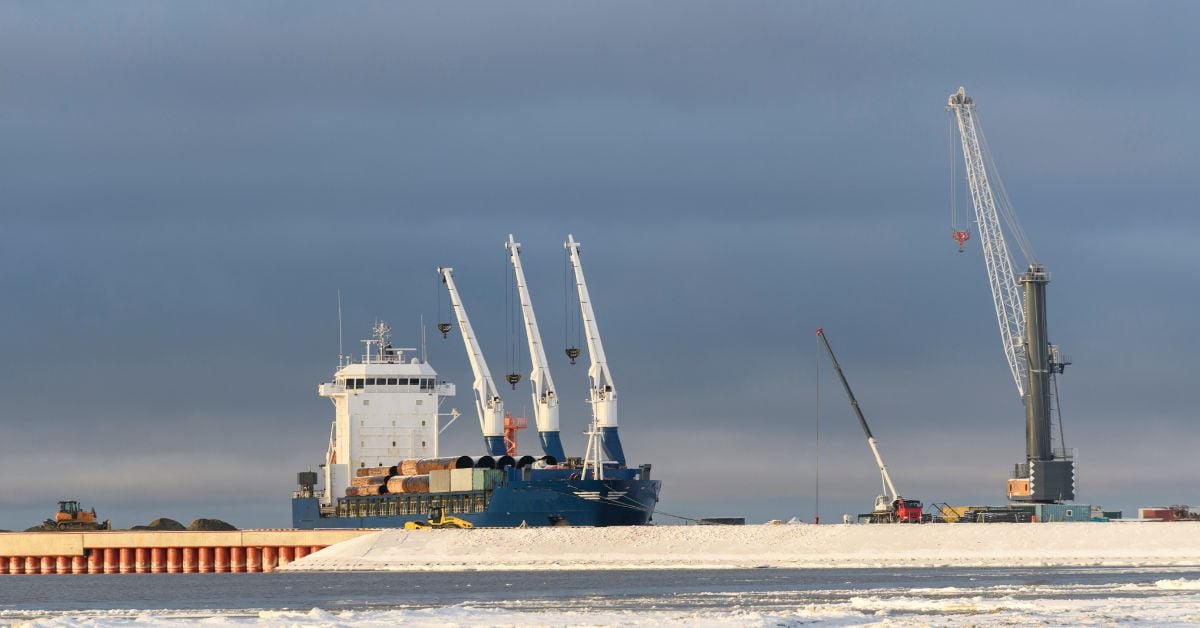
A Chinese container vessel has completed a transit of the Arctic's Northern Sea Route in 25 days, cutting weeks off the traditional Suez Canal passage. The voyage is being reported as a risky operational first for a commercial container ship in that corridor. For our readers who track maritime logistics, climate indicators, and integrated data ecosystems, this is not a headline about a single ship. It is a real-time signal of how the physical parameters of global trade are being recalibrated.
The achievement sits alongside other structural shifts we are monitoring. In the Gulf of Oman, Gulf of Oman STS Transfers Max Out Amid Rising Saudi Oil Exports show that traditional chokepoints are hitting capacity limits. Meanwhile, Russia Calibrates Export Revenue for Northern Sea Route Icebreaker Fleet reveals the state-level financial engineering behind making this route viable. These three stories form an empirical pattern: the global shipping network is being redesigned by necessity, not by choice.
Our take is measured but direct. The Arctic passage is a validated demonstration of operational feasibility, but it is not yet a commercial norm. The vessel completed the journey, but we must ask: under what conditions, and at what cost? The icebreaker fleet required to keep this route open year-round remains underfunded, as the Russian revenue calibration story makes clear. The voyage is a measurable data point in a longitudinal trend of diminishing sea ice, but each transit carries empirical risks, ice damage, search-and-rescue gaps, and environmental impact in a fragile ecosystem. We would tell any policymaker or logistics planner to treat this as a climate indicator, not a shortcut.
The practical consequence for our readers is this: integrated data ecosystems must now include Arctic transit windows as a variable in supply-chain modeling. Just as Integrated Subsea Infrastructure Shifts to Enhance Indian Ocean Connectivity shows cables rerouting away from existing chokepoints, shipping routes are being redrawn by environmental and geopolitical pressures. The takeaway to quote is this: "A 25-day Arctic crossing is no longer theoretical; it is a calibrated benchmark against which all future route-planning will be measured." The open question is whether the supporting infrastructure, icebreakers, ports, search-and-rescue, and insurance models, can be validated before the next vessel attempts the same passage. That is the detail to watch.