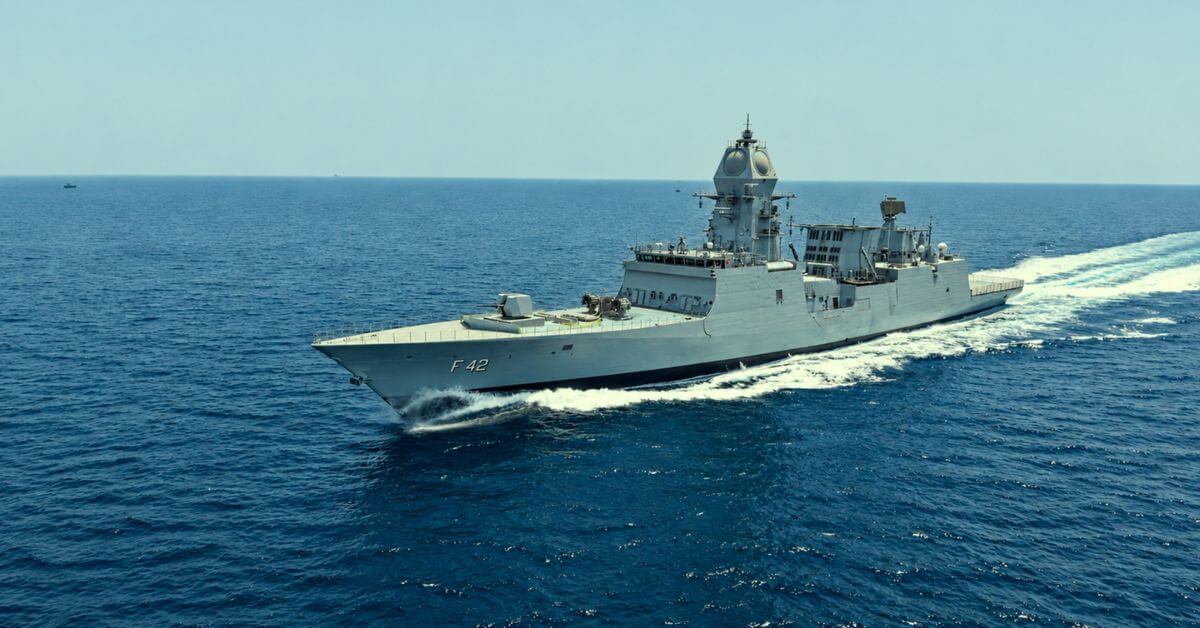
The delivery of INS Vindhyagiri, the seventh and final Project 17A stealth frigate, marks a milestone that deserves more than a routine commissioning note. This is a case study in how disciplined industrial learning can reshape naval capability timelines. All seven ships reached the Indian Navy within 23 months of the lead vessel's handover, and the build time for the last frigate dropped to 68 months from 84 for the first. That 19 percent reduction is not an accident; it is the measurable output of an integrated modular construction method and a supply chain that now includes over 200 small and medium businesses. For a service that plans to add more than 60 warships over the next decade, as reported in India Advances Naval Modernization with 7 Next-Gen Stealth Frigate Order, this kind of empirical efficiency is the difference between a plan and a promise.
What matters for readers who track maritime strategy is that these figures are not just procurement metrics. They are operational reality. Each P17A frigate carries BrahMos cruise missiles, Barak 8 air-defence systems, and an active electronically scanned array radar, all integrated into a 6,670-tonne hull that can sustain 28 knots and patrol for 5,500 nautical miles. The 75 percent indigenous content is not a political talking point; it means that future refits, upgrades, and logistics chains are less vulnerable to foreign supply disruptions. Compare this to the pace of other naval programs globally, where cost overruns and schedule slippage are routine. GRSE's delivery of 121 warships out of 811 total vessels built is a longitudinal record of capability, not a one-off achievement.
The Indian Navy is now moving to Project 17B, with a request for proposal expected to lead to a contract for seven next-generation stealth frigates by 2028. The question is whether the same learning curve can be replicated or accelerated. The Vindhyagiri's build cycle already shows that experience compresses time, but the next generation will need to integrate even more advanced sensors and weapons while maintaining the same delivery discipline. The navy's parallel work on long-range maritime reconnaissance, as detailed in Five decades of maritime reconnaissance: INAS 312's evolution from Super Constellation to P-8I, suggests they understand that surface combatants and airborne surveillance must evolve together. Meanwhile, South Korea's recent launch of the Pyeongtaek frigate with an indigenous radar, covered in South Korea's Pyeongtaek frigate integrates indigenous radar for maritime intelligence, shows that regional peers are also pushing for self-reliant sensor suites.
The specific detail to watch is the commissioning timeline. INS Vindhyagiri is expected to enter service within two months. If that holds, the Indian Navy will have added seven stealth frigates to its active fleet in under three years from the lead ship's delivery. That pace, validated by actual delivery dates rather than press releases, is the benchmark against which Project 17B must be measured. The ocean does not wait for procurement cycles, and neither should the fleets that patrol it.