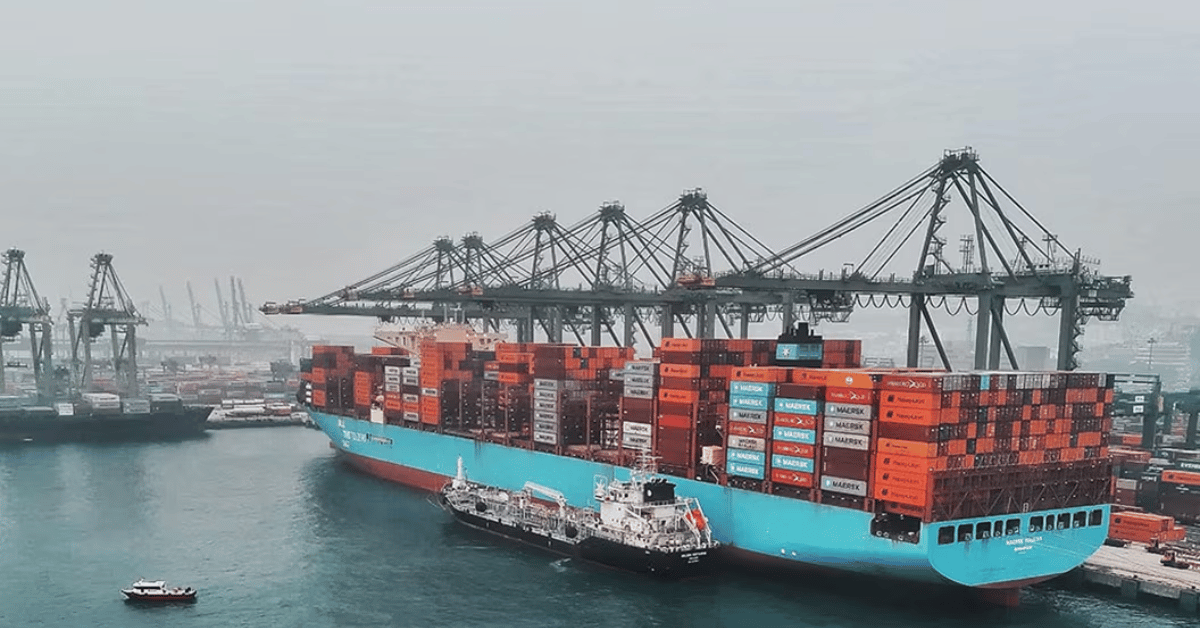
The maritime industry has a tendency to celebrate fuel trials as breakthroughs, but the Maersk Halifax bunkering in Singapore is a rare instance of a claim that holds up to scrutiny. By successfully taking on 5,000 metric tonnes of ISCC-certified bioethanol, Maersk has moved beyond theoretical pathways and into the operational reality of multi-fuel shipping. This is not a laboratory experiment; it is a commercial vessel running on a fuel that is available, certified, and scalable today. For an industry that has spent years debating which single fuel will win, this event offers a more practical answer: there will not be one.
This operation builds on Maersk's earlier trials aboard the Laura Maersk, Antonia Maersk, and Tangier Maersk, but it differs in one critical respect. Those were tests on vessels designed from the keel up for dual-fuel capability. The Halifax is a retrofit, which means the engineering challenges, fuel system integration, tank compatibility, engine calibration, were solved on an existing hull. That distinction matters for the thousands of ships already in the water. If the global fleet is to decarbonize before 2050, retrofits will carry much of the load. This bunkering proves that ethanol, with its established production and distribution networks, can be integrated into that reality. It also provides the kind of operational data that will help ports and regulators plan infrastructure investments, a point reinforced by the collaboration with the Maritime and Port Authority of Singapore. Compare this to the recent 1 000 Metric Tons of Green Ammonia Delivered in First Ship-to-Ship Bunkering, where the fuel itself was a first of its kind but the vessel was purpose-built. Both are necessary, but the retrofit path addresses a larger share of the fleet.
The practical takeaway for our readers is straightforward: ethanol is no longer a theoretical option. It is a fuel that can be sourced, bunkered, and burned at scale now, with greenhouse gas reductions that are measurable and certified. That does not mean ethanol alone will solve shipping's emissions problem. It is a transition fuel, not an endpoint. But transition fuels serve a purpose: they buy time for the harder technologies, green ammonia, hydrogen, battery-electric, to mature while delivering real reductions in the present. Maersk's multi-fuel strategy, as Emma Mazhari articulated, recognizes that no single pathway can do the job. This is a lesson that applies equally to ship repair infrastructure, as seen in the Maersk Vessel Arrives at L&T's Kattupalli Yard to Advance Indian Ship Repair, where operational readiness depends on distributed capacity rather than a single hub.
The open question that remains, and the one we will be watching, is scale. Five thousand metric tonnes is a meaningful volume for a single bunkering, but global shipping consumes roughly 300 million tonnes of fuel annually. The supply chains for certified bioethanol must expand by orders of magnitude to make a dent. The infrastructure, sourcing, and vessel operations have been stress-tested in Singapore. The next test is whether the feedstock and production capacity can follow.