oceanography
World Data Ocean keeps oceanography in one place: 140 stories so far. The section currently leads with “Navigating Oceanography Careers: Fieldwork, Demand, and Growth by Branch”, “Supporting the next generation with a legacy of ocean knowledge”, and “Charting a Career in Ocean Science Beyond Academia and Research”. Choosing a branch of oceanography is a decision best guided by validated, real-world demand rather than passion alone. A Seattle oceanographer is passing along a sizeable textbook collection to a grad student who needs it. A Global Hub for Ocean Intelligence 4 World Data Ocean is a centralized digital platform where researchers, scientists, and ocean enthusiasts converge to… The list below is every oceanography story on World Data Ocean, newest first.
Navigating Oceanography Careers: Fieldwork, Demand, and Growth by Branch
Choosing a branch of oceanography is a decision best guided by validated, real-world demand rather than passion alone. Among the three, physical oceanography currently shows the strongest measured growth, driven by its integrated data ecosystems and climate indicators essential for both academic research and industry. Biological oceanography offers significant fieldwork. Chemical leans more toward calibrated lab analysis. For field work, physical and biological branches demand more time at sea. Our article, "Pathways to Ocean Science: Untold Stories of Unconventional Beginnings," explores similar career navigation.
Supporting the next generation with a legacy of ocean knowledge
A Seattle oceanographer is passing along a sizeable textbook collection to a grad student who needs it. They recall the imposter syndrome and overwhelm of early career research, and how owning those books made the path feel more legitimate. This is a quiet act of legacy, grounded in the reality that science is built on shared tools and mentorship. For those navigating similar doubts, *Charting a Career in Ocean Science Beyond Academia and Research* offers further perspective on building a meaningful path in this field.
Charting a Career in Ocean Science Beyond Academia and Research
Ocean science careers extend far beyond the lab or lecture hall, and that is a fact worth validating. A BSc opens doors to roles in environmental consulting, policy analysis, and the private sector, fields where empirical data on climate indicators drives real-world decisions. Skills in data calibration, integrated monitoring, and peer-reviewed analysis are measurable assets. For deeper context on how climate data informs global action, see our piece on China's electric vehicle acceleration for measurable climate indicators.
Acidification Alters Phytoplankton Chemistry, Shifting Ocean Carbon Cycles
Rising ocean acidity is quietly rewriting the rules of phytoplankton chemistry, with measurable shifts in cellular composition that ripple through global carbon cycles. This isn't a distant forecast, it is empirical change, now documented in peer-reviewed findings. Understanding these biological recalibrations is essential for calibrating climate models. For a deeper look at how Earth's systems respond to change, see our coverage of "A vanished billion-year cliff may explain a gap in Earth's geologic record."
Where Artifacts Anchor Life: Maritime Archaeology Meets Reef Ecology
Where Artifacts Anchor Life asks a question many of us in the sciences have faced: whether to deepen expertise or broaden foundations. A maritime archaeology program with oceanography and marine biology electives is a validated, integrated path, not a detour. You already have empirical research experience and peer-reviewed work. That foundation is measurable. Adding targeted coursework in reef ecology will likely qualify you for further graduate study without starting over.
Deploying deep-sea cameras to capture bioluminescent signals in the abyss
Bioluminescent flashes in the abyss are among the ocean's most elusive signals, yet capturing them need not require a research vessel's full schedule. Deploying deep-sea cameras to record those sporadic glimmers, much like neutrino detectors resting in mine shafts, offers a low-cost, passive window into a world we rarely see. Leave the gear to brew while oceanographers tend to other duties; the resulting footage, though punctuated by darkness, promises genuine insight.
Validating the global ocean mixed layer with a profile-based climatology
A new study in AGU Publications validates the global ocean mixed layer using a profile-based climatology, offering empirical rigor to a critical climate indicator. Understanding this boundary between surface and deep waters is measurable, and this work strengthens the integrated data ecosystem we rely on. For deeper context on how shared data deepens global ocean understanding, our e-book "A Shared Data Ecosystem to Deepen Global Ocean Understanding" explores that collaborative framework.
A decade of empirical data illuminates the ocean's hidden reef ecosystems
A decade of empirical data now reveals the hidden architecture of our ocean's reef ecosystems, measured, validated, and mapped in real-time. These are not speculative models; they are calibrated observations from orbit to ocean floor. Understanding drives protection. For deeper context on the systemic challenges facing marine environments, see our related coverage on validated data gaps in Europe's marine policy demanding integrated solutions. The science is clear; the call to act is measurable.
From calculus to currents how a math major maps to ocean science
A math major paired with coursework in physics, chemistry, biology, and coding is a strong foundation for Applied Ocean Science, not a detour. Measuring ocean dynamics requires differential equations and linear algebra as much as it requires empirical observation. This student's interdisciplinary approach mirrors ocean intelligence itself: integrated. For deeper context on how we turn raw data into measurable climate indicators, see our coverage of the seafloor mapping work from the University of Sydney. The mathematics will hold.
Deep-sea survey confirms 200,000 leaking barrels of Cold War radioactive waste
Two hundred thousand barrels of Cold War-era radioactive waste are now visibly leaking on the Atlantic seafloor. A new deep-sea survey confirms what many feared: this historical dumping was never truly contained. The measured data are sobering, but they also empower action. This is not an alarm, it is empirical evidence demanding a calibrated, global response. Understanding drives protection. For more on how we track ocean pollutants, see our coverage of "Seafloor sediment confirmed as a vast plastic pollution reservoir."

Anchovy spawning patterns in the Bay of Biscay, measured and clarified
Anchovy spawning in the Bay of Biscay is not a random drift of eggs and larvae. It is a calibrated, measurable pulse, one that responds to shifting climate indicators with a precision we are only beginning to integrate into our ocean intelligence frameworks. The patterns are empirical, longitudinal, and increasingly vital for fisheries management. Understanding these dynamics drives protection.
ECCO‑Darwin model delivers first multi‑decadal global ocean CO₂ flux estimates
For the first time, a single model has delivered multi‑decadal global ocean CO₂ flux estimates. The ECCO‑Darwin data‑assimilative system integrates ocean physics with biogeochemistry, producing validated, peer‑observed records of surface ocean pCO2 from seasons to decades. This is measurable progress toward understanding the ocean's role as a carbon sink. Read how AI models and integrated data track shoreline debris at scale for another view of how integrated data ecosystems sharpen our planetary picture.
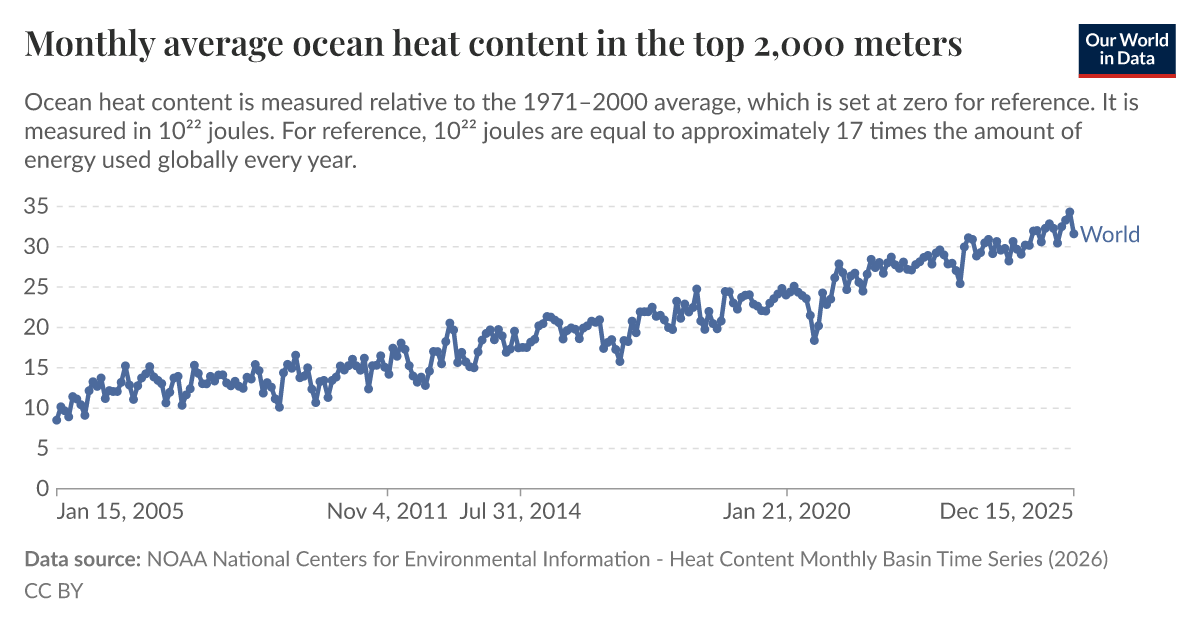
Measuring the Ocean's Warming Pulse at 2,000 Meters
Two thousand meters down, the ocean is warming measurably and without pause. Monthly average heat content in the top 2,000 meters provides one of the most empirically grounded climate indicators available, validated, peer-reviewed, and increasingly urgent. This isn't a distant signal; it is a calibrated pulse we can track in real time. Understanding drives protection. For deeper context on how global experts are building the data framework to monitor these changes, see "Global experts unite to steer Ocean Decade's data and knowledge framework."
Calibrating ocean intelligence to navigate a warming world
Calibrating ocean intelligence requires more than collecting data, it demands integration. Our warming world is outpacing fragmented observation systems. Validated, real-time measurements from orbit to ocean floor must become an integrated data ecosystem, not isolated snapshots. This is measurable, empirical work. Understanding drives protection. For deeper coverage, explore our related piece, "From orbit to ocean floor: integrated data reshapes our view of the sea," which examines how this unified approach is transforming marine science.
From orbit to ocean floor: integrating observations for Earth system predictions
A satellite sees the ocean's surface; a drifting buoy feels its depths. The Global Ocean Observing System, convened by the World Meteorological Organization, now integrates these vantage points into a single, calibrated data ecosystem. This is not abstract science. It is the foundation for Earth system predictions that shape climate resilience and maritime safety. For deeper context, our related coverage on ocean stewardship explores how this data refines our responsibility to the sea.
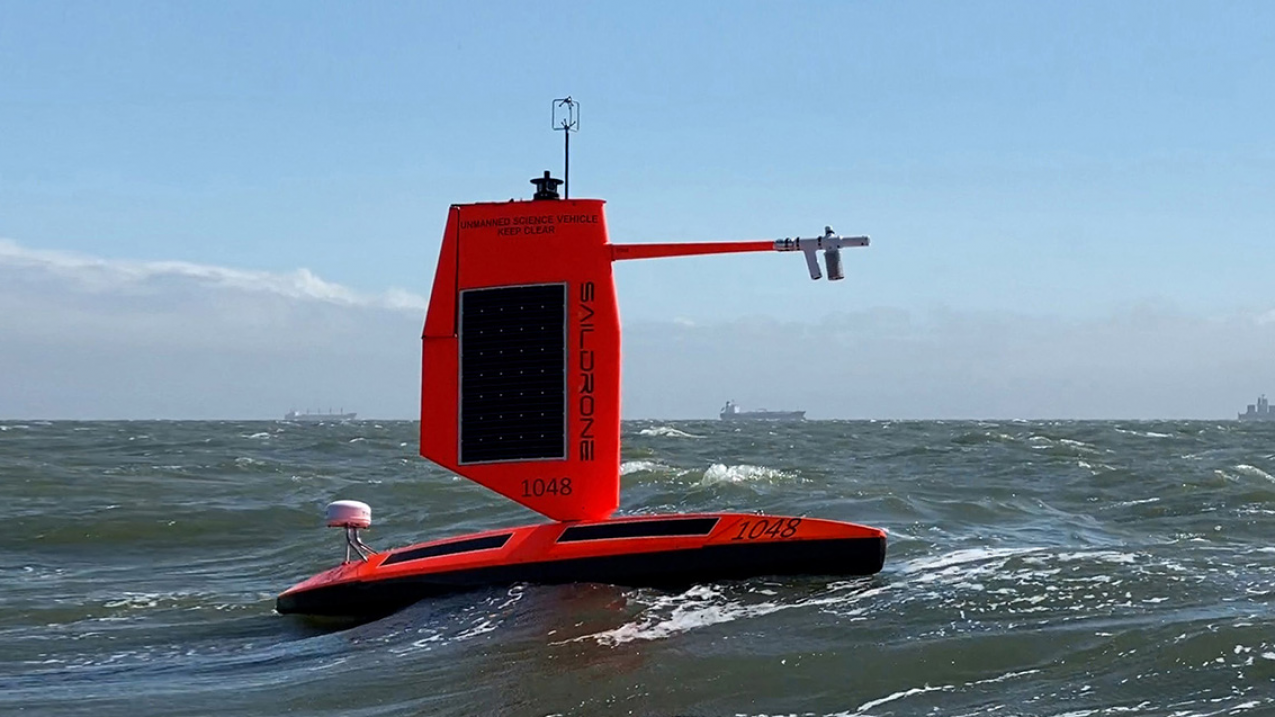
Saildrone delivers first-ever hurricane interior video from the ocean surface
For the first time, a Saildrone has captured video from inside a hurricane at the ocean surface, offering a new window into the forces that drive these storms. This is not abstract data; it is direct, empirical observation from a place we have never seen. Understanding drives protection, and this ocean intelligence is a measurable leap forward. For deeper context on the conditions fueling such storms, see our coverage of August's record-breaking ocean heat readings.

Calibrated search reveals ocean intelligence from seafloor to surface
From seafloor to surface, a calibrated search reveals ocean intelligence that is both validated and measurable, this is what NOAA's new discovery platform delivers. It transforms raw depth data into integrated, real-time insights we can trust. Understanding drives protection, and this tool makes that possible. For deeper context on why such calibrated monitoring matters, read our coverage of the proposed US cuts that risk leaving the world "flying blind."
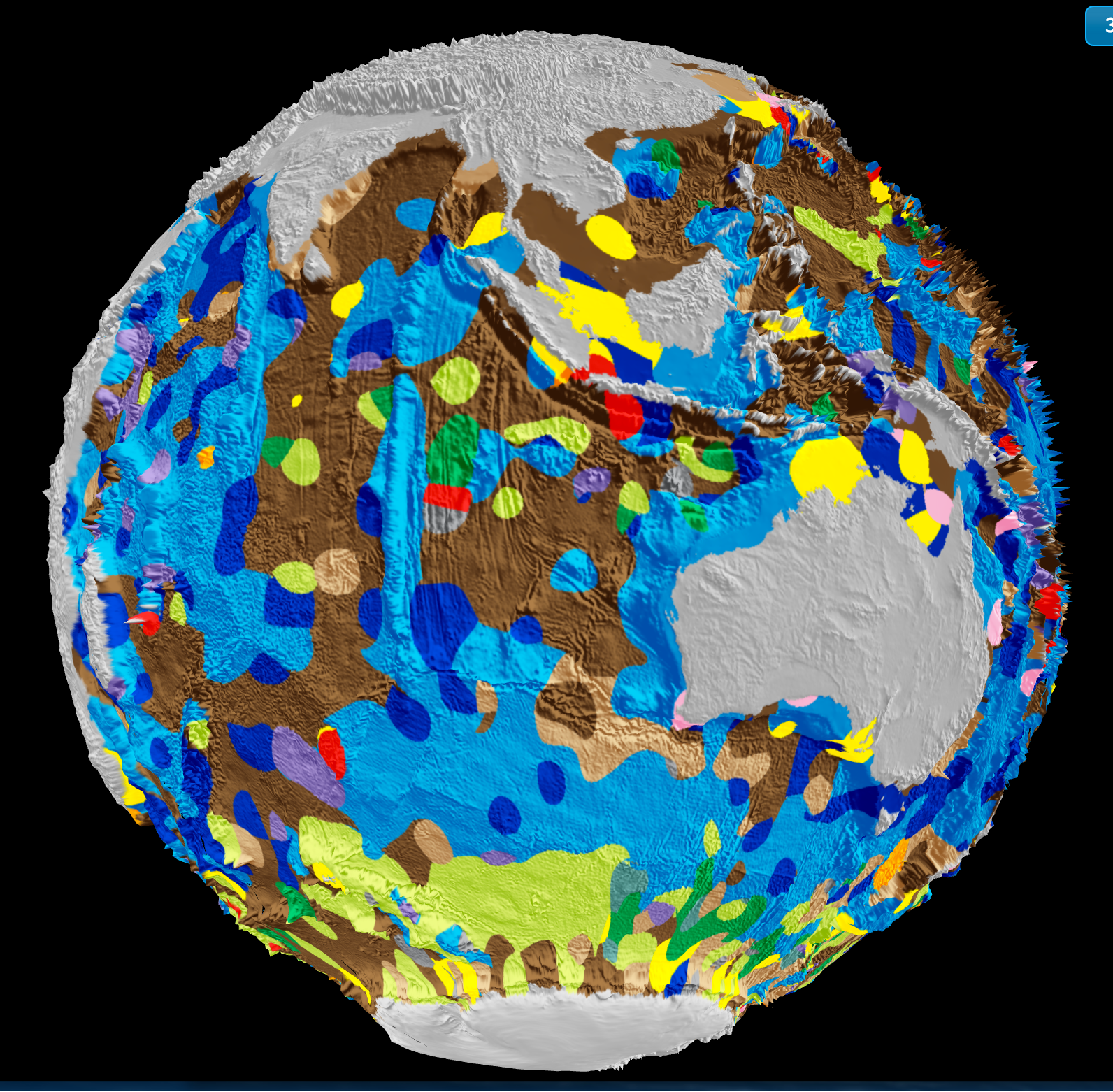
From orbit to ocean floor: big data maps the seafloor with precision
A University of Sydney-led team has integrated satellite altimetry with shipboard sonar data to produce a calibrated, high-resolution map of the global seafloor. This isn't just a sharper image, it's a validated baseline for measuring change. Understanding drives protection. When we can track sediment transport, tectonic activity, and benthic habitat shifts with empirical precision, ocean stewardship becomes measurable. For deeper context on how ocean intelligence reveals system-wide change, see our coverage of the century-long current slowdown.
Daily Global Eddy Tracks Now Calibrated for Ocean Intelligence
Daily global mesoscale eddy tracks have now been calibrated for ocean intelligence, offering scientists a validated, real-time view of these powerful rotating currents from satellite altimetry. This dataset transforms how we measure ocean energy transport and climate indicators. Understanding these eddies is essential, and for deeper context on ocean carbon fluxes, the ECCO‑Darwin model delivers first multi‑decadal global ocean CO₂ flux estimates. From orbit to ocean floor, we are building an integrated data ecosystem for a measurable, shared future.
Ocean Color Shift Reveals Measurable Climate Indicators Worldwide
A measurable shift in ocean color, detected across decades of satellite data, now offers a new, empirical window into global climate change. These are not subtle variations; they are validated indicators of biological and chemical transformation at planetary scale. Understanding drives protection. For deeper context, our coverage of "Decades of Atlantic circulation data reveal measurable climate indicators" complements this finding, reinforcing how integrated ocean intelligence reveals the pulse of a changing Earth.
Empirical ocean data powers the measurable path to energy transition
The ocean's role in the energy transition is not theoretical, it is empirical. Measurable ocean data powers the path forward, validating climate indicators and calibrating our decisions. The World Economic Forum makes this clear: data is the foundation. For those tracking the science beneath the surface, our coverage of the Ocean Carbon and Acidification Data System offers a peer-reviewed look at how validated, integrated data ecosystems turn ocean intelligence into actionable climate insight. Understanding drives protection.

Open Source Data Charts a Measurable Course for Global Ocean Mapping
A new open-source data framework charts a measurable course for global ocean mapping, turning fragmented observations into a coherent, integrated data ecosystem. This isn't abstract theory, it's a calibrated, peer-reviewed foundation for action. We see this as essential to building ocean intelligence. For a deeper look at how empirical data traces pollution back to its sources, see our related piece, "Tracing ocean plastic to its land-based sources via empirical data." Understanding drives protection.
From orbit to ocean floor, data refines ocean stewardship
A small ocean drone returned validated data from inside a Category 5 hurricane, proving that even the most extreme conditions can yield empirical ocean intelligence. From orbit to ocean floor, integrated data systems refine our understanding of marine ecosystems. This is how we transform stewardship from reactive concern into measurable action. For deeper coverage on peer-reviewed findings from extreme environments, see "Small ocean drone returns validated data from inside Category 5 hurricane."
A validated global atlas of ocean thermohaline structure from WOA18
A validated global atlas of ocean thermohaline structure from WOA18 now offers the scientific community an empirical, peer-reviewed baseline for understanding ocean circulation and climate indicators. This integrated data ecosystem transforms decades of measurements into a measurable, calibrated resource. Understanding drives protection. For deeper context on how real-time ocean intelligence is gathered, see our coverage of Royal Caribbean Group's expanded role as a calibrated platform for ocean data.