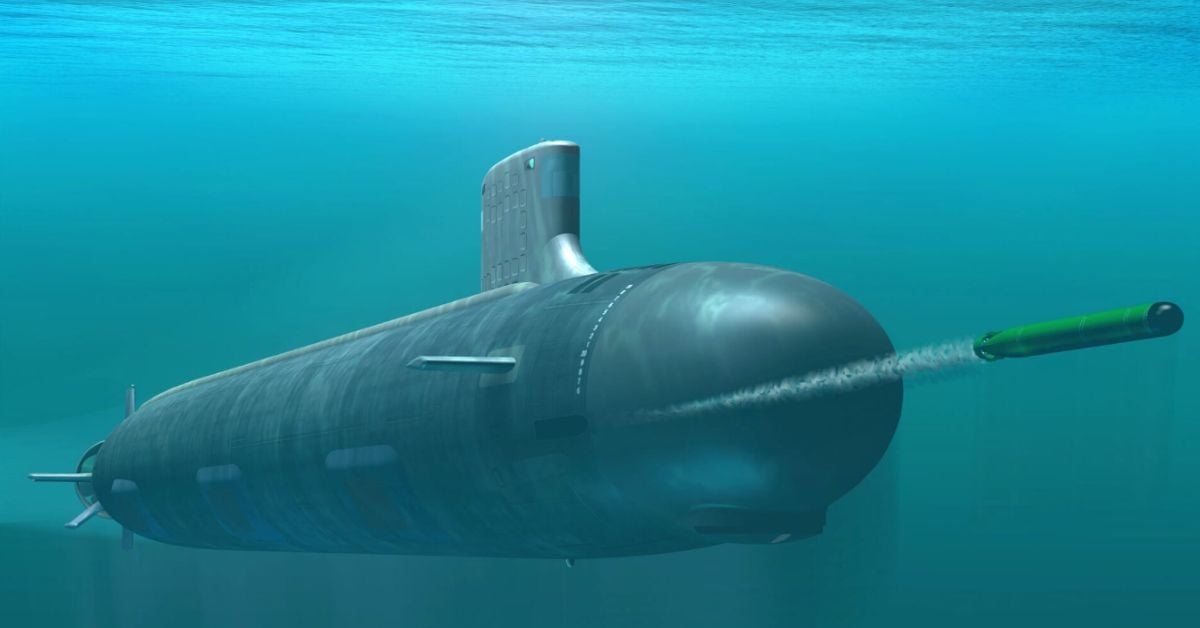
The U.S. Navy's move to embed what it now calls "Super Intelligence" into submarine design is a pragmatic step, not a flashy one, and that is exactly why it matters. By asking industry to build software that can strategically rearrange complex systems inside the SSN (X) attack submarine, the service is admitting that human engineering alone has reached a limit in balancing payload, performance, and hydrostatic stability within a confined hull. This is not about replacing engineers; it is about giving them a calibrated tool to solve a problem that has only grown more difficult as submarines pack nuclear propulsion plants, advanced weapons, sensors, and crew quarters into a single, buoyancy-critical envelope.
The notice from the Naval Sea Systems Command's SSN (X) Program Office asks companies to register interest by November 6, 2026, and to categorize themselves as traditional or non-traditional defense contractors. The distinction matters because it signals an openness to fresh approaches from outside the usual shipbuilding ecosystem. The Navy wants a software that can determine how major systems should be distributed without compromising efficiency or functionality, and it wants that software to account for the delicate relationship between weight and buoyancy. Even small internal changes can shift the center of gravity or longitudinal trim, and a submerged vessel has no margin for error. This is a validation problem at its core: the software must be empirically sound, measurable in its outputs, and integrated with real-world engineering constraints. For our readers, the practical takeaway is that the Navy is treating "Super Intelligence" as a peer-reviewed design partner, not a marketing label. The competition, expected to begin next week, will reveal which companies can deliver that level of rigor.
This initiative connects directly to broader trends in naval engineering and security. For instance, a recent report on Nuclear Propulsion Advances as China Targets 2027 Carrier Launch underscores the urgency of maintaining undersea superiority as peer competitors accelerate their own nuclear programs. Meanwhile, the Navy's parallel work on Validating the grid against digital threats with a $23M Navy contract shows a consistent pattern: the service is investing in software-based validation for both physical and cyber domains. The SSN (X) program aims to combine the speed and weapon capacity of the Seawolf-class with the acoustic discretion and sensor performance of the Virginia-class, and at roughly 10,100 tons underwater displacement, it will be a larger platform than the Virginia-class's 7,800 tons. That extra volume does not simplify the design challenge; it compounds it. The software must manage more systems, more weight, and more variables without tipping the hydrostatic balance.
What remains to be seen is how much "Super Intelligence" will actually influence the final design. The notice does not mention investments or a development schedule, and the term itself is a political substitute for artificial intelligence, not a technical specification. The competition will clarify whether this is a genuine shift in how the Navy validates submarine architecture or a rebranding of existing computational tools. The specific consequence to watch is whether the winning proposal can demonstrate a validated, integrated data ecosystem that links system placement directly to buoyancy and trim calculations in real time. If it can, the SSN (X) will not just be a bigger submarine; it will be a smarter one, designed by a collaboration between human expertise and machine-calibrated precision. If it cannot, this remains an interesting request for information with no tangible impact on the hull that eventually goes to sea.