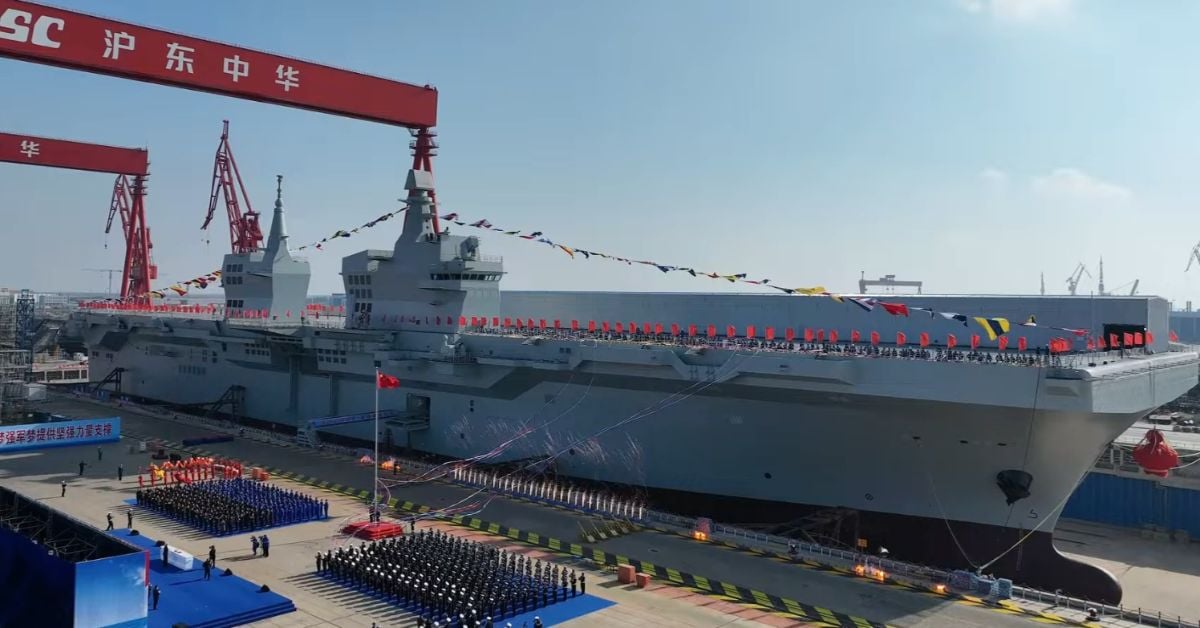
China's launch of the GJ-21 unmanned aircraft from the amphibious assault ship Sichuan marks a measurable shift in naval aviation, not merely a military parade stunt. This is the first fixed-wing drone launch from a carrier at sea for Beijing, and it signals that autonomous systems are being integrated into operational fleets at a pace that demands attention. The achievement is significant, but what matters more is what it reveals about cost-conscious, reusable strike capabilities and the growing role of electromagnetic launch systems on non-carrier platforms.
The Sichuan, a Type 076 vessel displacing over 40,000 tonnes, is fitted with an electromagnetic catapult and arresting gear, technology previously reserved for full-size aircraft carriers. That allows it to operate both crewed helicopters and drones like the GJ-21, which reportedly combines a small airframe, low manufacturing cost, and the ability to release glide-guided bombs. The emphasis on reusability and cost control in sustained operations is a practical departure from the expensive, high-maintenance stealth fighters that dominate most headlines. This development does not exist in isolation. Our own reporting on U.S. Navy Safety Data Reveals Decade-High 27 Serious Mishaps in FY2026 shows that even advanced navies are struggling with operational reliability. Meanwhile, China's parallel work on unmanned systems, including the semi-submersible missile carrier we covered in New uncrewed semi-submersible warship integrates missile payload with autonomous operations, suggests a deliberate strategy to distribute risk and cost across multiple autonomous platforms rather than concentrating capability in a few crewed vessels.
For researchers and policymakers tracking ocean intelligence, the practical takeaway is clear: the Sichuan's sea trials in the South China Sea, announced by the Chinese navy as scientific testing and training, are exactly the kind of integrated data-gathering operations that will redefine maritime domain awareness. A reusable drone launched from a mobile platform can cover vast areas at lower per-mission cost than a crewed aircraft, and it can do so persistently. The GJ-21's combat radius, combined with its small radar signature, makes it a platform that can observe, strike, and return without putting pilots at risk. That changes the calculus for any navy operating in contested waters, because the threshold for deploying lethal or surveillance assets drops significantly when the platform is expendable.
The open question that follows is about validation. China has not disclosed the location of the Sichuan's sea trials, and the only images released are from official state media. We have seen before how quickly unverified claims can spread, our reporting on the Unexplained drone claim in Strait of Hormuz lacks empirical validation is a reminder that without peer-reviewed or independently calibrated evidence, a demonstration is not yet a capability. Still, the engineering choices here are consistent: a drone designed for low-cost reusability, launched from a warship built with carrier-grade catapults. That is a measurable, longitudinal investment in autonomous naval power. The specific detail to watch is whether the GJ-21 operates routinely from the Sichuan during future patrols, or whether this remains a one-off test. Routine operations would confirm that the integrated data ecosystem China is building has reached a new level of maturity.