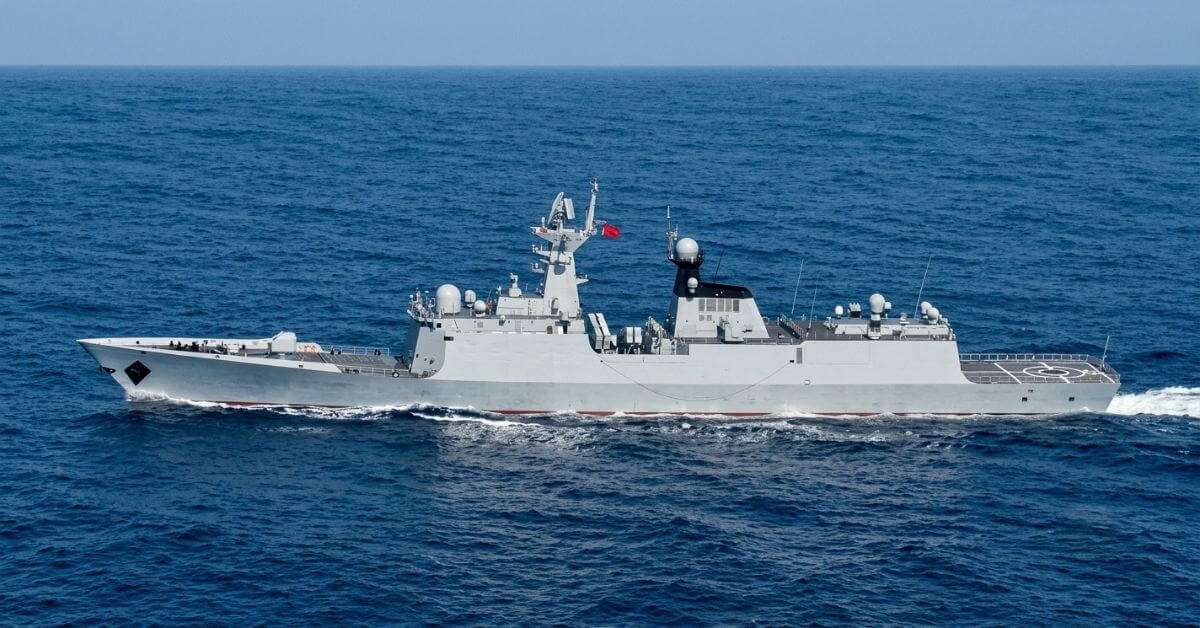
Transparency in military hardware is rarely a neutral act, and China's decision to open a 10,000-ton Type 055 destroyer for public boarding at the Zhuhai airshow is a deliberate signal of operational confidence. This is not merely a public relations gesture; it is a calibrated demonstration of industrial capacity and strategic intent that our readers should measure against the backdrop of global naval modernisation.
The PLA Navy is placing its most advanced surface combatant, a vessel NATO classifies as a cruiser due to its 112 vertical launch system cells, alongside a Type 075 amphibious assault ship and a Type 054A frigate for the first time. By integrating naval aviation with the J-35 and J-15T fighters at a maritime exhibition area, Beijing is framing its carrier strike groups as cohesive, deployable assets. This directly parallels the operational logic behind the U.S. Navy's push for larger capital ships fitted with hypersonic weapons, a development we covered in our analysis of Nuclear capital ships advance as Navy weighs hypersonic battle fleet. Both navies are prioritising platform size and magazine depth, but China is now willing to let thousands of civilians walk the deck of a warship that carries more cells than an Arleigh Burke.
What this means in practical terms is that the Type 055 is no longer a prototype or a regional deterrent, it is a production-line asset with eight ships in service and upgraded variants under construction. The unnamed destroyer on display is likely assigned to the Southern Theatre Command, placing it within striking distance of the South China Sea and key chokepoints. Opening it to public boarding demystifies the vessel's scale and capability, suggesting that Beijing is confident its next-generation designs have already moved beyond this baseline. For defence analysts and policymakers, the takeaway is clear: the Type 055 is now a known quantity, and the unknowns will be found in the upgraded hulls still in the yards.
The juxtaposition with the U.S. Navy's endurance benchmarks is instructive. While the USS Spruance completed a 357-day deployment, a feat we examined in A 357-day deployment redefines naval endurance in a new strategic era, China is displaying the platforms that would contest that endurance at sea. The Type 055 is designed for long-range air defence and anti-submarine warfare, exactly the mission set that sustains a carrier group through extended operations. One open question is whether the PLA Navy will match the crew rotation and logistical sustainment required for such deployments, or whether it is prioritising hull numbers and public visibility first.
The specific detail to watch is the integration of the KJ-600 airborne early warning aircraft with these warships at the Zhuhai show. A carrier strike group's effectiveness depends on its sensor network, and pairing a fixed-wing early warning platform with a 112-cell destroyer signals an emphasis on over-the-horizon targeting. That is a concrete capability gap that regional navies will need to address, not a ceremonial launch.