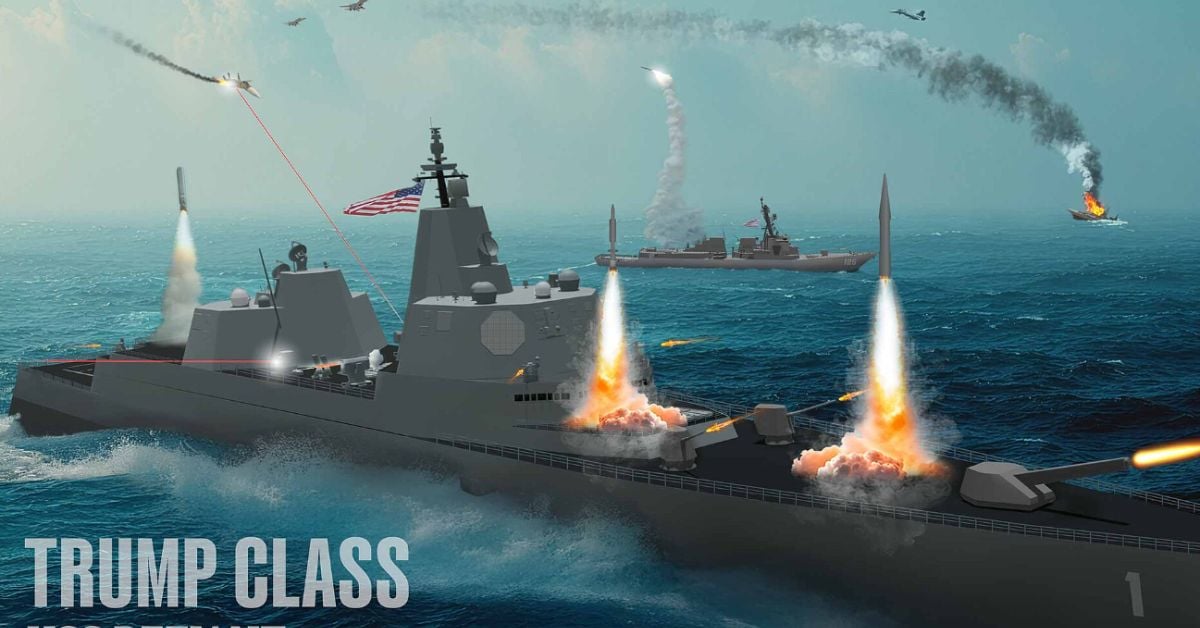
The U.S. Navy's reported plan to build 15 Trump-class nuclear-powered battleships is a gamble on concentration over distribution, and it carries risks that the service has not fully accounted for. Procuring capital ships of roughly 35,000 tons, each fitted with 128 vertical launch cells, a dozen hypersonic missiles, and nuclear propulsion, represents a deliberate pivot away from the distributed lethality model that has guided recent naval thinking. For readers tracking the evolution of naval power, the practical consequence is clear: the fleet is betting that a smaller number of heavily armed, long-endurance hulls can dominate the Indo-Pacific, even as the Navy simultaneously expands its Flight III Arleigh Burke-class destroyer fleet from 23 to 57. The tension between these two trajectories, more destroyers versus fewer battleships, deserves scrutiny.
The appeal of nuclear endurance for trans-Pacific patrols is straightforward, but the cost structure is sobering. At an estimated $23.4 billion for the lead ship and roughly $18 billion per follow-on vessel, the 15-ship program carries a price tag of $275 billion before research and development. That figure does not include the integration of immature technologies such as electromagnetic railguns and high-energy lasers, which the Navy plans for future upgrades. The 600-ton hypersonic launch module already being prepared for destroyer USS Michael Monsoor signals that hypersonic strike capability is advancing separately, yet the battleship program plans to embed those same weapons in a platform that must also accommodate new radar and directed-energy systems. The Congressional Budget Office has flagged that equipping fewer ships with many missiles runs counter to the earlier effort to distribute weapons across more platforms and unmanned systems. That is not a minor bureaucratic observation; it is a strategic trade-off that affects survivability and mission flexibility.
The industrial base constraint is the most concrete obstacle. Newport News Shipbuilding remains the only U.S. yard capable of building nuclear-powered surface combatants, and while other facilities can fabricate modules, final assembly must occur at a single site. The Navy's 30-year plan calls for 371 new vessels to grow the fleet from 286 to 398 ships by 2056, yet the battleship program alone would consume a disproportionate share of shipyard capacity and budget. Meanwhile, the nuclear escort USS Ted Stevens completed its historic transit home, demonstrating that nuclear surface combatants can operate across theaters, but that transit did not test the kind of sustained high-tempo deployment that a 35,000-ton battleship would face in a peer conflict. The question is whether the Navy can build these ships on schedule without starving the rest of the fleet.
Our take is that the Trump-class proposal represents a clear-eyed attempt to project power across vast distances, but it also concentrates risk, financial, technological, and industrial, in a way that demands rigorous validation before the first hull is ordered. The specific detail to watch is the maturity of the railgun and laser systems, because if those technologies slip, the battleship risks becoming an expensive shell waiting for weapons that may never arrive.