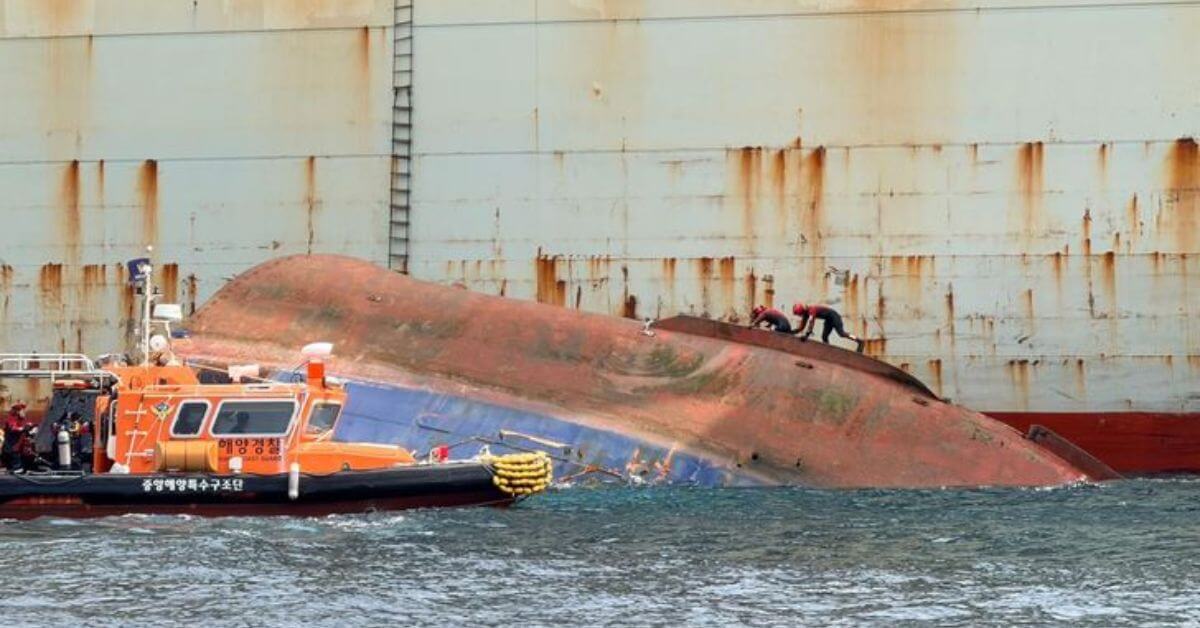
The TNS Catcher capsized and sank in under two hours on a routine towing operation, roughly nine kilometers east of Oryukdo Island, leaving six crew members missing and one dead. The 286-tonne tug went down at 1:29 p.m. and settled on the seabed by 3:27 p.m., a timeline that raises immediate questions about hull integrity, load stability, and the margin for emergency response in coastal waters. This is not a distant, slow-motion disaster; it is a sudden, violent event in one of the world's busiest sea lanes. We should read this alongside the Cargo Ship Fire Prompts Evacuation Near Mykonos and the Bulk Carrier Freed After Prolonged Grounding Near Gladstone, because together they sketch a pattern: maritime incidents are not rare exceptions but persistent hazards that demand continuous, empirical scrutiny.
Our honest take is that the maritime industry's focus on response capability, while necessary, is misaligned with prevention. Every incident report we publish, from the Mykonos fire that forced 29 people to abandon ship to the six-day grounding off Gladstone, points to the same uncomfortable truth: we are good at reacting, but we remain poor at predicting. The Busan tugboat sinking is particularly instructive because it involved a tug, a vessel designed for control and stability, towing a container ship, a task executed thousands of times daily. For a tug to capsize in calm conditions, the failure was likely systemic: a miscalculated towline angle, a sudden shift in the towed vessel's wake, or an unvalidated stability model. We do not know the cause yet, and we must not speculate. But we should demand that the investigation release its raw data, not just its conclusions. That is what we would tell a reader who asks: watch the stability calculations, the maintenance logs, and the loading certificates, because those are where the truth lives.
What does this mean in practical terms for our readers, many of whom are researchers, policymakers, and mariners? It means treating every incident as a data point for a larger integrated data ecosystem, not as an isolated news item. The Cochin Shipyard’s expansion of design capabilities through its Conoship stake shows that the industry is investing in better engineering, but design improvements are worthless if operational practices lag behind. We would argue that the takeaway here is not about tugboats specifically, but about the gap between design standards and real-world stress. A tug towing a container ship in a busy harbor faces dynamic forces that static calculations often underestimate. The ocean does not care about your certification; it responds to physics. So, the concrete point to watch is this: how quickly will the Korean authorities release the automatic identification system data and the voyage data recorder? That timeline will tell us whether the industry is serious about learning, or just about cleaning up. We will be tracking it, and we suggest our readers do the same.