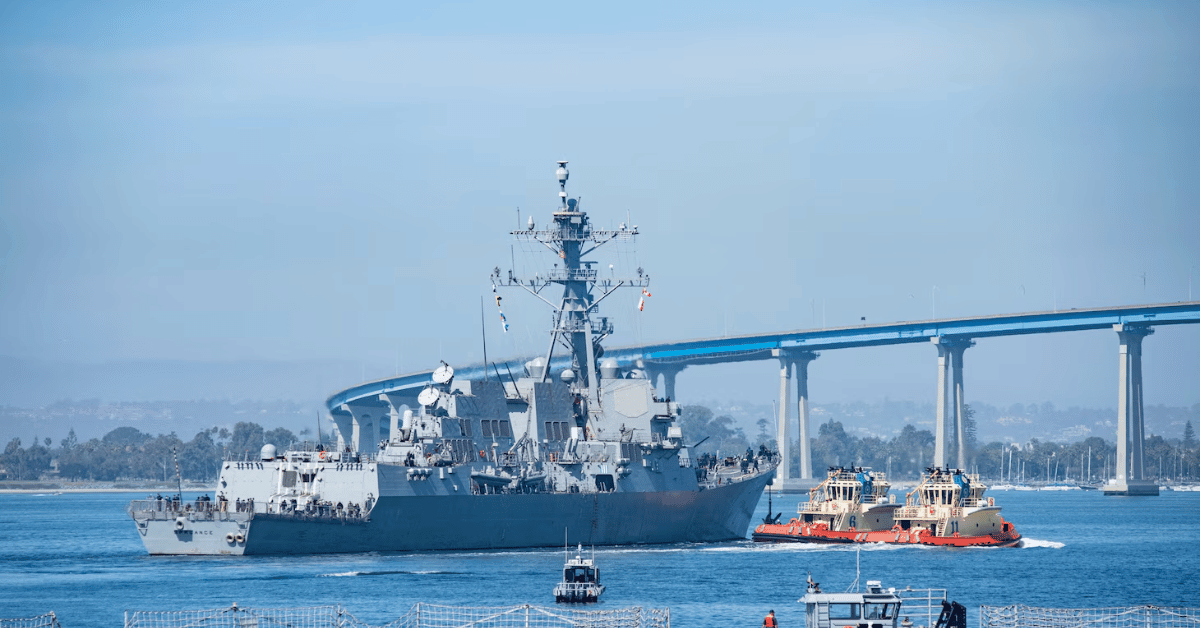
Threatening to find and harm two U.S. Navy officers on a public platform is not a diplomatic statement; it is an act of intimidation that demands a clear-eyed response. The Iranian embassy in South Africa posted images of the commanding officer and executive officer of the destroyer USS Spruance with the message "We will find you," escalating a months-long accusation that the officers ordered missile strikes on a school in Minab. This is not a legal claim or a political protest, it is a direct threat against uniformed service members who have already been awarded the Combat Action Ribbon and a Presidential Unit Citation for their deployment. For our readers, the practical takeaway is this: the line between state-sponsored rhetoric and actionable targeting has grown dangerously thin, and the international community must treat it as such.
The context of this threat cannot be separated from the operational record of USS Spruance. The ship completed a 357-day deployment, the longest Navy deployment since World War II, covering 88,000 nautical miles and launching Tomahawk missiles as part of Operation Epic Fury on February 28. Navy officials credited the destroyer with downing 12 enemy drones and 4 anti-ship cruise missiles, and later with intercepting the Iranian-flagged cargo ship Touska after it ignored U.S. warnings for six hours. These are not abstract achievements; they are the measurable outcomes of a sustained combat posture. Meanwhile, the loss of a supertanker carrying over 2 million barrels of oil after a mine strike in the Strait of Hormuz, as we reported in 2 Million Barrels of Oil Lost as Supertanker Sinks After Mine Strike in Hormuz Strait, underscores the real-world stakes of maritime security in the region. The same waters where USS Spruance enforced a blockade are now the site of infrastructure attacks that disrupt global energy supply chains. And as we noted in A 357-day deployment redefines naval endurance in a new strategic era, the Navy's willingness to sustain such a long deployment signals a strategic shift toward persistent presence, not episodic patrols.
What makes the embassy's threat particularly concerning is its timing. It was issued on the same day USS Spruance returned to San Diego, targeting officers who are now home and accessible to the public. The embassy previously accused these same officers in March of launching missiles that killed 168 children in Minab, an allegation the Pentagon has not yet addressed in its own investigation. Whether or not that accusation holds up to empirical scrutiny, the pattern is clear: state actors are using social media to weaponize unverified claims against military personnel. This is not a new tactic, but it is a calibrated escalation when paired with the phrase "We will find you." President Trump's response, that Iran would "not exist very long" if it succeeded in killing a senior American official, frames the consequence, but the open question remains: what protocols exist to protect service members from state-sponsored doxxing and threats after they return from deployment?
The concrete point to watch is the Pentagon's investigation into the Minab school strike. If it releases findings that contradict Iran's accusation, the embassy's threat loses its stated pretext but gains a sharper profile as pure intimidation. If it confirms any part of the claim, the legal and diplomatic landscape shifts entirely. Either way, the threat against USS Spruance's officers is not a side story to the deployment, it is the closing chapter of a 357-day operation that redefined naval endurance, and the next chapter begins with a question of accountability.