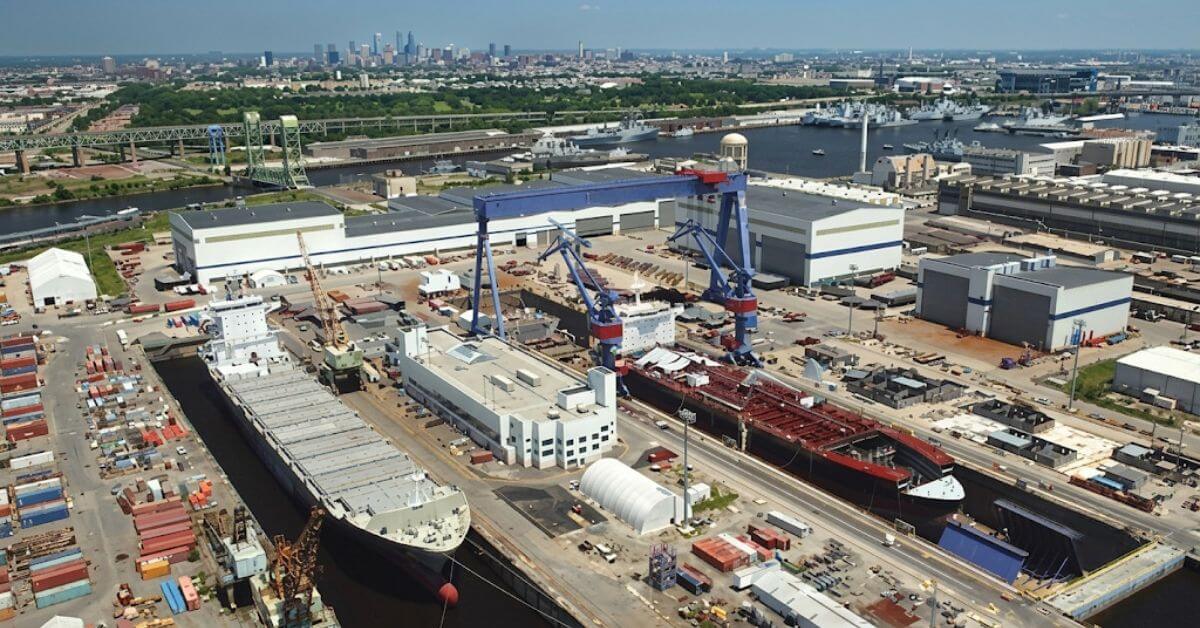
The steel cut last month at Hanwha Philly Shipyard marks more than a single keel-laying: it signals a deliberate recalibration of how the United States builds and sustains its maritime energy backbone. For the first time in nearly a decade, an American yard is constructing a medium-range tanker for the Jones Act fleet, and the implications reach well beyond Philadelphia.
These four 49,500 DWT vessels, ordered by Hanwha Shipping and due in 2029 and 2030, are not merely replacements for aging tonnage. They represent a measurable upgrade in how the U.S. coastal trade will move crude oil, refined products, and chemicals. The design meets IMO Type 2 and Type 3 chemical-carriage rules, and the optional 18-segregation Type 2 setup allows a single ship to load multiple distinct cargoes and keep them separated throughout the voyage. That is a practical, operational gain for a fleet that has long relied on older, less flexible hulls. The CEO's claim that this will be the first MR tanker built in the United States in a decade is a direct indicator of how far domestic shipbuilding capacity had receded. That this order follows closely on the yard's selection for the U.S. Navy's Landing Ship Medium program, and comes after the christening of the containership *Makua* for Matson, suggests a yard that is methodically diversifying its production base, military, container, and now tanker. For context on how allied shipbuilding is advancing in parallel, consider how South Korea's Pyeongtaek frigate integrates indigenous radar for maritime intelligence, a project also carried out at a Hanwha Ocean yard. Both efforts reflect a parent company that is pushing integrated, domestically sourced capabilities across naval and commercial sectors.
What matters most for the Jones Act fleet is the timing. The average age of U.S.-flagged tankers has been climbing, and the energy supply chain depends on vessels that can meet modern environmental and safety standards. These ships are not experimental; they are built to validated, energy-efficient designs that comply with current IMO rules. The yard's president said the tankers give the yard and its workers a base for steady production, which is a plain acknowledgment that consistency in the order book is as important as the technology on board. That stability allows for workforce retention, process improvement, and the kind of longitudinal learning that reduces cost and risk on subsequent hulls. The broader maritime community should also note that this order comes amid ongoing scrutiny of tanker operations, as seen in the Lawsuit Filed Against Tanker Operators Over Mississippi River Collision. Newer, better-segregated vessels are not a cure for human error, but they reduce the number of variables that can lead to cargo contamination or operational delays.
The concrete point to watch is the delivery schedule. If these four vessels enter service on time in 2029 and 2030, they will provide a real-time benchmark for whether the U.S. shipbuilding base can sustain a multi-year production run of complex commercial tonnage. The yard claims to have delivered close to 50 percent of all large ocean-going commercial ships built for the Jones Act since 2000. That statistic is not a boast; it is a measure of how few yards remain capable of this work. The question is whether this order will be a one-off modernization or the start of a repeatable cycle. The answer will be visible in the steel that follows.