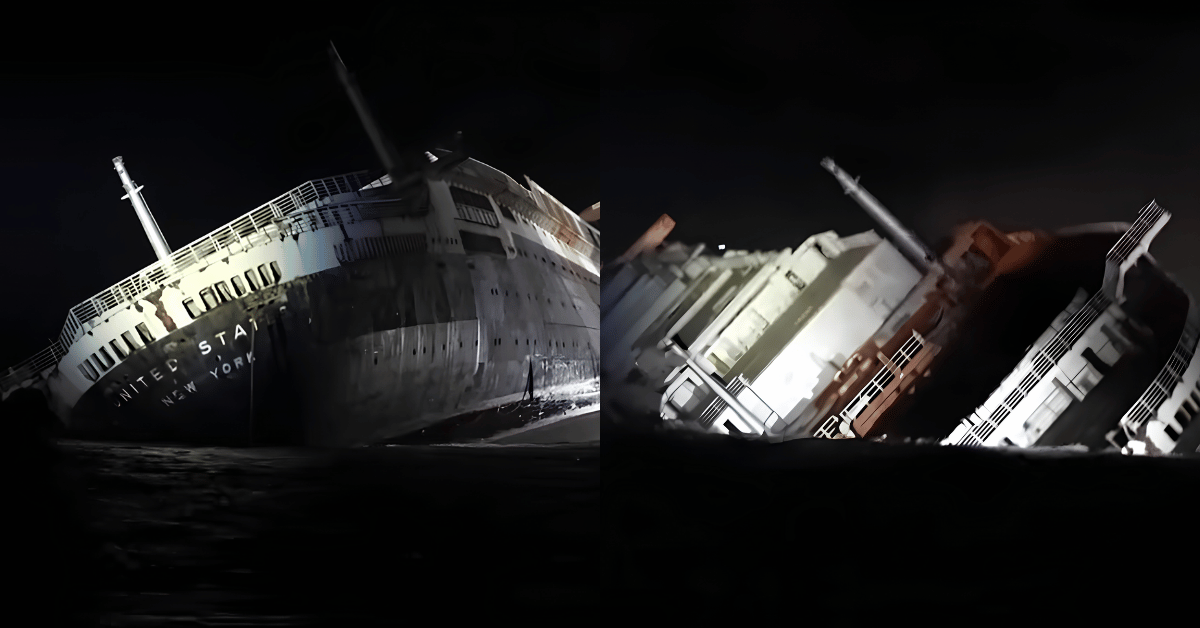
The sinking of the SS United States off the Florida coast is not merely a spectacle; it is a calibrated, measurable intervention in marine habitat creation. By transforming a 990-foot ocean liner into the world's largest artificial reef, Okaloosa County has executed a project that should serve as a model for how we repurpose industrial assets into empirical tools for ocean stewardship. This is science in service of action, and it deserves close attention from anyone who tracks how human infrastructure can be integrated into marine ecosystems.
The numbers tell a precise story. The vessel now rests in 180 feet of water, with its top deck at 60 feet, accessible to inexperienced divers while providing vertical relief that attracts pelagic species like tuna, marlin, and swordfish. The county's tourism director projects a recovery of the $10 million investment within two years, based on an existing annual reef revenue of $10-12 million. This is not speculative; it is a validated economic model that aligns with the data we have seen from other deployments. Our coverage of unattended cameras delivering continuous reef fish data in the Gulf of Mexico demonstrates how such structures can be monitored in real time to measure ecological return. The SS United States now becomes a fixed station in that data ecosystem, offering longitudinal observations of colonization rates, species diversity, and biomass accumulation. Meanwhile, the parallel work of dismantling the USS Enterprise in Mobile Bay, as we reported in Decommissioning of USS Enterprise Begins in Mobile Bay Safety Zone, raises the obvious question: could that vessel also find a second life as a reef, or will its nuclear propulsion system foreclose that option? The contrast between these two fates highlights the importance of designing ships from the keel up with eventual reef conversion in mind.
What makes this project stand out is the deliberate engineering that preceded the sinking. Crews filled 128 fuel and lubricant tanks with water to ensure the ship would rest evenly on the seabed. Large 10-by-10-foot openings were cut into the decks, and over 400 portholes were removed. No explosives were used, in compliance with federal environmental regulations. This was not a scuttling; it was a placement. The five-hour descent, slower than the predicted one hour, reflects the care taken to avoid structural collapse and to maximize the habitat value of the wreck. The liner's two 65-foot funnels, removed beforehand, will anchor a museum dedicated to its history, ensuring that cultural memory and ecological function are not traded off against each other.
The practical takeaway for researchers, policymakers, and coastal managers is this: the SS United States reef is a replicable template. The county has already committed to five or six additional artificial reefs. Each one represents an opportunity to test hypotheses about reef geometry, depth, material composition, and fish recruitment. The wreck now sits close enough to the USS Oriskany for an experienced diver to visit both in a single day, creating a paired study site that spans two decades of reef maturation. What will the longitudinal data show about the rate at which a 70-year-old steel hull integrates into a living reef? That is the question we will be watching, and the one that makes this sinking far more than a headline.