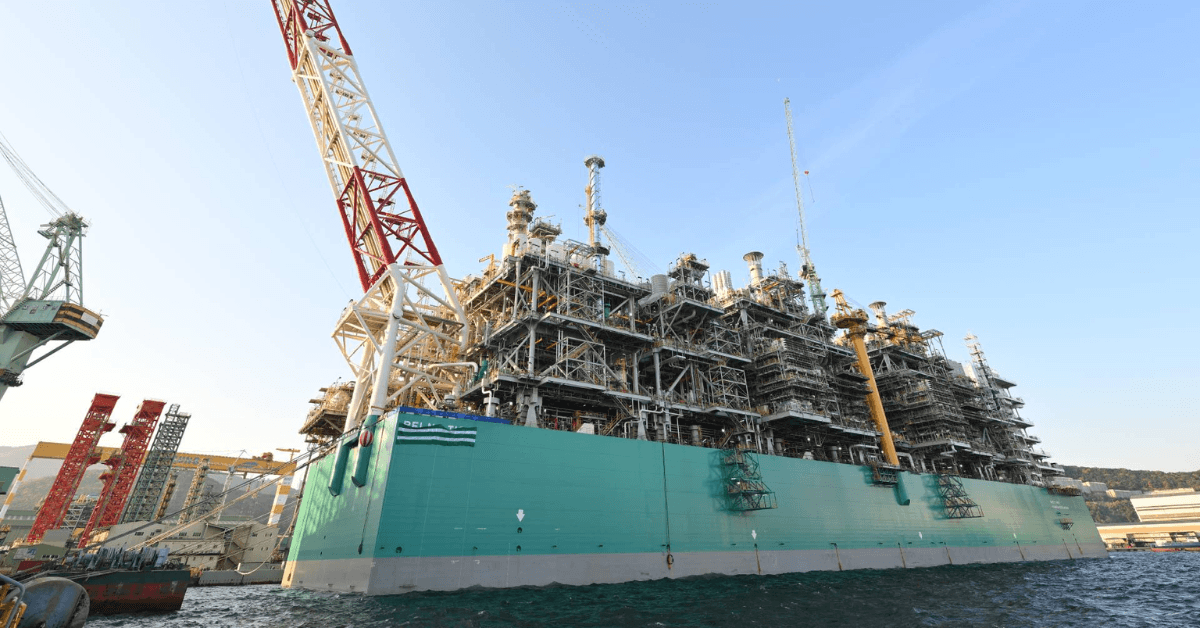
Petronas has done something quietly significant with PFLNG TIGA, and the energy world should pay attention. By naming the world's first nearshore floating LNG facility at a Samsung Heavy Industries yard in South Korea, the Malaysian giant is not just adding another vessel to its fleet, it is recalibrating the economics of gas monetisation for coastal nations. This is a calibrated response to a persistent problem: how to unlock stranded gas reserves without the billion-dollar price tag and multi-year delays of onshore liquefaction plants. The nearshore design, which connects directly to onshore pipelines and power grids, skips both the expensive onshore plant and the complex deepwater mooring systems. That matters for our readers, who track where capital and time are being saved in the energy transition. For context, this follows Petronas's earlier steps with PFLNG Satu (shallow water, 2016) and PFLNG Dua (deepwater, 2021), but the nearshore model is a distinct third path. It is also worth noting that Samsung Heavy Industries is the same yard behind the planned First nuclear-powered LNG carrier planned for transatlantic route, a project that pairs nuclear propulsion with LNG transport, a different kind of innovation, but one that shares this story's logic of making gas logistics more efficient and less carbon-intensive.
Our take is straightforward: PFLNG TIGA represents a pragmatic middle ground that the industry has needed. Floating LNG has always promised flexibility, but the offshore units were capital-intensive and weather-dependent. By moving the facility closer to shore, into calmer coastal waters, Petronas reduces construction time and mooring complexity while retaining the core advantage of avoiding a permanent onshore plant. The vessel's 2-million-tonne-per-year capacity is not trivial; it is roughly equivalent to a mid-sized onshore train. For a country like Malaysia, which sits on significant gas resources in Sabah, this means faster monetisation and a shorter path to export revenue. The start-up target of Q3 2027 is ambitious but grounded in the fact that the hull is already named and under construction. Compare this to the long timelines of greenfield onshore projects, which often drag past a decade. The nearshore model also lowers the environmental footprint: less seabed disturbance, less coastal land use, and a direct tie-in to existing infrastructure. That aligns with the growing demand for secure, lower-emission energy that Petronas Gas & Maritime CEO Datuk Adif Zulkifli cited at the naming ceremony.
There is a broader implication here for the LNG value chain. If nearshore FLNG proves viable, it could become a template for other nations with offshore gas but without the industrial base to build onshore liquefaction. The vessel's dimensions, 281 meters long, 64 meters wide, are large enough to be a serious production unit but small enough to be built in standard dry docks. That scalability is the real innovation, not the technology itself. It is also a reminder that the gas market is not monolithic: deepwater, shallow-water, and nearshore solutions serve different geological and economic realities. Petronas is effectively hedging its portfolio across all three, which is a sensible strategy in a world where demand for LNG is growing but capital discipline is tightening. And while the South Korea's Pyeongtaek frigate integrates indigenous radar for maritime intelligence shows Seoul's naval ambition, the same shipbuilding expertise is clearly being applied to energy infrastructure, a dual-use capability that benefits both security and commerce.
The specific detail to watch is the operational performance in Sabah's coastal conditions. Nearshore waters are not immune to weather; monsoon seasons, tidal ranges, and local shipping traffic will test the facility's uptime. If PFLNG TIGA delivers reliable throughput from a nearshore position, it will validate a model that could be replicated from West Africa to Southeast Asia. If it struggles, the industry will have learned that the sweet spot between offshore and onshore is narrower than it appears. Either way, Petronas has put a measurable, empirical bet on the table. We will be watching the 2027 start-up date, and the production numbers that follow.