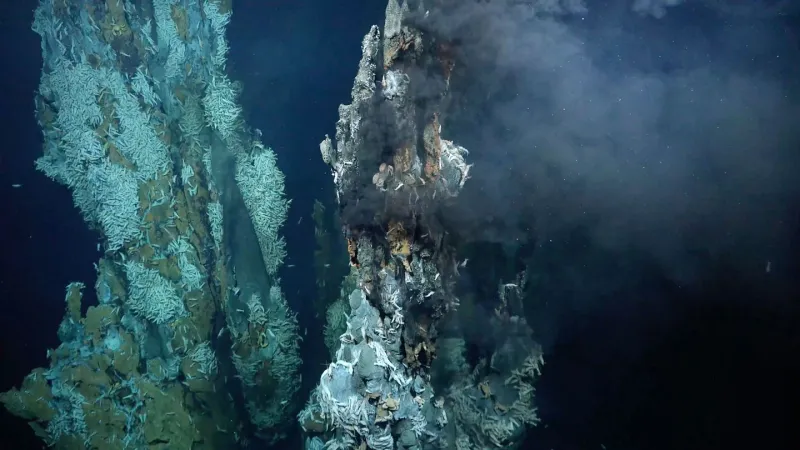
The deep sea has long been treated as a realm of isolation, a place where life survives on its own terms, cut off from the surface world. This new finding upends that assumption in a way that matters far beyond academic curiosity. The discovery that ocean currents link distant deep-sea vent ecosystems shows that life spreads between these scattered oases, and more importantly, that these systems are tied to the sunlit ocean above. That is not just a detail about larval dispersal. It is a recalibration of how we understand the planet's interconnected systems. For researchers, it means the boundaries we draw between marine zones are increasingly artificial. For the rest of us, it means that what happens at the surface, from warming waters to shifts in current patterns, does not stay there. It reaches down.
This is where the practical implications begin to take shape. If deep-sea ecosystems are linked by currents, then they are also linked by whatever travels with those currents, including the data we rely on to study them. That connection is worth pausing on, especially when we consider how much of our ocean intelligence already depends on physical infrastructure. The recent work on Integrated Subsea Cables Enhance Data Transmission Across the Indian Ocean reminds us that 99% of the world's data flows under the sea. These cables are not just conduits for communication; they are part of the same environment we are trying to understand. The more we integrate real-time monitoring into that infrastructure, the better we can track the very currents that connect these ecosystems. And when we encounter the unknown, as with the Unidentified Specimen Found in Oahu Waters Sparks Ocean Data Inquiry, our ability to respond depends on whether we have baseline data to compare against. Every unidentified find is a gap in our knowledge, but it is also a prompt to ask better questions.
What stands out here is not just the finding itself, but what it demands of us. The link between deep-sea vents and the sunlit ocean is not a one-way street. It is a reminder that ocean health is not a local issue. It never was. The same currents that carry larvae across thousands of kilometers also carry climate indicators, nutrients, and, increasingly, the effects of human activity. For policymakers, this is a signal to stop treating deep-sea management as a niche concern. For scientists, it is a call to share data across borders and disciplines. For the public, it is a reason to care about ocean conditions even if you live nowhere near a coast. The ocean does not respect our maps, and this finding proves it.
The question we should be asking is not whether these ecosystems are connected, but how quickly we can build the observational networks to track those connections in real time. The technology exists. The will is the bottleneck. If we are serious about stewardship, we need to treat the ocean as what it is: a single, integrated system. The currents are already doing their part. The question is whether we can keep up with them. Watch for the next step in integrated subsea observation, because the data that flows through these cables may soon be as important as the water itself.