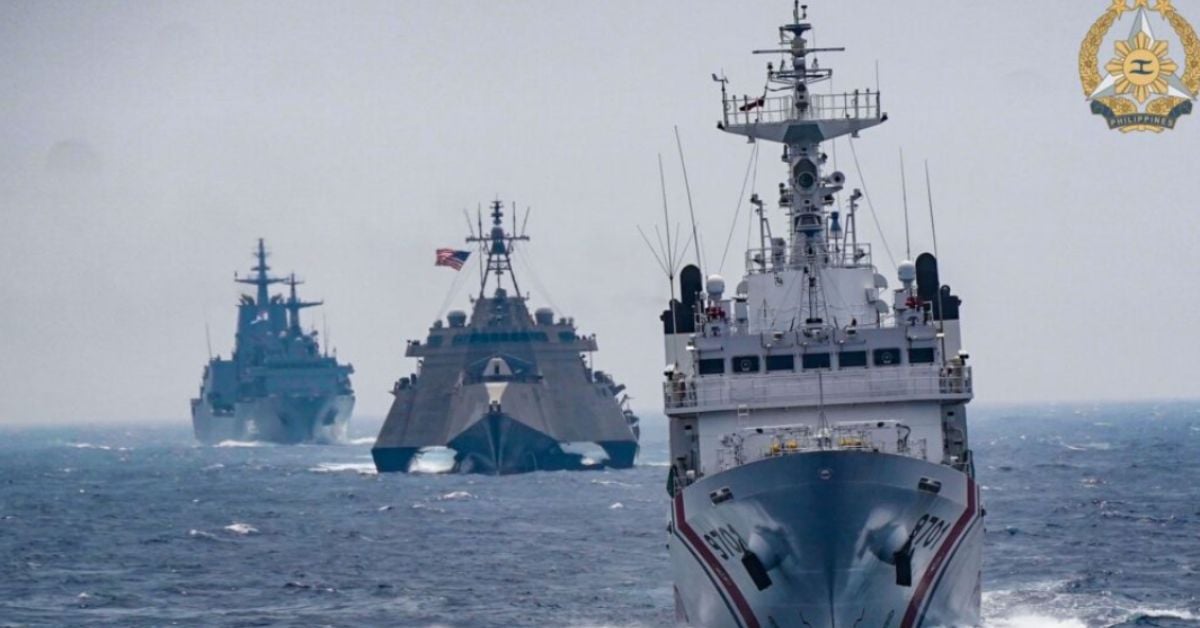
Warships from Australia, the Philippines, and the United States conducted a joint exercise in the West Philippine Sea, and Chinese vessels trailed the formation near Sabina Shoal. On the surface, this reads as another routine show of naval presence in a contested waterway. But the pattern of the past several months, including the China’s New Nuclear Carrier Signals Extended Naval Operations Capability and the quiet expansion of Alaska’s Base Kodiak to Gain Enhanced Arctic Capabilities with New Pier, tells us that this is less about any single incident and more about the operational geometry of the entire Pacific.
What stands out to us is not the act of trailing itself, but what it represents: a calibrated, real-time measurement of escalation thresholds. For our readers who track maritime domain awareness, this is the kind of event where the data matters more than the headline. Chinese warships did not block or intercept; they shadowed. That distinction is critical. It suggests a doctrine of competitive monitoring rather than direct confrontation, a posture that is measurable and empirically consistent with recent behavior. The practical takeaway is that naval forces in this region are now operating inside each other's decision loops, and the margin for miscalculation is narrowing with every exercise cycle.
We would tell a reader who asks what this means for them: this is not a prelude to war, but it is a sustained increase in the cost of ambiguity. When you see joint exercises becoming more frequent and shadowing becoming routine, you are seeing the emergence of a new normal where presence is the primary currency. This is why the related developments matter. The move toward nuclear-powered carriers, as reported in our earlier coverage, extends operational endurance without refueling, which changes how far and how long a carrier group can hold a station. Similarly, the new pier at Base Kodiak is not just infrastructure; it is a logistics enabler that shortens response times for Arctic and North Pacific contingencies. These are not isolated investments. They are integrated data points in a larger ecosystem of naval capability.
The honest assessment is that incidents like this will become more frequent, and the risk is not in the encounter itself but in the absence of clear communication channels during one. The open question we are watching is whether the existing maritime incident agreement mechanisms are being updated to match the new operational tempo. A specific detail to monitor is how often the trailing vessels choose to broadcast their positions on AIS versus navigating dark. That single variable will tell us more about intent than any press release. For now, our take is measured: the ocean is not a place for surprise, and the more we can validate behavior through transparent, peer-reviewed observation, the more stable the region becomes. That is the standard we should hold this and every future exercise to.