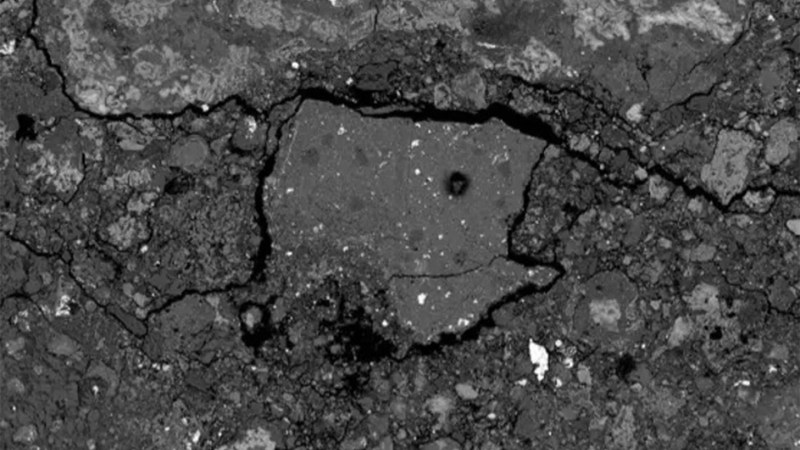
A single rock from space, one that landed with enough force to crash through a New Jersey roof, has delivered something far more significant than a structural inconvenience. The brine-formed meteorite that fell in 2024 carries amino acids, and those molecules are now offering us a direct, tangible line of inquiry into how life's building blocks may have arrived on early Earth. This is not a vague astronomical curiosity; it is a laboratory-grade sample of the chemistry that preceded biology, preserved in a way that demands our attention.
The discovery matters because of what the meteorite is, not just what it contains. Brine-formed meteorites are rare. They carry water-soluble salts and organic compounds in a matrix that suggests a wet, chemically active parent body. When we find amino acids in such a sample, we are not looking at contamination from a terrestrial kitchen counter. We are looking at a record of processes that occurred in space, under conditions that may mirror those on our own planet before life emerged. This is the kind of empirical evidence that moves the conversation from speculation to measurable hypothesis. It connects directly to the broader scientific narrative we have been tracking, such as how Magma and microbial activity may rewrite a 2-billion-year-old carbon signal, reminding us that our interpretations of deep-time chemistry are always subject to revision when new data arrives.
For our readers, the practical takeaway is straightforward: this is not a story about a rock hitting a house, though that is the hook. It is a story about the origins of molecular complexity. The amino acids found here are the same kinds of molecules that serve as the building blocks for proteins in all known life. Finding them in a brine-rich meteorite suggests that the conditions for forming these compounds were present in the early solar system, and that they could have been delivered to Earth, and other planets, via impacts. This does not prove that life began this way, but it does validate a key step in that hypothesis. It gives researchers a concrete sample to study, one that can be analyzed for isotopic ratios, mineral context, and the exact conditions under which these molecules formed.
We would tell anyone who asks about this discovery to watch for the next layer of analysis. The presence of amino acids is a strong signal, but the scientific community will now want to know about chirality, about the specific types of amino acids present, and about whether the brine chemistry favored certain reactions over others. These are the details that will either strengthen or complicate the connection between meteoritic chemistry and the origins of life on Earth. In the same way that Cascadia’s Subduction Zone Reveals a Fragmented Tectonic Process forced a rethinking of how we model plate boundaries, this meteorite may force us to refine our models of prebiotic chemistry. And just as Fossilized Poop Reveals Feathered Dinosaur Traits Linked to Survival offered a narrow but telling glimpse into a much larger evolutionary process, this sample offers a narrow window into a much larger question about our own chemical origins.
The honest assessment is that we are at the beginning of a long analytical process, not the end of a story. The meteorite is in hand, the amino acids are confirmed, and the implications are significant. What we need now is careful, peer-reviewed work that moves from detection to understanding. The question to watch is whether the specific chemistry in this brine-formed sample can be shown to be capable of supporting the next step toward life, such as forming more complex structures like peptides. That is the next threshold. And it is a threshold we now have a better chance of crossing because a rock fell on a roof in New Jersey.