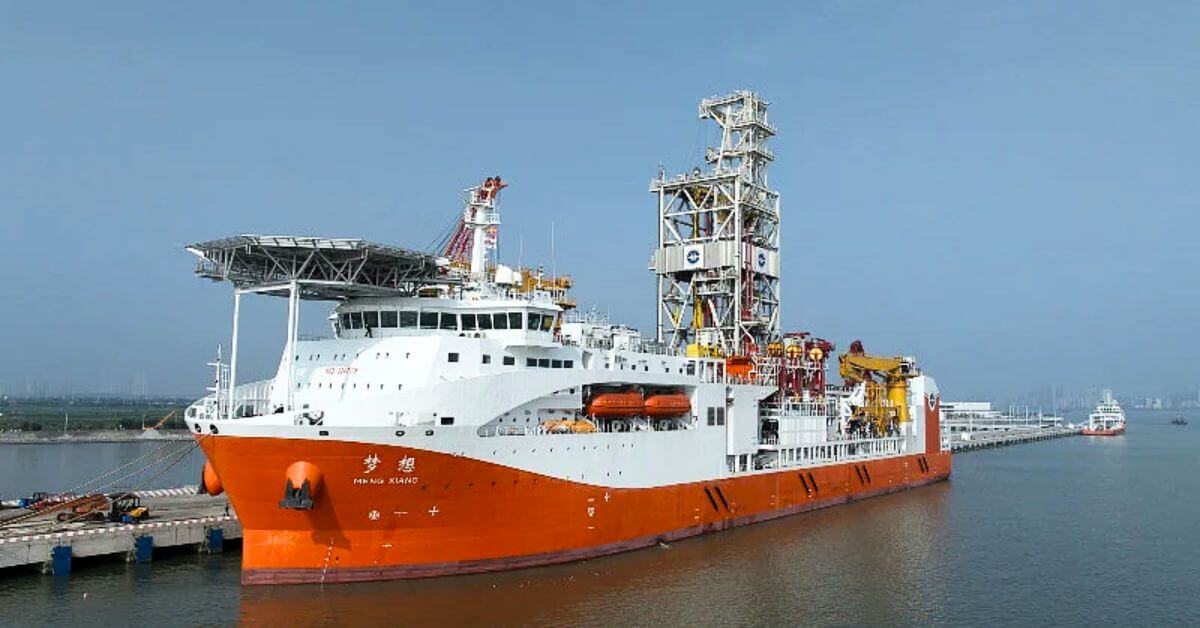
The Mengxiang's return to Guangzhou after its first scientific drilling mission in the South China Sea is not just a milestone for a single vessel, it is a practical demonstration that humanity's capacity to observe the deep ocean is accelerating. For our readership of researchers, policymakers, and ocean professionals, the real story lies in what this benchmark enables: calibrated, longitudinal data from a region that remains critically under-sampled. This mission brings us closer to an integrated data ecosystem where subsurface temperatures, sediment cores, and acoustic profiles can be correlated in ways that were previously impossible. As we noted in our coverage of Calibrated Data Models Reveal Subsurface Temperatures in the South China Sea, such observations are severely limited by cost and operational difficulty. The Mengxiang's success directly addresses that gap.
This is not merely about depth records or national pride. The vessel's ability to retrieve sediment cores and measure physical properties at these depths yields empirical evidence for climate indicators that models alone cannot validate. When we pair this capability with innovations like the RAP-Based Mooring System Enhances Long-Range Deep-Sea Acoustic Detection, we begin to see a future where real-time acoustic data and geological samples are integrated into a single ocean intelligence framework. That integration matters because it moves us from episodic snapshots toward continuous, peer-reviewed monitoring. The Mengxiang's first mission sets a standard for how deep-sea drilling can be operationalized as a repeatable, measurable tool, not a one-off expedition.
What does this mean in practical terms? For climate modelers, each core sample from the South China Sea provides a millennial-scale record of ocean circulation and carbon storage. For marine geologists, the ability to drill at these depths with precision opens empirical questions about crustal structure and hydrothermal activity. And for the broader community concerned with ocean stewardship, it means that the gap between what we assume and what we know is narrowing. The urgency of climate change demands that we move from inference to measurement. The Mengxiang's data will be part of that shift. Our earlier report on the Integrated Response Saves 25 Seafarers After Container Ship Distress reminded us that the ocean's risks are immediate and human. This drilling mission addresses a different kind of risk, the risk of operating with incomplete knowledge.
The takeaway is direct: the Mengxiang has proven that deep-sea drilling can be executed with the scientific rigor and operational reliability that the field has long needed. The question now is whether the data will be shared openly and integrated into global databases as quickly as it was collected. That decision will determine whether this benchmark becomes a foundation for collaborative ocean intelligence or remains an isolated achievement.