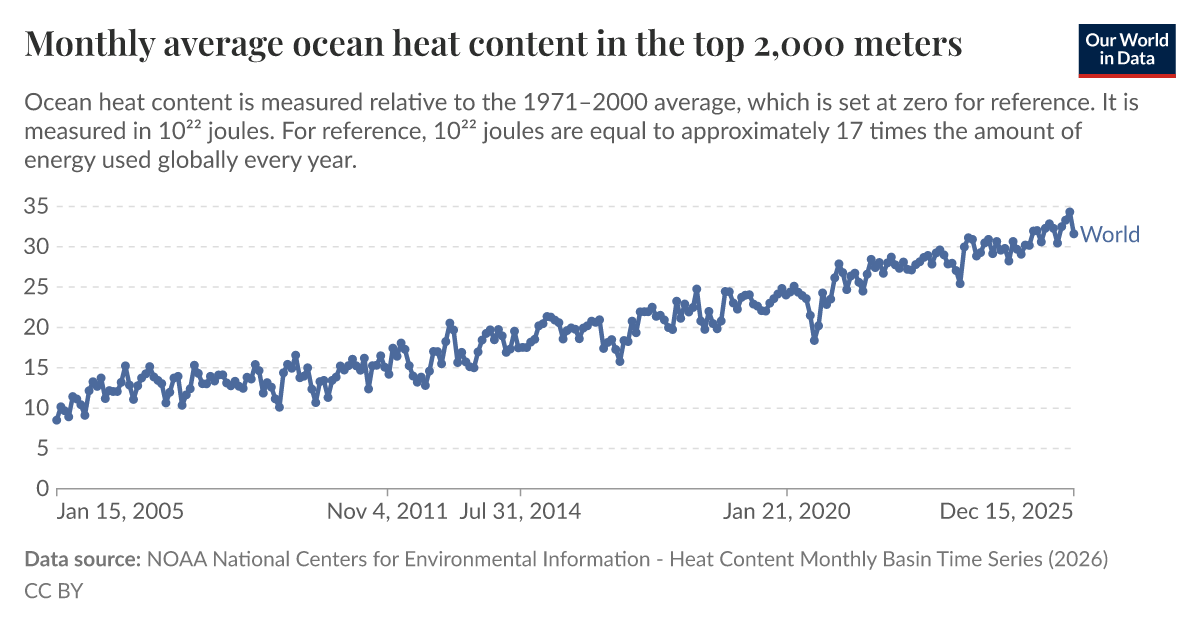
The steady accumulation of heat in the upper 2,000 meters of the ocean is not an abstract data point, it is the most direct measurement we have of Earth's energy imbalance, and it demands a correspondingly precise response from the global scientific community. Monthly average ocean heat content in the top 2,000 meters, as tracked by Our World in Data, shows a clear and accelerating warming trend that has now persisted for decades. This is not a forecast or a model projection; it is an empirical, validated record of what has already happened. For researchers, policymakers, and ocean data managers, the question is no longer whether the deep ocean is warming, but how we can calibrate our observing systems and data frameworks to capture that signal with the resolution needed for actionable climate intelligence.
The challenge is that measuring heat content at depth requires sustained, integrated observation networks, Argo floats, research vessels, satellite altimetry, all feeding into a coherent data ecosystem. Our recent coverage of Global experts unite to steer Ocean Decade's data and knowledge framework highlighted the collaborative effort underway to harmonize these disparate data streams into a unified system. That work is not academic; it is the infrastructure that turns raw temperature readings into the longitudinal, peer-reviewed climate indicators that underpin everything from fisheries management to emissions targets. Similarly, as explored in Tracking Climate Signals in the Deep Ocean Heat Record, the monthly resolution of these heat content measurements allows us to distinguish natural variability from the forced warming signal, a distinction that becomes sharper the longer and more complete the record becomes.
This is where the practical stakes come into focus. A warming ocean at 2,000 meters does not just raise global mean temperature; it alters circulation patterns, expands water volume (driving sea-level rise), and changes the chemistry of the deep sea. The same integrated data ecosystem that tracks heat content can also reveal compound extremes, as shown by the phenomenon of Agulhas Leakage reveals intensifying compound ocean extremes, where marine heatwaves and ocean acidity extremes are co-occurring with greater frequency. When heat content rises, the ocean's capacity to absorb carbon dioxide changes, and the baseline for what counts as a "normal" temperature shifts upward. Every tenth of a degree matters for marine ecosystems that have evolved within narrow thermal windows.
Our take is clear: the monthly heat content record is not just a number to watch, it is a diagnostic tool that must be kept open, calibrated, and accessible. The specific consequence to track is the rate of change in the deep layer. If the warming signal at 2,000 meters continues to accelerate, it will force a recalibration of climate models and a reassessment of carbon budgets. The question we should be asking now is whether our global observing network is expanding fast enough to keep pace with the signal it is designed to measure.