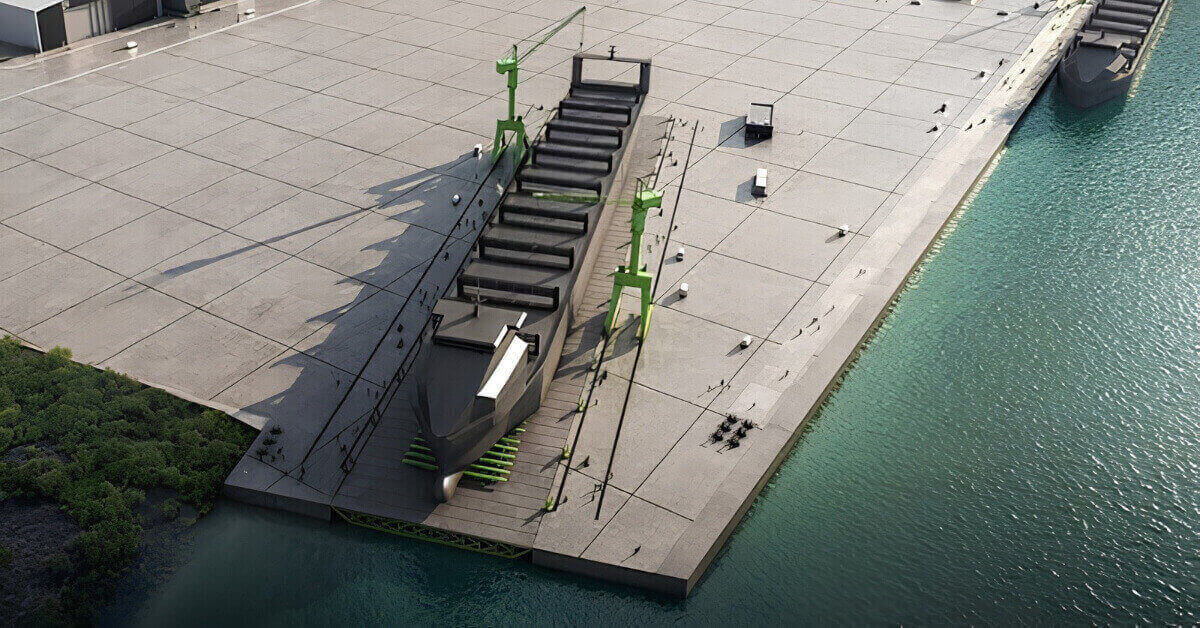
The world's largest shiplift is not merely a feat of engineering; it is a calibrated response to a measurable shortfall in allied shipbuilding capacity. When Saronic and Syncrolift announced the 67,000-tonne tandem shiplift for Port Alpha in Brownsville, Texas, they validated a principle we have long observed: integrated infrastructure, not just individual vessels, determines maritime readiness. This project, valued at over USD 100 million and part of a USD 3 billion yard investment, directly addresses the bottleneck that a Senior U.S. Navy and Marine Corps tour of HD Hyundai’s Ulsan shipyard highlighted just weeks ago, the gap between demand for naval and commercial hulls and the physical capacity to build them. Port Alpha's shiplift, capable of lifting more than twice what any existing installation can, eliminates the need for multiple graving docks by allowing vessels to be constructed and fitted out on flat land, then moved onto the platform for launch. That is not incremental improvement; it is a structural shift in how yards can scale.
For our readers, researchers, policymakers, and industry strategists, the practical consequence is a new data point in the calculus of maritime logistics. Syncrolift's digital-twin controls and condition monitoring mean this system is not just a heavy lifter but an integrated data ecosystem. Every launch generates empirical feedback on stress, alignment, and cycle times, feeding a longitudinal record that can inform future yard designs. This aligns with the logic behind the SPY-6 radar upgrade on USS Pinckney, where a single calibrated asset becomes a node in a broader intelligence network. Here, the shiplift becomes a node in a production network, one that can be monitored, optimized, and replicated. Saronic's choice of Syncrolift after evaluating multiple docking technologies underscores that empirical performance, not marketing, drove the decision.
What makes this project purpose-driven is its dual-use mandate. Port Alpha is designed for both autonomous and crewed vessels, serving commercial and defense customers. The shiplift's 300-meter platform and 67,000-tonne capacity are not arbitrary numbers; they reflect the size and weight of next-generation surface combatants and large unmanned platforms. The yard covers 835 acres initially, with room to expand to nearly 4,400 acres. That scale, combined with Syncrolift's track record of over 240 installations worldwide, suggests a replicable model. The open question, and the detail to watch, is how this integrated production system will interface with the digital-twin and robotic welding methods being explored in Hyundai’s proposed U.S. naval shipyard. If those two approaches converge, the United States could see a measurable acceleration in hull production within a single decade. For now, the shiplift is the foundation; the vessels it launches will be the proof.