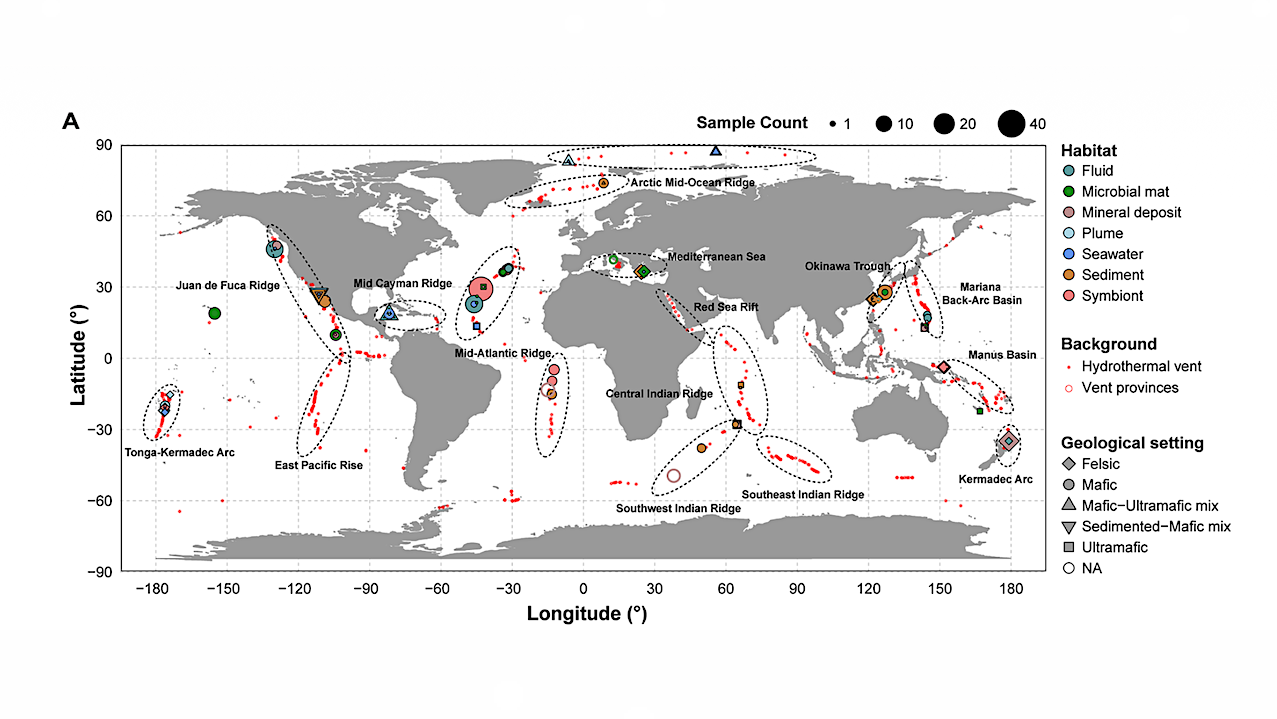
The deep sea is not a desert, it is a chemical engine room, and we have just been handed a map of its viral operators. The Global Ocean Hydrothermal Vent Virus Genome Dataset, or VentVirGenomes, represents the first systematic, global catalog of viruses in Earth's most extreme oases. With nearly 400,000 viral contigs and over 330,000 operational taxonomic units drawn from 405 samples across seven habitat types and depths down to 5,000 meters, this is not a narrow study. It is a foundational reference, built from publicly archived metagenomes, that fundamentally rewrites what we can measure about life where sunlight never reaches. For researchers and policymakers tracking the boundaries of life on this planet, and for the astrobiologists who will soon send robotic submersibles to Europa or Enceladus, this dataset transforms a black box into a calibrated, integrated data ecosystem.
What makes this work stand out is not just its scale but its practical utility. By identifying 79,317 predicted virus-host linkages and classifying 68 percent of viral operational taxonomic units at the realm level, the team behind VentVirGenomes has given us a peer-reviewed, empirical baseline. This matters because hydrothermal vents are not static laboratories. They are dynamic systems that influence global biogeochemical cycles, and viruses are the silent regulators of microbial turnover in those systems. Without this resource, any attempt to model carbon flux or microbial community response to vent activity relied on inference from a handful of sites. Now we have a global, longitudinal dataset that can be validated and built upon. This is exactly the kind of integrated, real-time capable foundation that our New Whale Chart Brings Validated Migration Data to Ocean Data Platform aims to provide for megafauna, but here applied to the invisible majority of ocean life.
The implications extend directly to the search for life beyond Earth. Hydrothermal vents are one of the few environments on our planet where chemosynthesis, not photosynthesis, drives the entire food web. If we cannot catalog the viral and microbial diversity in these chemically driven ecosystems here, we have no calibrated method for doing so in the subsurface oceans of icy moons. The VentVirGenomes dataset is not an abstract catalog; it is a methodological template. It tells us that with enough globally distributed, standardized sampling, we can build a validated reference for life in extreme environments. This is a concrete, measurable step toward operationalizing astrobiology. It also connects directly to the kind of tipping-point monitoring we see in New Atlantic Current Data Signals Weakening and Imminent Tipping Point, because if viral dynamics in vent ecosystems shift in response to changing ocean chemistry, that signal may precede larger system collapses.
The open question that remains is whether the global research community will treat VentVirGenomes as a static archive or as a living, continuously updated resource. The dataset is hosted on GitHub and linked to NIH/NLM supporting materials, which is a strong start. But a single release, no matter how comprehensive, cannot capture the temporal variability of vent ecosystems. The next step is to integrate real-time monitoring data from active vent fields into this framework, turning a one-time survey into a sustained ocean intelligence system. That is the specific consequence to watch: whether funding agencies and ocean observing networks commit to the longitudinal sampling required to keep this dataset alive. For now, we have the map. The question is whether we will have the discipline to update it.