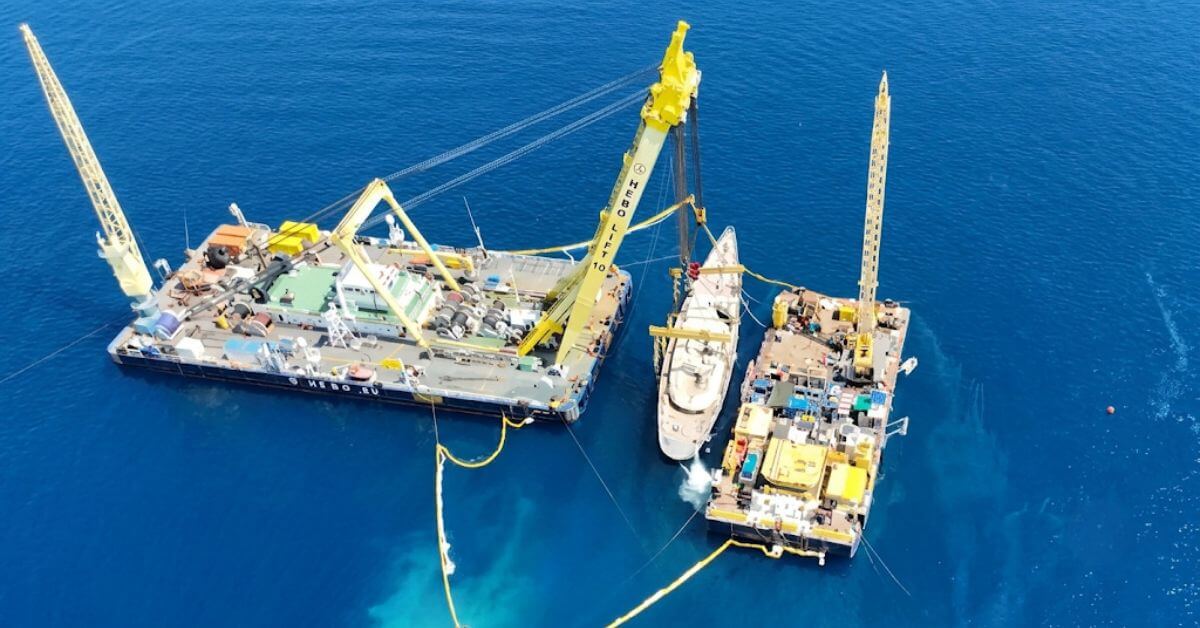
The Bayesian sinking was a tragedy born of assumptions, not inevitability. The MAIB's final report is clear: a 56-metre superyacht with a known vulnerability to high winds was never assessed for the simple condition of lying at anchor with its sails down and its centreboard raised. That gap in stability analysis cost seven lives, including those of Mike Lynch and his 18-year-old daughter Hannah. For an industry that prides itself on precision engineering and rigorous safety protocols, this finding is not just a failure of documentation, it is a failure of foresight.
What happened off Porticello on August 19, 2024, was both sudden and predictable. A downburst, a mass of cold air dropping from a thunderstorm, hit the yacht with winds of 68 knots or more. In under 15 seconds, Bayesian was knocked onto its side. The crew had no reason to expect that specific hazard, but they also had no guidance on how their vessel would behave if it came. The approved stability information handed to them never flagged the risk of a knockdown at anchor because the yacht had never been assessed in that configuration. This is not a criticism of the crew; it is a systemic oversight. The MAIB's call for the Red Ensign Group to revise the Yacht Code and for the UK's Maritime and Coastguard Agency to add downburst risks to training syllabuses is a direct, empirical response to that oversight. It is a measured step, but it also raises a broader question: how many other vessels have vulnerabilities that remain unassessed because the conditions of their operation were never modelled?
This story connects directly to our coverage of maritime safety and structural resilience. When the Cargo vessel collision on the Delaware River disables bridge crossing occurred in November, the investigation focused on navigational error and infrastructure impact. Bayesian's case is different: it is about a vessel's inherent design limits colliding with a weather phenomenon that was forecast but not understood in terms of its specific threat. Meanwhile, the deliberate sinking of the SS United States Sinks to Rest as World's Largest Calibrated Artificial Reef demonstrates how careful planning and measured deployment can turn a vessel's end into a net positive for ocean science. Bayesian's end was the opposite, unplanned, uncalibrated, and deadly. The contrast underscores a central point: we have the tools to assess risk, but only if we apply them to every operational state, not just the ones we consider standard.
The practical takeaway for our readers is this: stability assessments must account for the vessel at rest, not only under sail. The MAIB report is a call for integrated risk analysis that treats "at anchor" as a distinct and potentially hazardous condition, not a default safe state. The Met Office has been asked to push the World Meteorological Organisation to better communicate rare but high-impact hazards in its data services. That is a concrete, measurable outcome. The question that remains open is whether the Yacht Code revisions will require real-time monitoring of loading conditions and centreboard position, or whether they will rely on static paperwork. The speed of the accident, 14 minutes from calm to knockdown, means that the next tragedy will not wait for a paper update.