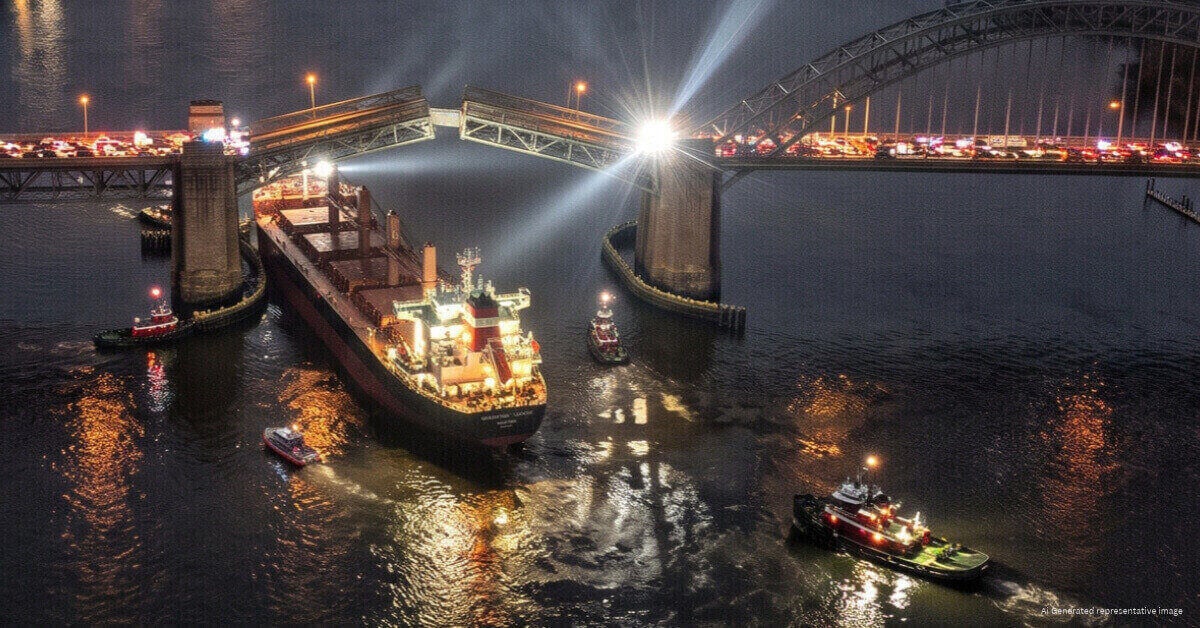
A bascule bridge that cannot close is not a minor mechanical hiccup, it is a fracture in the region's circulatory system. The collision between the cargo vessel *Strategic Alliance* and the Tacony-Palmyra Bridge on November 12 disabled the span's closing mechanism, forcing a major backup on the Philadelphia side and raising questions about the resilience of aging infrastructure on one of the nation's busiest inland waterways. For the estimated 76,200 vehicles that cross this bridge daily, the disruption was immediate. For the maritime industry, the incident is a calibrated reminder that a single point of failure, whether a seized roller or a ship strike, can ripple across supply chains and commuter routes alike. The bridge reopened by the next morning, but the pattern is worth tracking: this is the third notable incident at this crossing in just over a decade, following a 2013 roller seizure and a 2018 fender strike. The Coast Guard and the Burlington County Bridge Commission now face the empirical task of determining whether the damage is structural or operational, and whether the bridge's steel tied-arch and bascule leaves remain within validated safety margins.
Incidents like this are not isolated operational notes; they are climate indicators in their own right. As vessel traffic on the Delaware River increases alongside cargo volumes, the margin for error narrows. The *Strategic Alliance*, a 591-foot Singapore-flagged ship, struck the bridge while it was open for passage, a routine procedure that turned into a multi-hour disruption. No injuries were reported, and the ship was berthed at a Kinder Morgan facility with an inspection team present, but the event echoes a broader theme: the integrated data ecosystem that governs maritime safety must account for human and mechanical variables that cannot be fully calibrated in advance. Compare this to the Coast Guard Extends Medical Support to Crew Near Vieques, where a swift airlift resolved a crew health emergency at sea, or the FBI Investigation Opens After Fatal Incident on MSC Cruise Ship in Galveston, which highlights how quickly routine maritime operations can escalate into complex investigations. Each case underscores the need for real-time, peer-reviewed data sharing between port authorities, bridge operators, and vessel traffic services, not after the fact, but as a preventive baseline.
Our take is that this collision is a measurable signal, not a freak accident. The Tacony-Palmyra Bridge opened in 1929, replacing a ferry that had run since 1922; its bascule span offers only 54 feet of vertical clearance, meaning large vessels must request openings for every transit. That operational rhythm, repeated thousands of times, creates a longitudinal dataset that should inform predictive maintenance and traffic management. The Burlington County Bridge Commission should publish its inspection findings with the same clarity that researchers expect from ocean intelligence platforms. The public deserves to know whether the bridge's fenders, bascule machinery, and structural integrity remain within validated thresholds after each strike, not just after headline events. The 2018 fender strike and the 2013 roller jam are already in the record; this 2026 collision adds a third data point. The question is whether the commission will treat it as an outlier or as part of an integrated pattern requiring structural upgrades.
One specific detail to watch: the bridge remained open after the collision to allow another vessel to pass before it was lowered. That decision, prioritizing maritime traffic over road traffic in the immediate aftermath of a strike, reveals the operational hierarchy on the Delaware River. It also raises a practical question for commuters and policymakers: what is the protocol when a bridge is disabled mid-cycle, and how long would a full closure last if the damage had been worse? The answer should not depend on the next collision to find out.