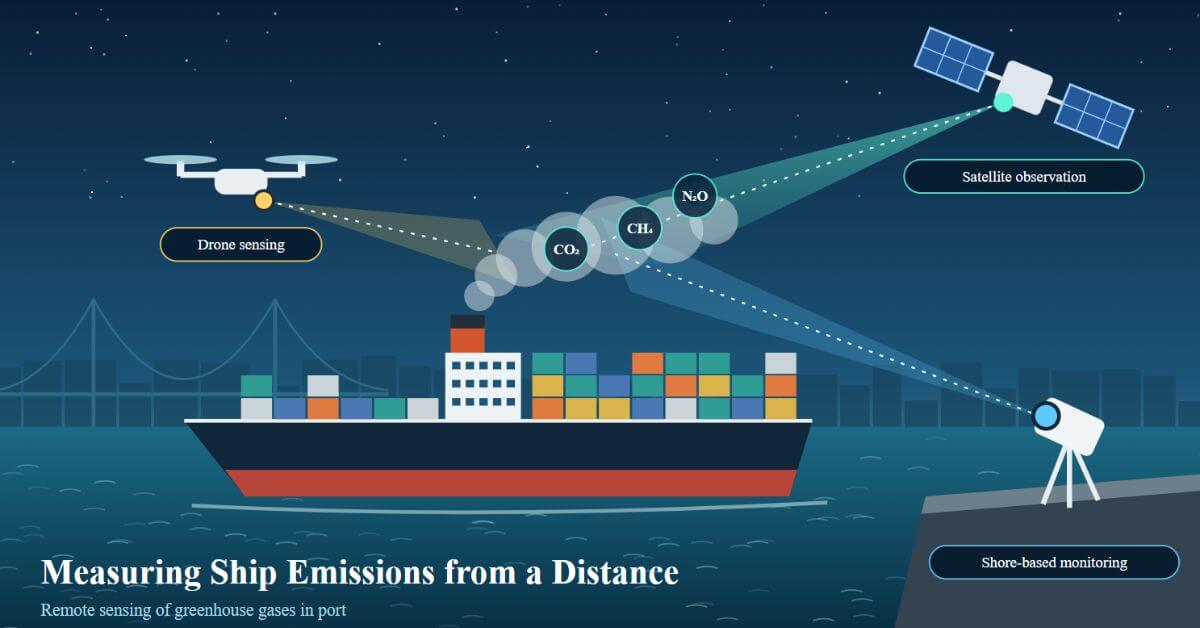
Understanding drives protection, and the shipping industry has long operated on a paper-based assumption of its own emissions. The True Emission Eye Maritime project at Yokohama Port changes that equation by replacing calculation with direct, empirical measurement. Infrared sensors reading ship exhaust from piers and the Yokohama Bay Bridge skywalk represent a practical leap: for the first time, regulators and port operators can validate emissions without boarding a vessel. This is not a theoretical model; it is calibrated, real-time ocean intelligence applied to one of the hardest-to-measure sectors. The approach mirrors how we have seen Decoding a Half Century of Upwelling Along the Campania Coastal System combine satellite observations with high-resolution simulations to reveal patterns invisible to any single data source. Here, too, the integration of ground-based infrared readings with planned drone and satellite coverage aims to build a layered, verifiable picture of what ships actually release.
For researchers and policymakers, the practical meaning is straightforward: the era of self-reported fuel-consumption sheets as the sole basis for emissions accounting is ending. NYK Line and its seven partners, including MUFG Bank, Nagoya Electric Works, ArkEdge Space, and Shimizu Corporation, have moved from test facilities to a working port environment. The principle is sound: carbon dioxide and other gases absorb and emit light at specific wavelengths, and optical sensors can capture those signatures from a distance. By combining exhaust readings with vessel distance and weather data, the system produces a measurable, peer-reviewed alternative to paper estimates. This matters because global regulators are tightening emission rules, and the difference between what a ship reports and what it emits has been a persistent blind spot. The New Ocean Temperature Record Signals Escalating Climate Pressure reminds us that the ocean is absorbing the consequences of every unmeasured ton of greenhouse gas. Direct emissions data from ports and eventually from satellites closes that gap.
The project's ambition to track emissions from orbit is the detail to watch. Fixed monitoring points at ports will yield high-resolution local data, but the partners are studying how to merge satellite readings with ground measurements to cover wider ocean areas. That integration, linking orbital observation to pier-level infrared capture, could transform emissions reporting from a port-by-port patchwork into a continuous, validated dataset. The eight members aim for real-world deployment, which would make vessel reporting transparent for shipping lines and port operators alike. The open question is whether this technology can scale beyond Yokohama and whether the data will be made publicly accessible or remain proprietary. For an industry where compliance has often been an exercise in paperwork, the arrival of an empirical, remote verification system is not incremental, it is foundational.