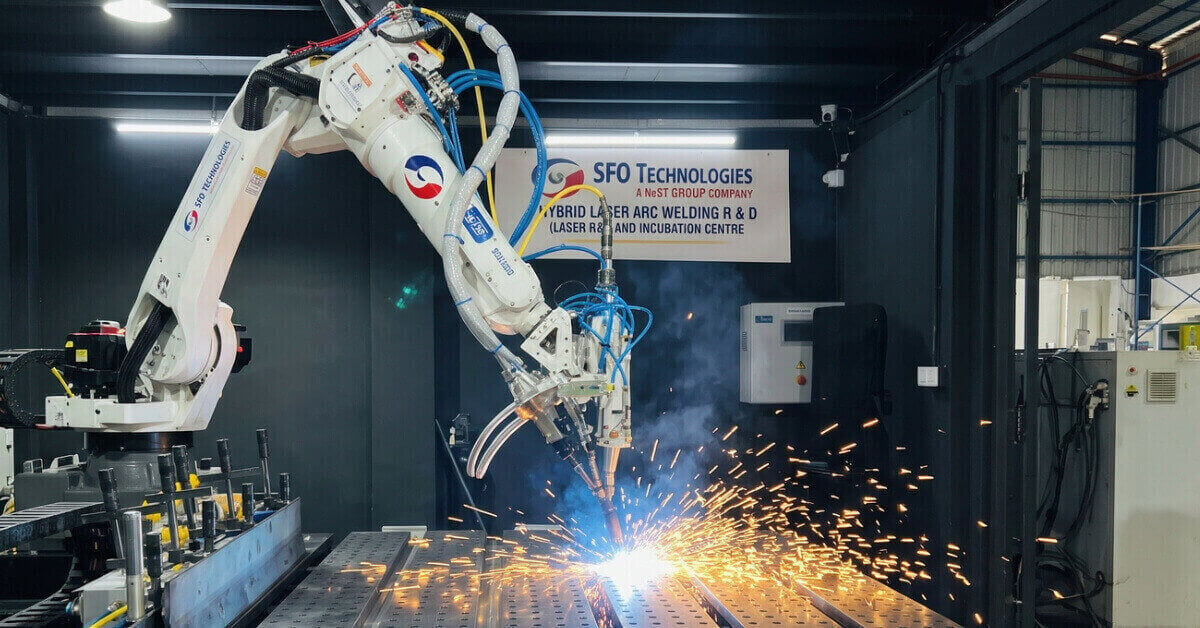
India's first indigenously designed Hybrid Laser Arc Welding system represents more than a manufacturing milestone, it is a calibrated step toward self-reliance in the very technologies that build our ocean-facing industries. The collaboration between SFO Technologies and Cochin Shipyard Limited has produced a system that integrates laser welding, arc welding, robotics, and automation around a high-power fibre laser source developed entirely in-house. For readers tracking the intersection of maritime capability and industrial innovation, this is a development worth watching closely. It connects directly to broader shifts we have covered, such as how Edge intelligence and multi-AUV networks advance autonomous hydrographic surveying and how From satellite to sensor: real-time ocean intelligence across the data ecosystem is transforming data collection. The welding technology is a physical counterpart to those digital advances, a tool for building the vessels that carry sensors, lay cables, and maintain the infrastructure of ocean observation.
The practical implications are measurable. Hybrid Laser Arc Welding delivers faster welding speeds, deeper penetration, and lower distortion than conventional methods. In shipbuilding, where structural integrity depends on thousands of precisely executed welds, consistency is not a luxury, it is a safety requirement. The system's ability to improve repeatability means that vessels built at Cochin Shipyard will meet higher quality standards, and that productivity gains can reduce construction timelines. This is not speculative: the technology has been jointly developed, tested, and validated at the new Advanced Laser Engineering Centre in Kalamassery. The same system can be applied to defence platforms, railway wagons, energy sector components, and large industrial tanks, giving Indian manufacturers a validated alternative to imported laser welding platforms. As we noted in our coverage of Four New Ports Strengthen Andhra Pradesh's Role in the Eastern Maritime Gateway, port infrastructure expansion demands efficient vessel construction and repair capabilities. This welding technology directly supports that demand.
What makes this announcement significant is the source of the laser itself. SFO Technologies did not integrate off-the-shelf imported components; they developed the high-power fibre laser source domestically. That choice reduces supply chain vulnerability and builds institutional knowledge that can be applied to future optical and photonic systems. Dr. N. Jehangir stated plainly that the project demonstrates how "high-end manufacturing technologies can be conceived, engineered and built in India." That claim is validated by the facility's dual mission: research and testing alongside commercialisation. The centre is positioned to support the national Atmanirbhar Bharat vision, but it is also a practical engine for industrial competitiveness.
The open question is how quickly this technology scales beyond shipbuilding. The system's applicability to railways, energy, and heavy engineering suggests a broad addressable market, but adoption will depend on manufacturers retooling processes and training welders on hybrid systems. Cochin Shipyard's role as both developer and first customer provides a real-world proving ground. If the system delivers the promised gains in speed and quality, it will create a replicable model for other sectors. The detail to watch is the pace at which the new centre moves from validation to commercial deployment, because that pace will determine whether this achievement becomes a singular milestone or the foundation of a broader industrial capability.