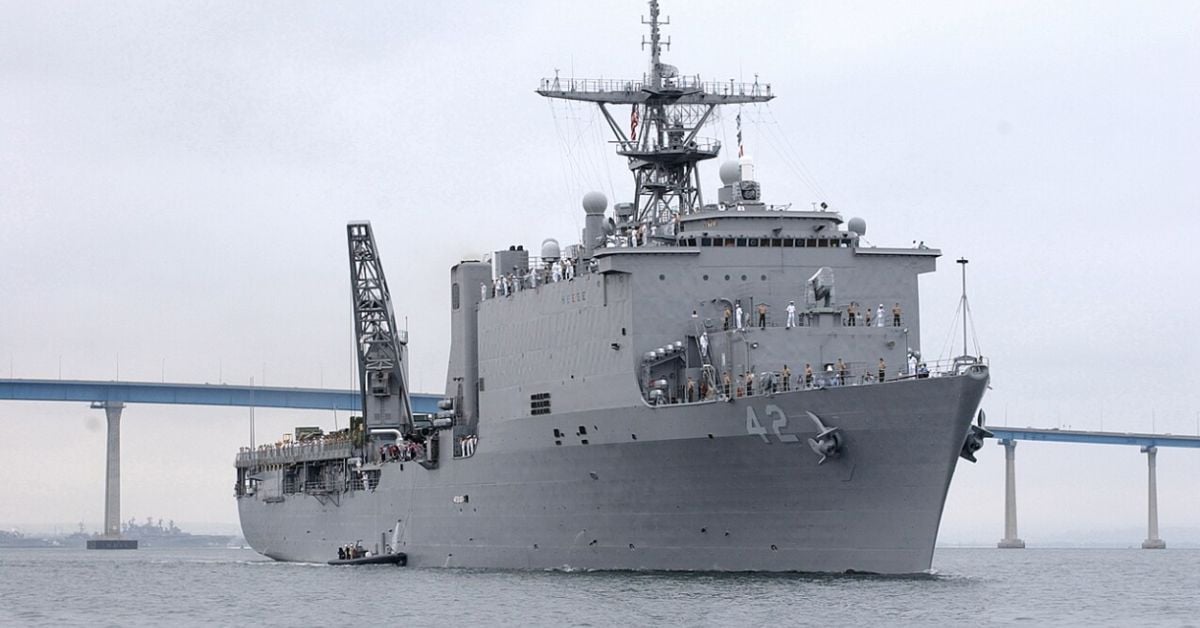
Four decades of validated service ended quietly at Naval Base San Diego this week, and the moment deserves more than a ceremonial passing of the colors. USS Germantown, a dock landing ship that logged 40 years of active duty, was decommissioned not with fanfare but with the steady recognition that long-term maritime capability is built on repeatable, measurable performance. For those of us who track ocean intelligence and naval readiness, this is not a nostalgic farewell. It is a calibration point, a reminder that endurance in the maritime domain is itself a form of data.
The Germantown's service life overlaps with a period of profound change in how we monitor and project power at sea. When this ship was commissioned, the Pacific theater looked very different, yet the fundamentals held: integrated logistics, amphibious reach, and the quiet persistence of a hull that kept showing up. That same principle applies to the 300-day deployment yielding calibrated data from the Pacific theater, where a destroyer's long patrol produced measurable returns. And it echoes in the port visit that deepened U.S.–Bahamian maritime alignment, a smaller but equally telling example of how presence translates into partnerships. The Germantown's record is not an outlier; it is the baseline that newer platforms must match.
What does this mean in practical terms? For researchers, policymakers, and ocean enthusiasts alike, the decommissioning signals that we are at the end of an era defined by hulls, and the start of one defined by networks. The Germantown was built to carry Marines and landing craft, but its real cargo was the institutional knowledge of how to operate across vast distances with limited margin for error. That knowledge is now being transferred to systems that integrate real-time data streams, climate indicators, and joint-force coordination. The question is whether we are retiring the institutional memory along with the ship, or whether we are actually upgrading the platform for a more complex ocean environment.
The takeaway is direct: decommissioning is not an ending but a validation of what worked. The Germantown's four decades prove that consistent, peer-reviewed operational practice, whether in ship handling or data collection, produces results that no single technological leap can replace. As we watch the projectiles strike crude and LNG tankers in the Strait of Hormuz, it is worth remembering that the ships protecting those sea lanes today will one day be decommissioned too. The question is not whether they served well, but whether we are capturing the lessons they validated. That is the real legacy of the Germantown, and it is a metric we should watch closely in the decade ahead.