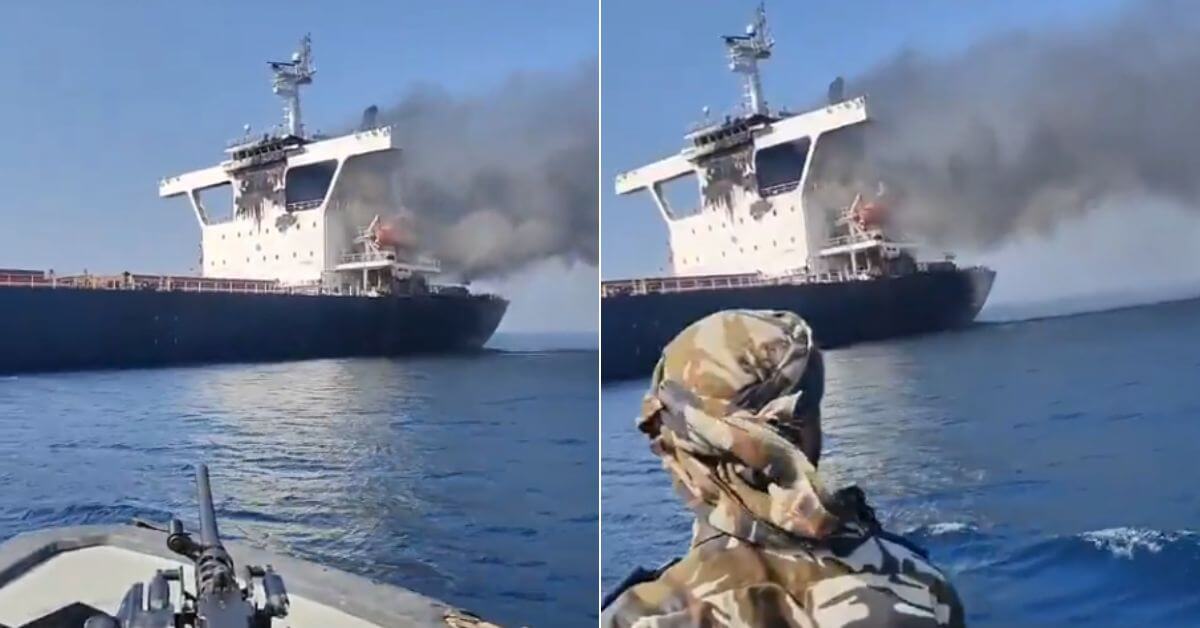
A single seafarer's life was lost this week when the bulk carrier MV Cape Dao was struck by two torpedoes off the coast of Oman. The attack, reported on Wednesday, September 23, is not an isolated incident but a grim data point in a worsening pattern that stretches from the Arabian Sea to the Andamans. For those of us who track ocean intelligence, the tragedy is a reminder that the sea's greatest dangers are no longer just meteorological. The crew member's death is a human cost that no shipping manifest can capture, and it demands a response that matches the severity of the moment.
This incident did not occur in a vacuum. It follows the prolonged grounding of a bulk carrier near Gladstone, Australia, where a vessel spent six days aground before being refloated, and it runs parallel to the diplomatic pressure mounting over the Strait of Hormuz, where Eighty Nations Urge Reopening of Vital Strait of Hormuz Shipping Lane. The contrast is instructive. A grounding is a navigational error corrected with tugs and tide; an attack is a deliberate act of violence that turns a commercial waterway into a contested zone. Meanwhile, the successful rescue of an injured seafarer near the Andamans, made possible by Ocean Data Enables Swift Rescue of Injured Seafarer Near Andamans, shows what is achievable when real-time information is prioritized. The difference between those outcomes is not luck; it is the quality of situational awareness and the speed of coordinated response.
Here is our honest take: the maritime industry has spent two decades hardening vessels against piracy, only to face a threat that is better armed, more sophisticated, and politically motivated. The torpedo attack on the Cape Dao is not a return to the Somali piracy playbook of skiffs and ladders. It is a state-adjacent or non-state-actor capability that treats a bulk carrier as a legitimate target. For shipping companies, the practical takeaway is uncomfortable but clear: rerouting around the Red Sea or transiting at higher speeds is no longer sufficient. The industry needs to integrate naval intelligence, satellite-based automatic identification system data, and predictive analytics into a single, validated picture. The tools exist, but they are too often siloed. If the Andamans rescue proved anything, it is that integrated data saves lives. The question is why that same logic is not being applied to the waters off Oman.
What we would tell a reader who asks about this attack is direct: do not expect a quick military solution, and do not assume your insurer will cover the full cost of a crew refusing to sail into a war zone. The diplomatic effort led by Bahrain and 80 other nations is a necessary step, but it is a political process that will take months, not days. In the interim, every shipowner must decide whether a cargo's delivery schedule is worth a crew's life. That is not hyperbole; it is the calculus now facing the bridge of every bulk carrier transiting the Arabian Sea. Watch how quickly the International Maritime Organization responds with new routing guidance. More importantly, watch whether the industry shifts from reactive defense to proactive intelligence-sharing. The Cape Dao is a warning, but it is also a test. We are not yet sure the industry will pass.