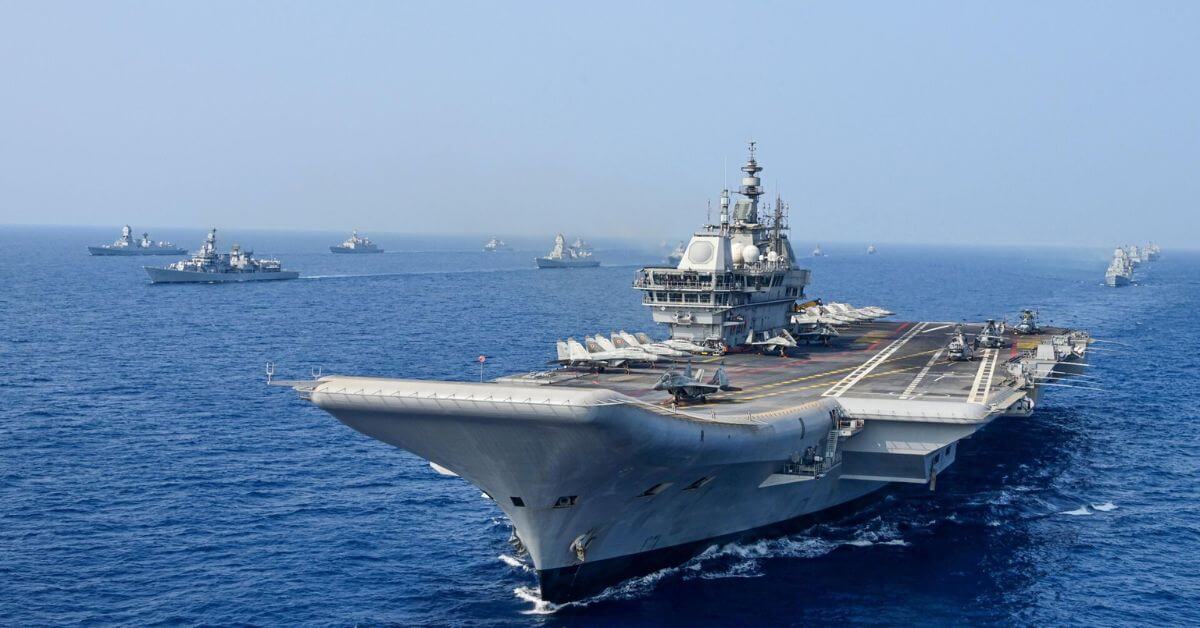
The Indian Navy's pursuit of indigenous SATCOM terminals is not a headline about hardware; it is a statement about strategic autonomy in a domain where data is as decisive as firepower. When a warship operates thousands of kilometres from shore, the ability to maintain secure voice, video, and data links is not a convenience; it is the difference between a coordinated fleet and a collection of isolated hulls. This move signals that India understands a fundamental truth: maritime power in the 21st century is measured in bandwidth as much as in displacement. We would tell any reader who asked that this is less about the terminals themselves and more about who controls the channel of communication. Relying on foreign or commercial constellations for sensitive naval operations introduces a vulnerability that no amount of onboard weaponry can compensate for. The push for indigenous systems is a direct acknowledgement that in a contested environment, the link is the target.
This development does not exist in a vacuum, and it connects to a broader pattern of ocean data sovereignty. We recently noted how Integrated Subsea Cables Enhance Data Transmission Across the Indian Ocean, noting that 99% of the world's data flows under the sea. If commercial and civilian data increasingly depends on subsea infrastructure, military operations cannot afford to be the weak link. Similarly, the challenge of Bridging Data Gaps: Integrating Citizen Science for Ocean Intelligence reminds us that the ocean remains critically under-observed, particularly in coastal zones. The Navy's requirement for reliable, long-range links is the military analogue to those civilian data gaps. And when we consider the recent rescue of a hijacked oil tanker by Puntland forces, as covered in our report on Puntland Forces Intercept Hijacked, US-Sanctioned Oil Tanker After 48 Hours, it is clear that maritime security operations depend on real-time awareness. A naval force that cannot share its picture of the battlespace is effectively blind, and a blind navy is a liability, not a deterrent.
Our take is that this programme should be evaluated not by its technological specifications, but by its integration strategy. The systems must be interoperable with allied and coalition networks while remaining secure from adversary exploitation. This is a delicate balance. The practical consequence for India is that its navy will be able to project power further with greater confidence, but only if the SATCOM ecosystem is paired with robust, validated cybersecurity protocols. The open question is whether the development timeline will match the pace of threat evolution. We would caution against treating this as a closed issue once the terminals are deployed; the true test is their resilience in a contested electromagnetic spectrum. The specific detail to watch is how quickly these systems move from trials to operational deployment across the fleet. If the induction is swift, it signals a mature industrial base. If it lags, it exposes a gap between intent and execution. For a nation with a vast coastline and a growing blue-water ambition, that gap is not acceptable. The concrete point is this: the next time an Indian warship sails beyond the horizon, its ability to act will be defined by the integrity of the link it carries.