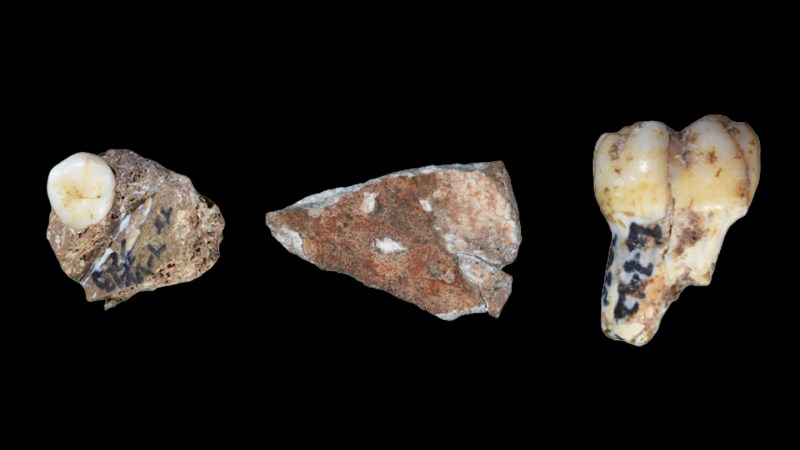
A fossilized tooth. A fragment of bone. Stone tools and the butchered remains of animals. These are the sparse but telling artifacts that now allow us to sketch the daily life of Denisovans, a human lineage we have only known through ghostly traces in ancient DNA. The new findings from a cave in China are a rare, direct glimpse into how these elusive hominins actually lived. For readers who track the movement of data and resources across the planet, this story is a reminder that the most profound discoveries often come from the most fragmented evidence, and that our understanding of complex systems, whether human migration or Record Port Activity Reflects Rising Chinese Exports Amid Trade Uncertainty, depends on how well we integrate scattered points into a coherent picture.
The Denisovan narrative has long been a triumph of inference. Their genome was reconstructed from a single pinky bone in Siberia. Now, with teeth and bone fragments from the Tibetan Plateau, we are moving from genetic signatures to behavioral archaeology. The associated animal bones and stone tools tell a story of adaptation: these were not simply wanderers but skilled hunters and toolmakers who thrived in a high-altitude environment. This matters because it challenges the linear, out-of-Africa model that once dominated paleoanthropology. The human story is far more networked, with multiple lineages overlapping and exchanging knowledge. In the same way that Integrated Subsea Infrastructure Shifts to Enhance Indian Ocean Connectivity reveals how modern data flows are rerouting around geopolitical chokepoints, these fossils reveal ancient human populations navigating their own physical and ecological constraints. The pattern is the same: resilience through mobility and adaptation.
Our take is straightforward: this is a validation of interdisciplinary science. The researchers did not rely on a single data type. They cross-referenced morphological analysis of the teeth with stratigraphic dating, faunal remains, and lithic technology. That integrated approach is exactly what we advocate for in ocean intelligence, combining satellite altimetry, buoy networks, and shipboard observations to produce a validated, real-time understanding of a system. The takeaway for our readers: the most robust conclusions emerge not from one golden dataset but from the calibrated integration of many imperfect ones. This is empirical, longitudinal science at its best. It also underscores a practical truth for policymakers and funders: you cannot predict what evidence will be decisive. A tooth can rewrite prehistory. A single temperature reading from a deep-sea mooring can validate a climate model.
What remains to be watched is how these findings interact with the growing body of evidence on human-environment interaction. The Denisovans occupied a specific ecological niche. As we map their range with greater precision, we will inevitably ask how their disappearance relates to climatic shifts or competition with modern humans. This is not an abstract question. It mirrors the urgency of understanding how current Gulf of Oman STS Transfers Max Out Amid Rising Saudi Oil Exports reflect a system under strain. In both cases, the capacity to adapt is finite. The Denisovan record shows us that even successful, long-established populations can vanish when they cannot integrate into a changing world. The concrete point to watch is whether future excavations in the same cave yield DNA or protein residues that can be directly linked to the tools, that would confirm whether the toolmakers and the tooth-owners were the same individuals. Until then, we have a compelling portrait, but not a complete one. And that is precisely the scientific honesty our audience expects.