Baleària Fast Ferry Receives Port Of Tenerife’s First Multi-Truck LNG Refuel
Our take
The recent operation at the Port of Santa Cruz de Tenerife, where the Baleària Fast Ferry received an LNG refuel via tanker trucks, represents a significant, albeit incremental, step towards decarbonizing maritime transport. This development underscores the increasing adoption of alternative fuels as the industry grapples with its substantial carbon footprint. As highlighted in our previous analysis of ICT development and maritime transport CO2 emissions: evidence from cross-country panel data, the relationship between technological advancements and emissions reduction is complex, but the shift to LNG, while not a perfect solution, provides a demonstrable pathway toward lower greenhouse gas emissions compared to traditional heavy fuel oil. The flexibility afforded by truck-based LNG bunkering, particularly in ports lacking dedicated LNG infrastructure, is a crucial enabler for wider adoption, circumventing the substantial upfront investment required for specialized terminals.
However, the transition to LNG isn’t without its challenges and risks. The incident involving the Glen Sannox ferry and the faulty valve releasing 700kg of highly flammable gas serves as a stark reminder of the inherent safety concerns associated with handling liquefied natural gas. While LNG offers a reduction in particulate matter and nitrogen oxides, it remains a fossil fuel and contributes to methane emissions – a potent greenhouse gas – throughout its lifecycle, from extraction to combustion. Furthermore, the current geopolitical landscape, as exemplified by the ongoing complexities surrounding Hanwha Ocean Faces $1 Billion Damages Claim Over Cancelled Contracts For Russia’s Arctic LNG 2, highlights the vulnerabilities inherent in relying on specific suppliers and regions for LNG supply, potentially impacting energy security and price volatility.
The Tenerife operation's success hinges on a robust framework of safety protocols and operational efficiencies. The use of tanker trucks, while providing flexibility, necessitates meticulous coordination and adherence to stringent safety standards to mitigate the risk of leaks or accidents. Real-time monitoring systems, calibrated to detect even minor anomalies in pressure or temperature, are essential. The integrated data ecosystem necessary to manage such operations – tracking truck locations, fuel levels, and port infrastructure availability – requires sophisticated communication networks and data analytics capabilities. This emphasizes the need for further investment in infrastructure and training, alongside the development of validated, empirical methods for assessing the full environmental impact of LNG bunkering, accounting for methane slip and other lifecycle emissions.
Looking ahead, the Port of Tenerife's initiative, and similar developments across global ports, signal a move towards a more decentralized and adaptable LNG bunkering model. The long-term viability of this approach, however, depends on continuous improvements in safety technology, the development of more sustainable alternative fuels like green hydrogen or ammonia, and a calibrated, data-driven assessment of the overall environmental footprint of maritime transport. A crucial question remains: will the increasing adoption of LNG act as a bridge to a truly decarbonized maritime sector, or will it become a temporary solution, delaying the transition to more sustainable and ultimately cleaner energy sources?
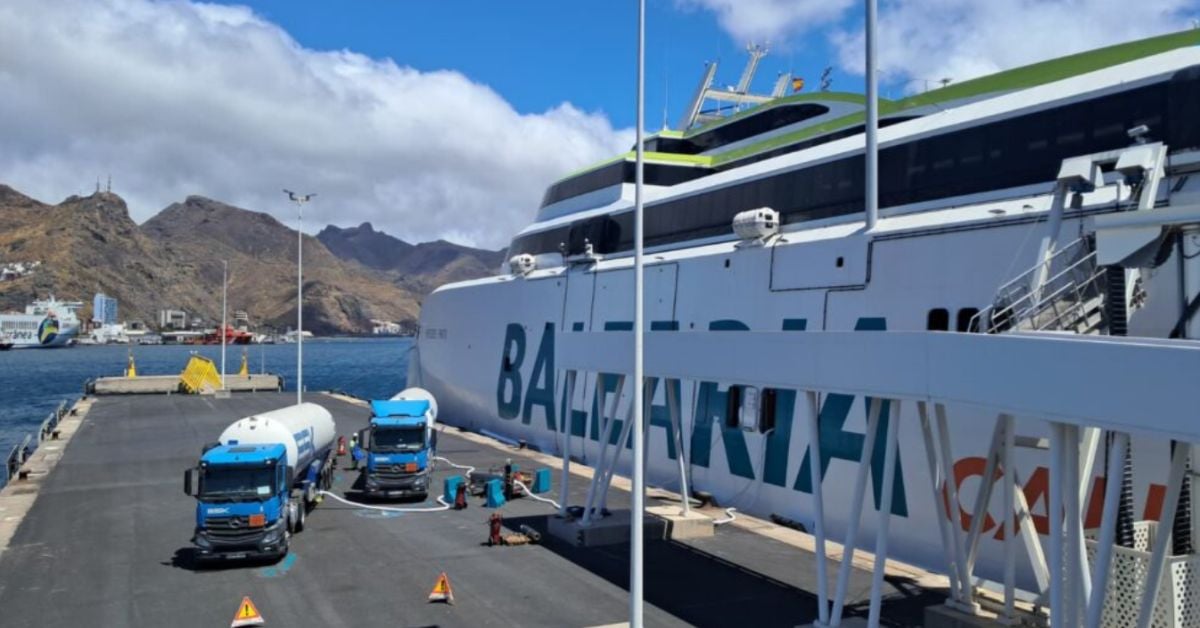
The port of Santa Cruz de Tenerife hosted this morning its first operation of supplying liquefied natural gas (LNG) to a ship by means of tanker trucks, specifically to the fast ferry Mercedes Pinto of the Baleària shipping group, incorporating the Multi Truck to Ship (MTTS) modality that allows the simultaneous supply of this fuel from several trucks to the tanks of the ship.
The operation began around 12:30 pm at the Anaga Dock pier and was carried out by ESK, SA, the company in charge of providing this service, during which 600 MWh were supplied by two tanker trucks, with a total pumping flow of 700 liters per minute.
The port of Santa Cruz de Tenerife already had experience in supplying LNG using the Ship to Ship (STS) method, which allows fuel to be supplied directly between two ships. Now, the Truck to Ship (TTS) and Multi Truck to Ship (MTTS) methods have been added, which allow this supply to be carried out from land using one or more tanker trucks, respectively, thus expanding the available options and adapting to the different operational needs of the ships.
This new modality responds to the need raised by Baleària to have this supply alternative in Tenerife for its eco-efficient vessels and allows the port to advance in a line of work linked to sustainability, innovation and energy transition, facilitating safe and efficient solutions in the face of the evolution of fleets and fuels used by maritime transport.
The implementation of this operation has been made possible thanks to the prior coordination work between the Port Authority of Santa Cruz de Tenerife, Baleària, ESK and the other agents and organisations involved, which has allowed us to define and validate a procedure adapted to the characteristics of the pontoon and the receiving vessels, with special attention to risk analysis, action and emergency protocols and coordination and safety measures.
Mercedes Pinto. The Mercedes Pinto, which is 123 meters long, 28 meters wide and has the capacity to transport 1,200 passengers and 425 vehicles, reaches a speed of 35 knots and is designed to offer fast, efficient and comfortable navigation.
It is Baleària’s twelfth ship with dual engines prepared to run on natural gas and biogas, a CO₂-neutral fuel, in line with Baleària’s roadmap towards decarbonization.
Press Release
Read on the original site
Open the publisher's page for the full experience