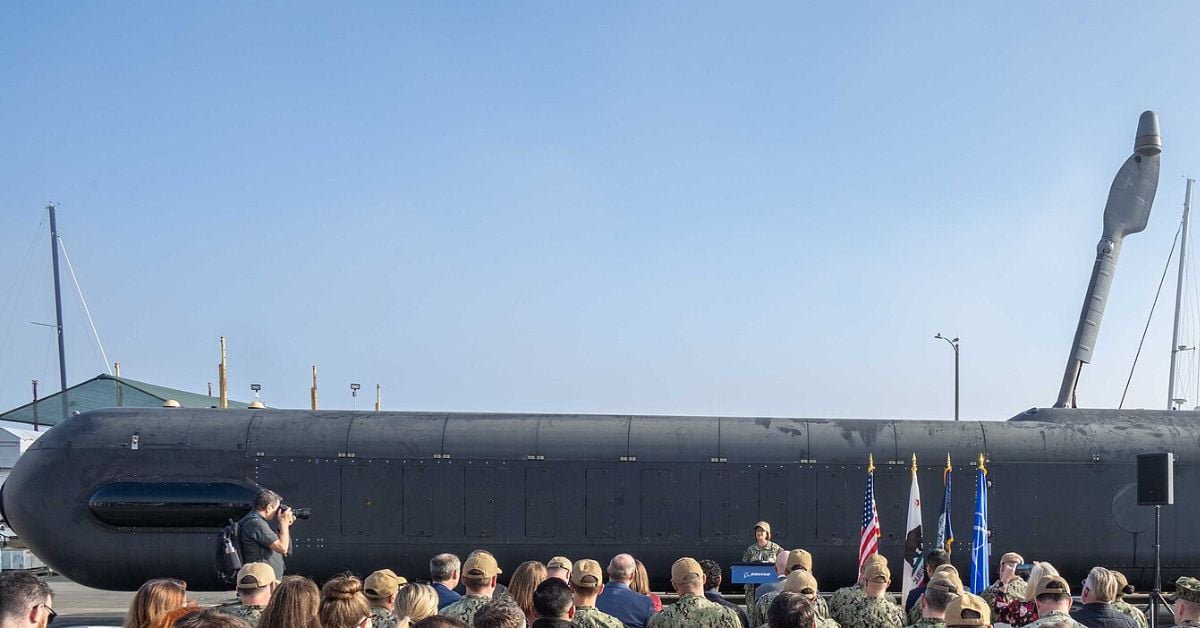
The Orca's 1,000-nautical-mile voyage is a significant operational data point, but the real story is the gap between technical demonstration and programmatic reality. The U.S. Navy has proven that an Extra Large Uncrewed Undersea Vehicle can sustain long-endurance transit in the Pacific, yet the Government Accountability Office now reports that this same program may never transition to an official program of record after nearly a decade and $885 million. For our readers, whether they are researchers tracking undersea autonomy or policymakers assessing fleet architecture, this contradiction is the takeaway: the hardware is moving forward while the acquisition framework is stalling.
The Orca's range of 6,500 nautical miles and its diesel-electric propulsion with an 18-kilowatt range extender represent a calibrated step toward persistent, long-distance undersea operations. The Navy has been working to integrate unmanned systems into carrier strike groups, and the July meeting between officials aboard the USS Theodore Roosevelt specifically explored using these vehicles to transport components between submarines and carriers, potentially eliminating the need for a submarine to surface. This is not speculative; it is a validated operational concept. We recently covered a parallel development in Remote Command Over 2,100 Miles Validates Carrier-Based Drone Integration, where the Navy connected to and controlled an MQ-25A Stingray from a carrier at distance. The pattern is consistent: the Navy is building a distributed, unmanned logistics and sensing network. The Orca is the undersea node in that integrated data ecosystem.
Yet the GAO report introduces measurable uncertainty. Five prototypes are now expected by the end of 2026, a three-month slip from last year's estimate and years behind the original schedule. Technical challenges remain in autonomy, battery endurance, and navigation. More critically, modifying payloads requires paying Boeing to alter proprietary software, a constraint that runs counter to the modular flexibility the service claims. The program's future is not assured. For researchers and defense analysts, this raises a practical question: will the empirical data from this voyage be enough to push the XLUUV into a program of record, or will the Navy let the capability drift while the technology matures elsewhere? The answer has direct implications for how quickly undersea drone operations scale.
A specific detail to watch is the proprietary software lock. The Navy says the Orca's modular design offers payload flexibility, but the GAO notes that any change requires Boeing to modify the code. In a rapidly evolving threat environment, that is not flexibility, it is a vendor bottleneck. As we saw with India's Private Shipyard Delivers First Multipurpose Naval Vessel INS Samarthak, other navies are moving quickly on modular platforms. The Orca program will need to resolve this constraint, or the technical achievement of a 1,000-mile voyage will be overshadowed by an inability to adapt the system to real-world missions.