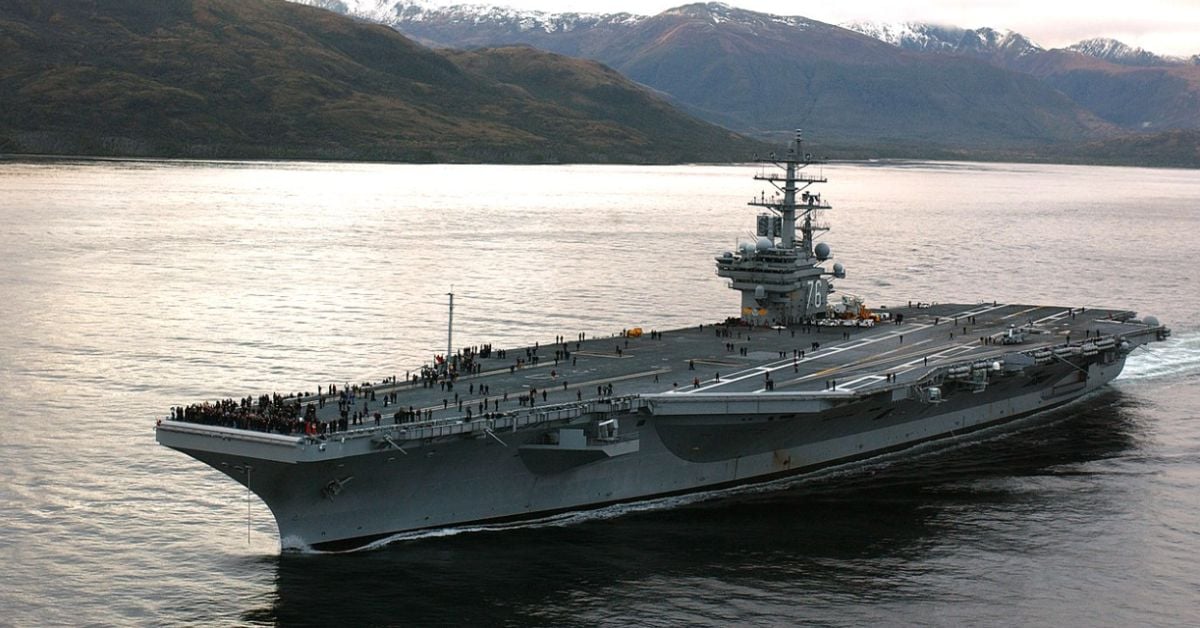
The U.S. Navy's successful remote control of an MQ-25A Stingray from a carrier 2,100 miles away is not just a technical demonstration, it is a validated proof point that unmanned systems are no longer experimental add-ons but core operational assets. This milestone, achieved aboard the USS Ronald Reagan while the aircraft sat in Illinois, confirms that the networks, interfaces, and command protocols for carrier-based drone integration are ready for the next phase. For anyone tracking naval modernization or the shifting balance of power at sea, this is the moment the concept becomes a capability.
What makes this achievement concrete is the operational logic behind it. The MQ-25A is designed to refuel manned aircraft like the F/A-18E/F Super Hornet, extending their range and time on station without pulling combat jets off mission to serve as tankers. That is a measurable gain in combat efficiency: every Super Hornet freed from refueling duty can remain a strike asset. The Navy's Unmanned Carrier Aviation Program Office, backed by Boeing and Lockheed Martin, has now shown that the command chain works over satellite links at transcontinental distance. This is the same kind of integration logic we saw when Validated AI inspection scaled to $300M for fleet readiness was applied to shipyard maintenance, both efforts aim to replace manual, manpower-intensive tasks with systems that deliver consistent, calibrated performance. The difference here is that the stakes are not just readiness metrics but the very geometry of carrier air operations.
This test also carries implications beyond the flight deck. The ability to operate an unmanned aircraft from a carrier at such distance suggests a future where the carrier itself becomes a mobile command node for distributed, unmanned assets. That matters directly for theaters where naval presence is contested, such as the South China Sea. As we noted when Monitoring Naval Activity in the South China Sea to Ensure Regional Stability, the ability to detect and respond to surface activity is central to maintaining freedom of navigation. An unmanned tanker that extends the reach of carrier-based fighters gives commanders more options to sustain air patrols and surveillance missions without repositioning the carrier itself. And when paired with the kind of long-range strike capability now being integrated into submarines, as seen with U.S. Navy Integrates Nuclear-Capable Cruise Missiles Into Virginia-Class Submarines, the cumulative effect is a fleet designed to project power from greater standoff distances, with fewer platforms exposed to direct risk.
The specific detail to watch is how the MQ-25A performs during routine flight operations and missions, not just controlled trials. The Navy has validated the connection and the control. The next question is whether the system can sustain that reliability under the electromagnetic and physical chaos of a flight deck during cyclic launch and recovery. If it does, the MQ-25A will become the foundation for a carrier air wing that includes multiple unmanned types. That is the concrete takeaway: the first unmanned refueling aircraft is a proof of concept, but the real test is whether the Navy can integrate it into the rhythm of daily carrier operations without degrading tempo. The answer will define how quickly the rest of the unmanned air wing follows.