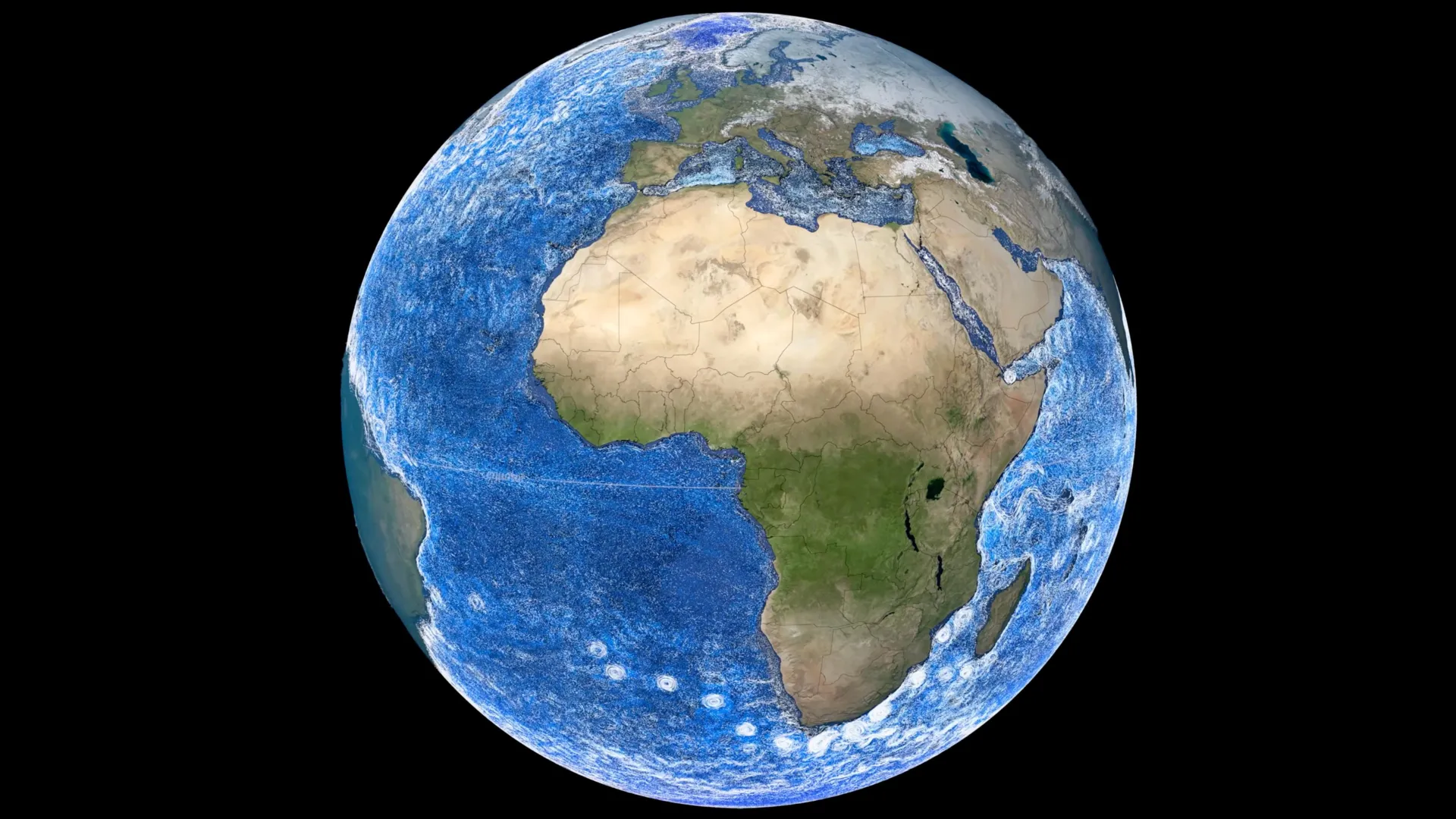
The ocean's most powerful currents do not move in straight lines, and the evidence buried beneath the seafloor proves it. New analysis of ancient sediments from roughly 3.4 million years ago shows that when the flow of warm, salty water from the Indian Ocean into the Atlantic nearly halted during a cold period, the Atlantic Meridional Overturning Circulation did not collapse. In fact, parts of it strengthened. That runs counter to the prevailing assumption that a weakened input from the Indian Ocean necessarily means a weaker AMOC. The system, it appears, has more internal flexibility than we give it credit for.
This matters far beyond the realm of paleoceanography. For researchers modeling future climate scenarios, the assumption that a single forcing mechanism dictates the strength of the entire overturning circulation is no longer tenable. The sediment record suggests that the AMOC can compensate, at least in part, by drawing on other components of the global circulation. That is not a reason for complacency; it is a prompt to refine our models. As we build integrated data ecosystems that combine satellite observations, subsea sensors, and historical records, we need to account for this kind of resilience. Calibrated ocean intelligence, now within reach through integrated data discovery is precisely the tool that could help us track these compensatory mechanisms in real time. Similarly, the Integrated Subsea Infrastructure Shifts to Enhance Indian Ocean Connectivity and the Integrated Subsea Cables Enhance Data Transmission Across the Indian Ocean highlight how much of our modern ocean observation depends on physical infrastructure routed through the very region whose historical behavior is now under scrutiny.
What we find most striking is not the resilience itself, but what it implies about our predictive blind spots. If the AMOC can partially decouple from Indian Ocean inflow under certain boundary conditions, then our current models, which often rely on simplified relationships between ocean basins, may be missing critical feedback loops. The practical consequence for our readers is direct: future projections of Atlantic circulation, and by extension regional sea level rise and storm tracks, may need to incorporate a wider envelope of possible behaviors. This is not an argument for alarm; it is an argument for intellectual humility. The ocean is not a machine with one lever. It is a complex, layered system where strength in one region can mask weakness in another.
The open question, then, is not whether the AMOC will collapse, but how many of these compensatory pathways remain active under the stronger warming expected in the coming decades. The sediment record gives us a snapshot of one cold period; it does not tell us how the system will respond to a rapid, greenhouse-driven perturbation. That is the detail to watch. As we continue to validate model outputs against empirical data, we should treat each new paleoclimate finding not as a contradiction of our tools, but as a calibration point. The takeaway worth quoting: the AMOC is not a single point of failure, but a network of interconnected flows whose resilience depends on conditions we are only beginning to measure.