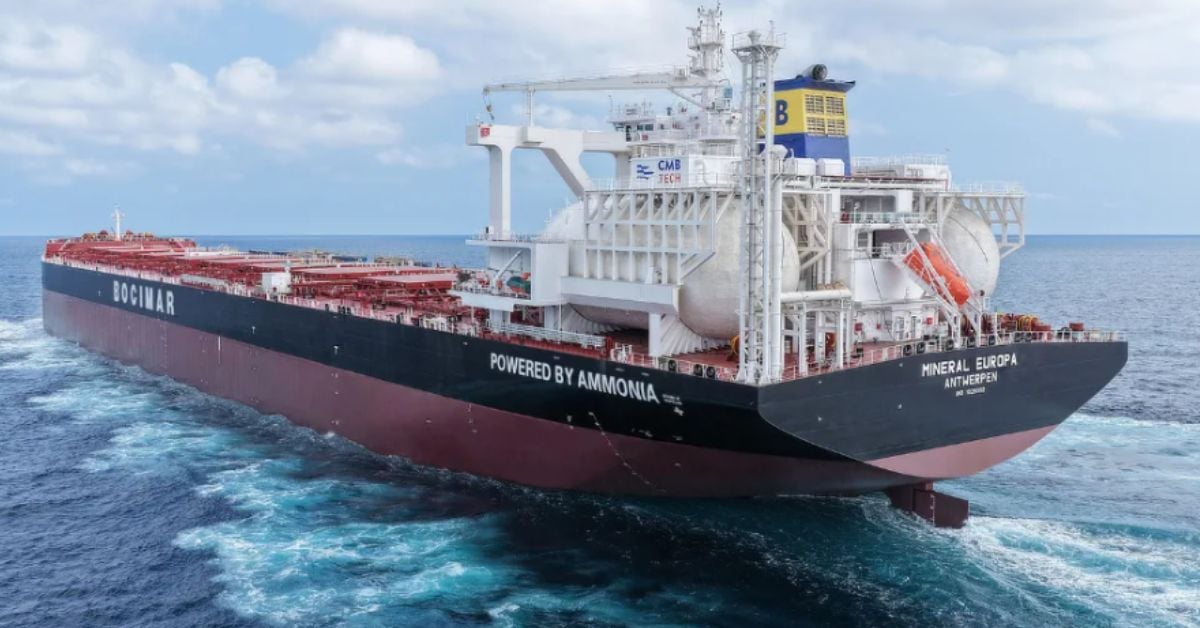
The Mineral Europa's maiden voyage is a genuine engineering milestone, but its real value will be measured in the data it produces, not in the ceremony of its launch. CMB.TECH has spent a decade building this 210,000-tonne dual-fuel bulk carrier, and the fact that it is now sailing to Australia with a full payload proves that ammonia propulsion has moved from the laboratory into the commercial fleet. That is not a small thing. Yet the company's own announcement omits the two numbers that matter most: the vessel's ammonia consumption and its emissions at different engine loads. Without those figures, we are celebrating a capability, not a result.
The dual-fuel design is the pragmatic bridge this industry needs. The ship can run on conventional marine fuels when ammonia supply is unavailable, which means it can enter service immediately without waiting for a global bunkering network to materialize. This is the same logic that has driven Australia’s measurable gains in solar and wind: adopt the technology where it works, then expand the supporting infrastructure as demand justifies it. The parallel is direct. Just as Australia's grid transition is validated by empirical output data, the Mineral Europa's first transit to Australian ports will be judged by the same standard. We should expect CMB.TECH to publish the engine-room logs from this voyage, and the industry should treat that data as a public good.
What makes this vessel strategically important is not the single ship but the pipeline behind it. By 2029, CMB.TECH plans to add 21 more ammonia-powered vessels, including a container ship, two chemical tankers, and 18 dry bulk carriers, with most deliveries scheduled within the next nine months. That is not a pilot program; that is a fleet transformation. It signals that the company sees ammonia not as an experimental sideline but as a core commercial proposition, particularly for dry bulk routes where fuel costs dominate operating expenses. The claim that ammonia can be produced from renewable sources like air, water, and power is credible, but it depends on the same condition that governs every energy transition: the availability of clean electricity at scale. This is where the conversation about port resilience against cyclone-driven economic loss becomes relevant. If ports are to handle a new generation of ammonia-fueled carriers, they must also adapt their infrastructure and safety protocols for a fuel with different handling characteristics than heavy fuel oil. The ship is ready; the ports are not yet.
The specific detail to watch is the vessel's performance on the Australian leg, particularly how the ammonia engine behaves under sustained load in open-ocean conditions. Sea trials are controlled; commercial voyages are not. Weather, cargo weight, and routing decisions will all affect combustion efficiency and emissions, and those variables are exactly what the next 21 ships need to account for. The Mineral Europa is a proof point, but the proof is incomplete until we see the numbers. CMB.TECH's CEO says decarbonisation is no longer a distant goal, and he is right. But goals are validated by measurements, not announcements. The first ammonia-fueled bulk carrier has left port, and the question now is whether the company will let us see what it learned on the way.