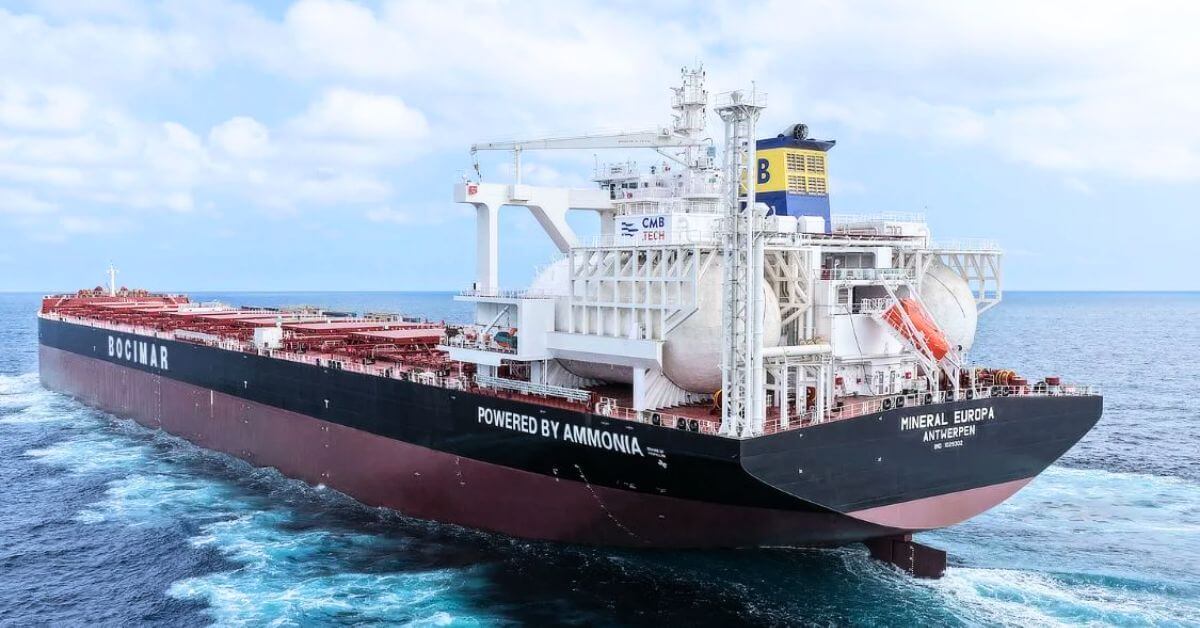
The first ammonia-powered bulk carrier to complete sea trials is not a proof of concept, it is a proof of system. The Mineral Europa, built for Belgian shipowner CMB.TECH, will soon sail to Australia on a dual-fuel engine that can burn both ammonia and conventional marine fuel. That is a measurable step toward decarbonizing one of the hardest sectors to clean up. But the real test will not be on the ship; it will be in the supply chain that must follow. As we have tracked with Measured decline in solar costs tracks each doubling of global capacity, infrastructure and cost curves can shift rapidly once deployment begins. The question is whether ammonia bunkering can follow a similar trajectory.
CMB.TECH plans to commission 21 ammonia-powered vessels by 2029, with nearly all arriving within the next nine months. That is an aggressive build-out, and it forces a practical question: where will the fuel come from? Green ammonia, produced using renewable energy, water, and nitrogen from the air, contains no carbon and emits no direct CO₂ when burned. Its environmental integrity, however, depends entirely on how it is made and delivered. If the ammonia is produced with fossil-based hydrogen, the emissions simply move upstream. The company has indicated it will invest in storage facilities and bunker barges, but a robust distribution network requires coordinated investment across ports, suppliers, and regulators. Compare this to the fragmented, opaque logistics we have observed in Tracking the Shadow Fleet: Sanctions Map 22 Vessels Tied to Iran's Oil Network, where a lack of transparency in fuel supply chains enables evasion of environmental and legal standards. The ammonia network must be built with traceability from the start.
Ammonia is toxic and must be handled with care. That is not a minor footnote. Every vessel will need storage systems designed for a corrosive, hazardous fuel. Every port that wants to serve these ships will need specialized transfer equipment. CMB.TECH's CEO, Alexander Saverys, has framed the technology as a way to cut emissions and reduce reliance on conventional fuels. He is correct, but the timeline depends on whether the fuel's production cost can fall fast enough to compete with diesel. As solar costs have shown, each doubling of capacity can drive prices down by roughly 20 percent. Ammonia production is not solar panel manufacturing, but the same principle applies: scale and learning-by-doing matter. The Mineral Europa validates the engine. The next five years will validate the economics.
The specific takeaway is this: the Mineral Europa's maiden voyage is not the finish line. It is the starting point for a supply chain that does not yet exist at scale. Watch whether port authorities in Australia and other major bunkering hubs approve ammonia storage and transfer permits within the next 18 months. That permitting timeline will be the real indicator of whether the shipping industry can turn an engineering success into an operational reality.