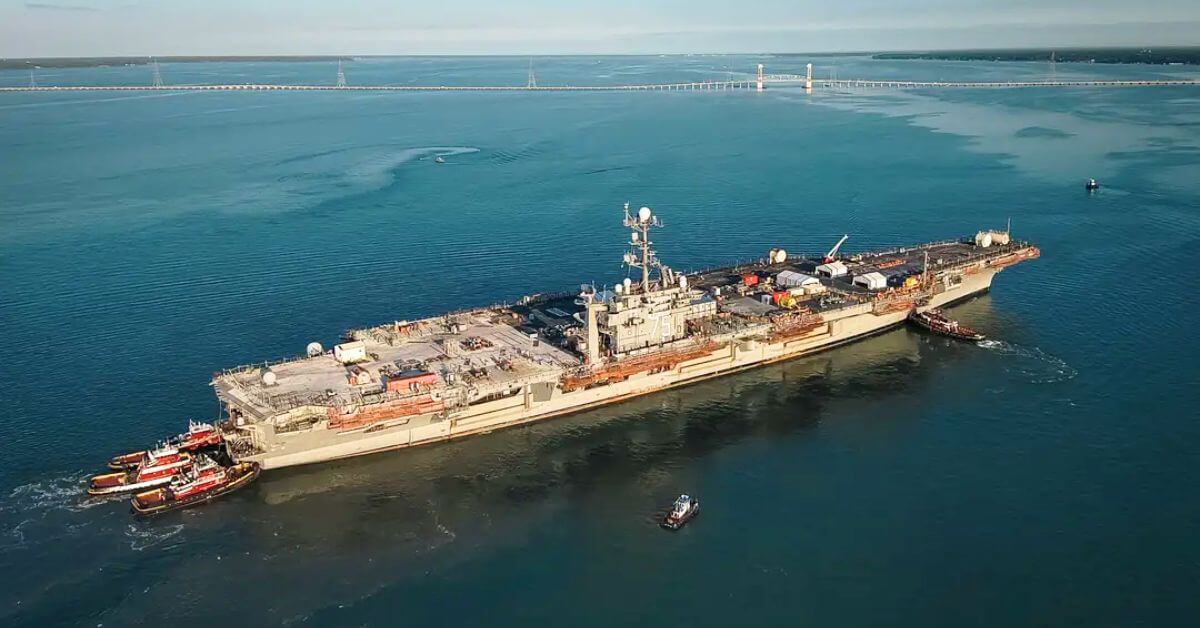
A $5.1 billion overhaul of a nuclear-powered aircraft carrier is not routine maintenance. It is a strategic bet on the longevity of a platform that defines American naval power projection, and it forces a clear-eyed question about what we are choosing to sustain. The arrival of USS Harry S. Truman at Newport News Shipbuilding for its refueling and complex overhaul signals a commitment to keeping Nimitz-class carriers operational for another 25 years, a decision that carries significant implications for maritime strategy, industrial capacity, and the data ecosystems that support both.
This investment does not exist in isolation. It runs parallel to a Next-generation naval aviation contract signals shift toward extended-range maritime capability that aims to give naval aviation greater reach, and a $200B Korean investment anchors new US nuclear capacity and LNG export corridor that will add new power generation capacity. Together, these stories paint a picture of a nation reinvesting in hard infrastructure, naval, energy, and industrial, at a scale that demands integrated, real-time data to manage effectively. The Truman overhaul alone will require years of calibrated engineering, validated supply chains, and longitudinal project management. This is where ocean intelligence becomes operational: tracking material flows, monitoring environmental conditions in the shipyard, and measuring the climate indicators that affect sea-level rise at naval facilities. The Navy is not just rebuilding a ship; it is stress-testing its entire support system.
Our take is that this project represents a measurable, empirical test of whether the United States can sustain complex industrial work over a multi-year timeline without mission creep or cost overruns. The $5.1 billion figure is not abstract. It is a commitment of resources that could have been allocated to newer, smaller platforms or distributed to accelerate the Columbia-class submarine program. By choosing to refuel Truman, the Navy is betting that the carrier's integrated data ecosystem, its sensors, combat systems, and maintenance records, can be modernized alongside its reactor core. The related incident during carrier recovery operations that injured four sailors is a sobering reminder that these platforms operate under extreme conditions, and that every overhaul must also address safety and human factors. The question we are watching is whether this overhaul will produce a vessel that is truly more capable, or simply an older one kept afloat.
The specific consequence to watch is the timeline. Overhauls of this magnitude have historically slipped, and each delay compounds costs and reduces fleet readiness. If Truman returns to service on schedule, it will validate the shipyard's capacity and the Navy's planning. If it does not, the debate over whether to invest in legacy platforms or pivot to distributed, unmanned systems will intensify. That debate is not theoretical, it is happening now, and the data from this overhaul will inform it. Our readers, whether researchers tracking defense budgets or policymakers assessing naval posture, should treat this project as a leading indicator of industrial resilience. The ocean is not the only thing being measured here. The health of the shipyard, the supply chain, and the workforce are equally empirical signals. We will be watching the metrics.