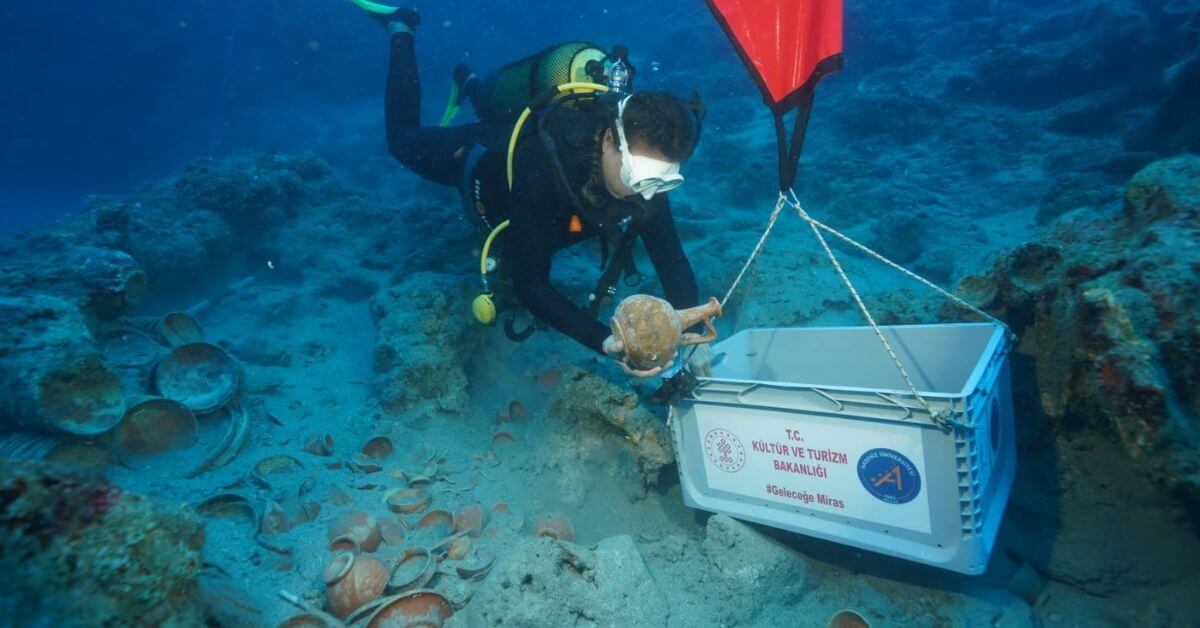
A 2,100-year-old shipwreck off the coast of Türkiye has yielded thousands of ceramic items from a Roman luxury cargo, a discovery that validates how little we still know about the ancient maritime economy. This is not merely a haul of artifacts; it is a calibrated empirical signal from a past global trade network that we are only beginning to map with precision. The find demands we ask what else lies beneath our busiest shipping lanes, especially as we build modern infrastructure like India Builds $1.5B Maritime Shield for War-Risk Coverage to protect today's cargo. Meanwhile, Turkish Navy marks 488th Preveva anniversary with homegrown frigate TCG Istanbul reminds us that the same waters the Romans sailed for luxury goods are now patrolled by sovereign fleets protecting national interests. The continuity of maritime risk is striking: the luxury items aboard that Roman ship were as vulnerable to weather, navigation error, and geopolitical tension as the cargo on any modern freighter.
For our readers, researchers, policymakers, and ocean intelligence professionals, this discovery matters in practical terms. It reinforces the value of longitudinal datasets. A single shipwreck tells us about one voyage; thousands of ceramic items, precisely dated and geolocated, can help reconstruct trade volumes, supply chain routes, and even climate-related shipping seasons across the ancient Mediterranean. The ocean floor is a peer-reviewed archive of human activity, and we have only begun to systematically read its layers. Every recovered artifact is a climate indicator in its own right, correlating with known periods of Roman expansion, shifts in sea level, and regional weather patterns. The integrated data ecosystem approach that World Data Ocean advocates, linking archaeological, oceanographic, and climate data, would allow these findings to inform more than museum displays.
What this also underscores is the fragility of maritime records. Unlike the real-time monitoring we now deploy for ocean intelligence, the ancient world left its cargo to the seafloor for two millennia before we could retrieve it. That gap matters. When we compare this story to tragedies like the Overloaded vessel capsizes on Lake Kivu, second fatal sinking in a week, the contrast is sobering: one ship was a luxury vessel carrying goods for the imperial elite; the other was a crowded boat carrying people who lacked basic safety margins. Both ended the same way, separated by two millennia. The difference is that we now have the tools to prevent the second kind of sinking, yet we still see preventable losses of life in inland waters like Lake Kivu. That is a failure of applied knowledge, not of technology.
The concrete takeaway from this Roman cargo is simple but demanding: the ocean holds a measurable record of human ambition and failure, and we have an ethical obligation to read it completely. The unanswered question is whether our modern maritime strategies, insurance pools, naval frigates, and safety regulations, are being built on empirical data or on assumptions. Until we integrate underwater archaeology, real-time vessel tracking, and climate monitoring into a single analytical framework, we are navigating blind. The Roman ship did not have that luxury. We do.