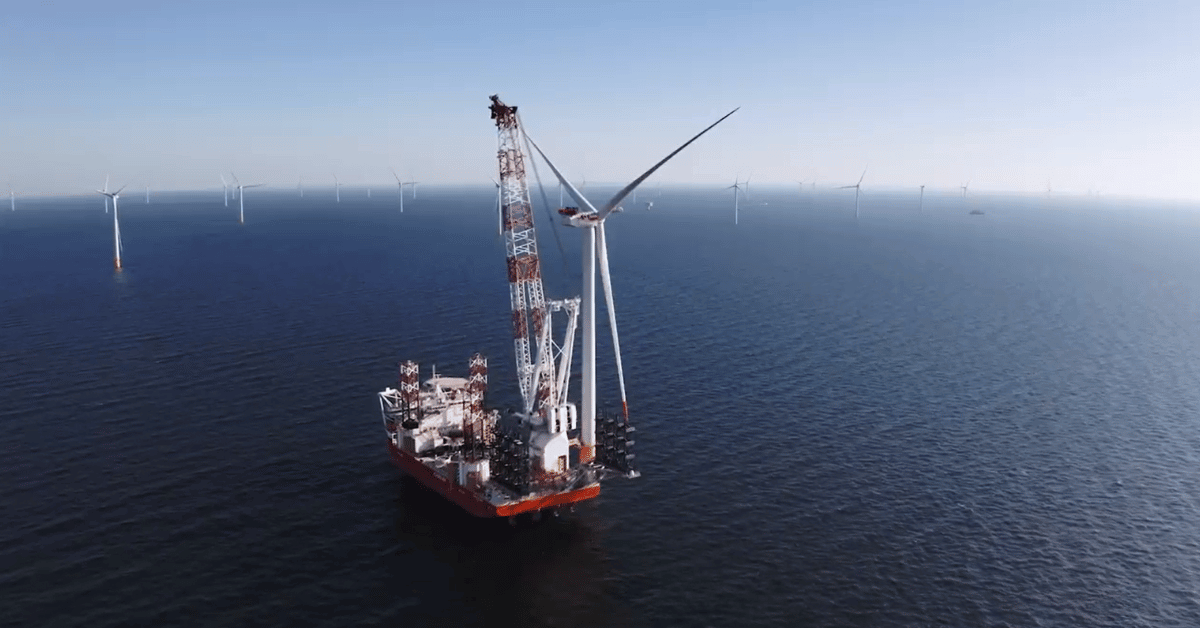
Seventy-six towers now stand in the Baltic Sea, and that is not just a number. It is the calibrated result of a supply chain that had to align weather windows, vessel schedules, and grid readiness across national borders. Cadeler's completion of all 76 turbines at the 1.2 GW Baltic Power farm gives Poland its first offshore wind array, and a working model for how calibrated at sea: wind-powered data center validates subsea operations can inform industrial-scale deployment. The practical consequence is straightforward: Poland has moved from planning to proof, and the proof is bolted to the seabed.
The milestone is measurable, not aspirational. Cadeler's two jack-up vessels, Wind Osprey and Wind Mover, placed all 76 Vestas V236-15 MW turbines, each standing over 260 metres tall with a swept area exceeding 43,700 square metres. That is not a rounding error; that is a 1.2 GW power plant built in the Baltic Sea. Baltic Power, a joint venture between ORLEN and Northland Power, delivered first power to Poland's grid in July 2026 and will soon generate up to 4 TWh annually, roughly 3% of Poland's current electricity demand. This is what integrated, real-time industrial execution looks like when it leaves the spreadsheet and meets saltwater.
The significance extends beyond the turbine count. Poland has spent years importing energy and planning its transition; this project converts planning into empirical output. For a country whose grid has leaned heavily on coal, 3% is not a revolution, but it is a validated first step. The scale is worth holding onto: 76 Vestas V236-15 MW units, each over 260 metres tall, with a swept area exceeding 43,700 square metres. That is not incremental tinkering. That is a measurable contribution to national demand, and it is repeatable. As Poland develops further zones, the question is whether the same calibrated, data-driven rigor that made this installation possible can be scaled across the wider Baltic basin.
What matters now is not the milestone itself but the system it validates. Completing 76 turbine installations in a demanding sea environment is a logistical achievement, but the lasting signal is about repeatability. Cadeler's two jack-up vessels, Wind Osprey and Wind Mover, did not just place hardware; they demonstrated that the industrial capacity to build offshore wind at scale exists in the Baltic right now. That matters because Poland's energy transition has been long on ambition and short on physical evidence. This project supplies that evidence. The calibrated at sea: wind-powered data center validates subsea operations work off China's coast shows the same pattern: complex marine installations are becoming repeatable, measurable feats, not one-off experiments.
For readers tracking the longevity of a booming ocean economy through integrated climate indicators, the Baltic Power milestone is a calibrated data point. The 76 Vestas V236-15 MW turbines, each rising beyond 260 metres with a swept area of more than 43,700 m², are not just engineering achievements. They are physical infrastructure that will feed roughly 4 TWh annually into Poland's grid, enough for 1.5 million households and about 3% of national demand. That is a measurable, verifiable contribution to the country's energy mix. The completion of turbine installation, executed by Cadeler's Wind Osprey and Wind Mover, brings the project to the final stage before full commissioning. First power reached the grid in July 2026; full operation follows.
What matters here is not the scale of the hardware, though 260-metre turbines are substantial. What matters is that Poland has crossed from planning into empirical reality. This is the kind of measurable progress that the energy transition needs: not more ambition statements, but a functioning asset, delivering 4 TWh annually to 1.5 million households. For a country whose grid has long leaned on coal, Baltic Power is a structural shift. The practical consequence is that Polish households will draw roughly 3 percent of national electricity demand from a single offshore array, and that percentage will climb as follow-on projects move from planning into the water. The completion also validates