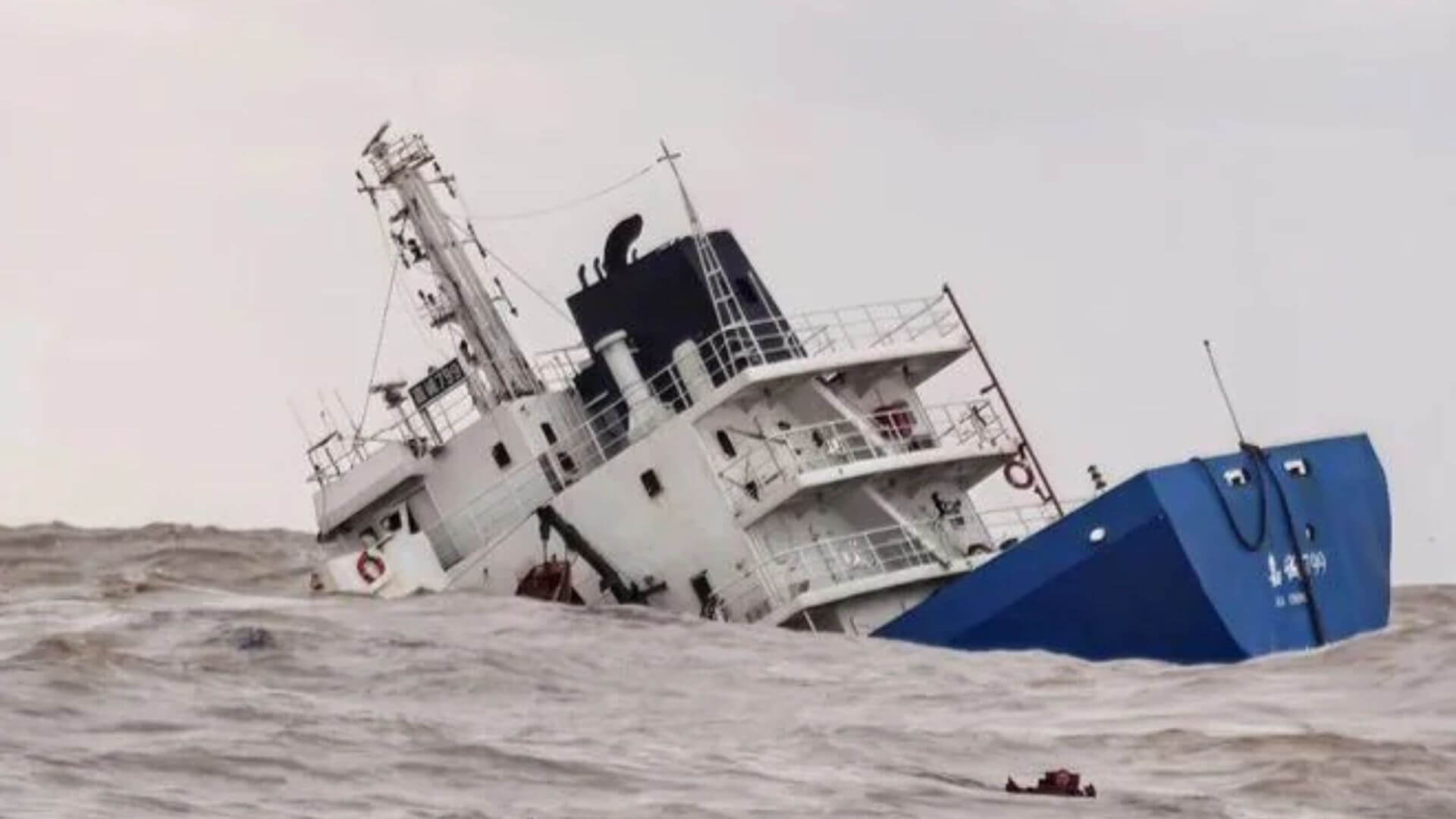
The rescue of all 14 crew members from the sinking bulk carrier Jia Cheng 799 in the Yellow Sea is a testament to effective emergency response, but it also underscores a troubling gap in our ocean intelligence. While the Yancheng Maritime Search and Rescue Centre and the East China Sea Rescue Bureau acted with commendable speed, deploying the Donghai Jiu 116 and helicopters in Force 8 winds and four-metre waves, the incident raises a fundamental question: why are we still relying on distress calls to learn that a vessel is in peril? For an industry that moves billions of tonnes of cargo annually, this reactive posture is no longer acceptable.
The sinking occurred in the southern Yellow Sea, a region where we have previously validated temporal spectral models for sediment carbon, a body of water we are actively studying for its climate indicators and ecological health. Yet, when a 6,000 DWT bulk carrier carrying steel began taking on water in two starboard cargo holds, the maritime safety system had no real-time data on the vessel's structural integrity or the flooding progression. This is not about blame; it is about a missed opportunity to integrate empirical, calibrated data streams into operational safety. Compare this with the International Maritime Organization's recent call for enforced safety rules in the Strait of Hormuz, where data integrity and proactive monitoring are framed as life-saving tools. The Yellow Sea incident shows that even with robust rescue protocols, we are still flying blind until the moment a mayday is sent.
For researchers, policymakers, and ocean enthusiasts who follow our work, this event carries a specific, uncomfortable takeaway: our ocean intelligence networks remain fragmented. We can measure human-driven ocean warming impacts on marine heatwaves with increasing precision, and we can model sediment carbon across monitoring dates, but we cannot yet predict or prevent a bulk carrier flooding in a high-traffic shipping lane. The Jia Cheng 799 was built in 2004, and its exact position at the time of sinking, along with the cause of the flooding, remains unknown. That information is not merely a detail for an investigation report; it is a data point that should be feeding into a larger, integrated data ecosystem designed to identify risk patterns before they become emergencies.
The rescue was successful, and that matters. Eight crew members fell overboard as the vessel sank, and all 14 were recovered. But success in rescue should not mask failure in prevention. The question now is whether maritime authorities will release the vessel's precise position, the flooding cause, and the crew's condition, and whether those data points will be integrated into the same climate and safety indicators we rely on for ocean stewardship. Until we close that loop, every rescue is also a warning we have not yet heeded.