Yellow Sea
5 stories filed under Yellow Sea on World Data Ocean. The newest of them: “Refining tidal models through calibrated bottom friction coefficients”, “AI and oceanography converge to predict coastal cesium levels”, and “Tracking larval fish across seasons reveals spawning hotspots around Korea”. Bottom friction coefficients are not merely calibration knobs, they are physical parameters that can reshape how we interpret tidal dynamics. The fastest cesium decay is in the Bohai Sea; the slowest is in the South China Sea. A Global Hub for Ocean Intelligence 4 World Data Ocean is a centralized digital platform where researchers, scientists, and ocean enthusiasts converge to… The list below is every Yellow Sea story on World Data Ocean, newest first.

Refining tidal models through calibrated bottom friction coefficients
Bottom friction coefficients are not merely calibration knobs, they are physical parameters that can reshape how we interpret tidal dynamics. By embedding perturbations through a Dirac delta function into a shallow-water model, this study reveals rotating Poincaré waves at odd multiples of the base tidal frequency. The analytical solutions show that sensitivity is highest in shallow, strong-current regions, including tidal entrance and exit zones.
AI and oceanography converge to predict coastal cesium levels
The fastest cesium decay is in the Bohai Sea; the slowest is in the South China Sea. A hybrid TRR, LSTM, TRR framework now reconstructs and predicts 137Cs activity in China's coastal waters, integrating a bound-constrained exponential baseline with an LSTM residual network. This is measurable progress: long-term projections carry 90% ensemble intervals, not point estimates. For deeper context on coastal modeling, see our related work on refining tidal models through calibrated bottom friction coefficients.
Tracking larval fish across seasons reveals spawning hotspots around Korea
Seasonal surveys of ichthyoplankton across Korean waters reveal a striking contrast: 30 egg taxa and 61 larval taxa in February, versus 53 egg taxa and 154 larval taxa in July. This measurable increase in species richness underscores the importance of timing in marine surveys. Regional differentiation sharpened in summer, with *Engraulis japonicus* dominating both eggs and larvae. Understanding these spawning hotspots is foundational to ocean stewardship. For deeper context on climate-driven shifts in marine ecosystems, see our related coverage of the 2025 Temperature Anomalies.
Salt Marsh Vegetation Boosts Organic Carbon Storage in Yellow Sea Wetlands
Salt marsh vegetation measurably amplifies organic carbon processing in the Yellow Sea wetlands. Our investigation of adjacent mud flat and *Suaeda japonica*-vegetated marsh sites confirmed that microbial turnover and carbon mineralization were consistently higher where vegetation thrived, with a pronounced summer surface hotspot coinciding with peak root biomass. Yet carbon burial efficiency remained modest, between 8.8 and 23.8 percent, demonstrating that stock inventories alone cannot capture a wetland's full carbon balance.
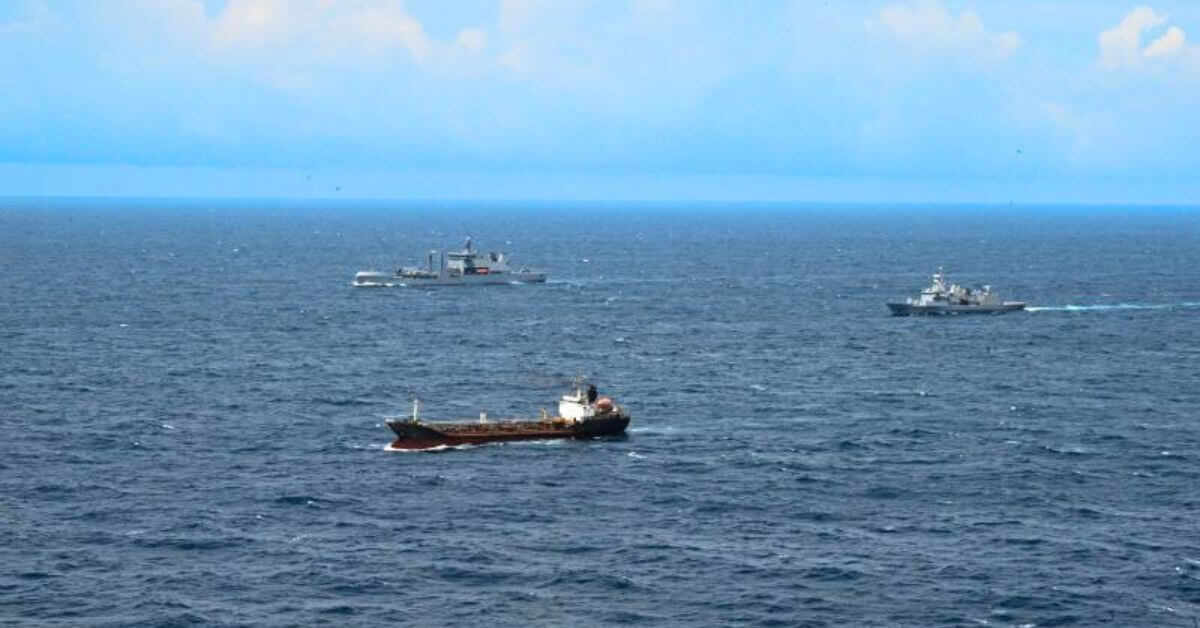
Kiwi Frigate Monitors Sanctions, Enhancing Global Maritime Security Intelligence
For three months, a Royal New Zealand Navy task group has monitored possible violations of UN sanctions against North Korea, turning a routine patrol into a concrete measure of maritime accountability. This is the kind of quiet, persistent work that gives "ocean intelligence" its weight. The deployment strengthens global security, yet it rarely makes headlines. It should. For deeper context on how regional navies are expanding their reach, see our related piece, "New Zealand Vessels Traverse Taiwan Strait En Route to Philippines Exercise.