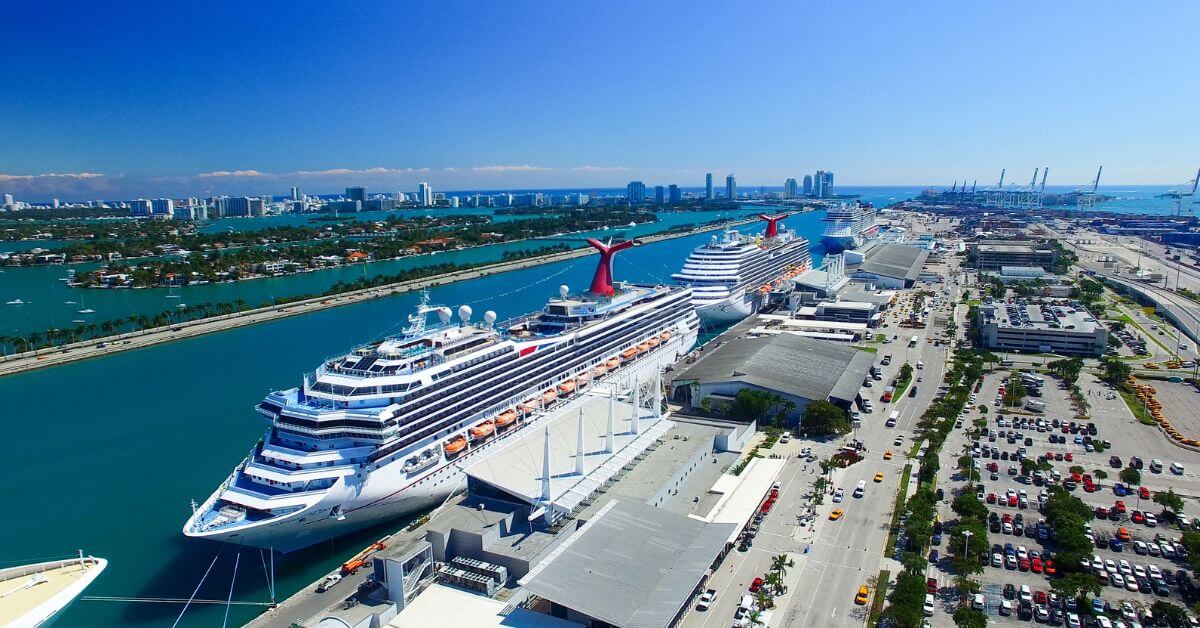
Ten million cruise passengers in a single year is not a neutral fact, and we should not treat it as one. PortMiami's record of 10.5 million guests for fiscal 2026 represents a 23 percent surge in ocean transit, and it demands a clear-eyed reckoning with what that volume means for the marine systems we study and depend on. This milestone is a measurable signal of growth, but growth without integrated environmental calibration is simply a larger footprint.
The timing is instructive. Just weeks before this announcement, the ocean liner SS United States was deliberately sunk off Florida to become the world's largest calibrated artificial reef. That project was framed as a restoration effort, a deliberate, engineered intervention to create habitat. Meanwhile, PortMiami's 10.5 million passengers represent a different kind of deliberate intervention: the daily, compounding pressure of fuel emissions, wastewater discharge, underwater noise, and physical disturbance along a coastline that also hosts the SS United States Sinks to Rest as World's Largest Calibrated Artificial Reef. One project adds habitat; the other adds traffic. The contradiction is not lost on anyone tracking real-time ocean intelligence in the region.
Port officials are right to credit modern infrastructure and resilient design for handling the surge. County Mayor Daniella Levine Cava and CEO Jonathan Daniels pointed to investments that are now delivering for local business. But from our vantage point, the relevant metric is not passenger throughput, it is the empirical, peer-reviewed data on what ten million passengers do to water quality, air emissions, and marine life over a sustained period. The port handled 832,142 passengers in October 2026 alone, a 19 percent increase over the same month last year. That is a longitudinal dataset in the making. We will be watching for the climate indicators and ecological measurements that should accompany every new cruise call.
This is also a moment to ask what kind of ocean stewardship scales alongside passenger volume. A South Korean training ship recently arrived in Pensacola as part of a multinational stewardship mission, bringing nearly 400 personnel focused on cooperative ocean science and maritime security. That vessel's mission is collaborative and purpose-driven. PortMiami's mission is commercial. Both operate in the same water, but only one is clearly accountable to the South Korean training ship arrives in Pensacola for multinational ocean stewardship mission framework of shared responsibility. The contrast is not a criticism of cruise travel; it is a call for transparency.
The concrete point to watch is cargo. PortMiami's TEU volume slipped 0.86 percent last fiscal year, ending a 12-year streak of steady container growth. If passenger traffic continues to rise while freight declines, the port's economic calculus shifts. That divergence may force harder questions about which forms of ocean transit are prioritized, and at what environmental cost. We will be tracking the next fiscal year's numbers not as a record to celebrate, but as data to validate.