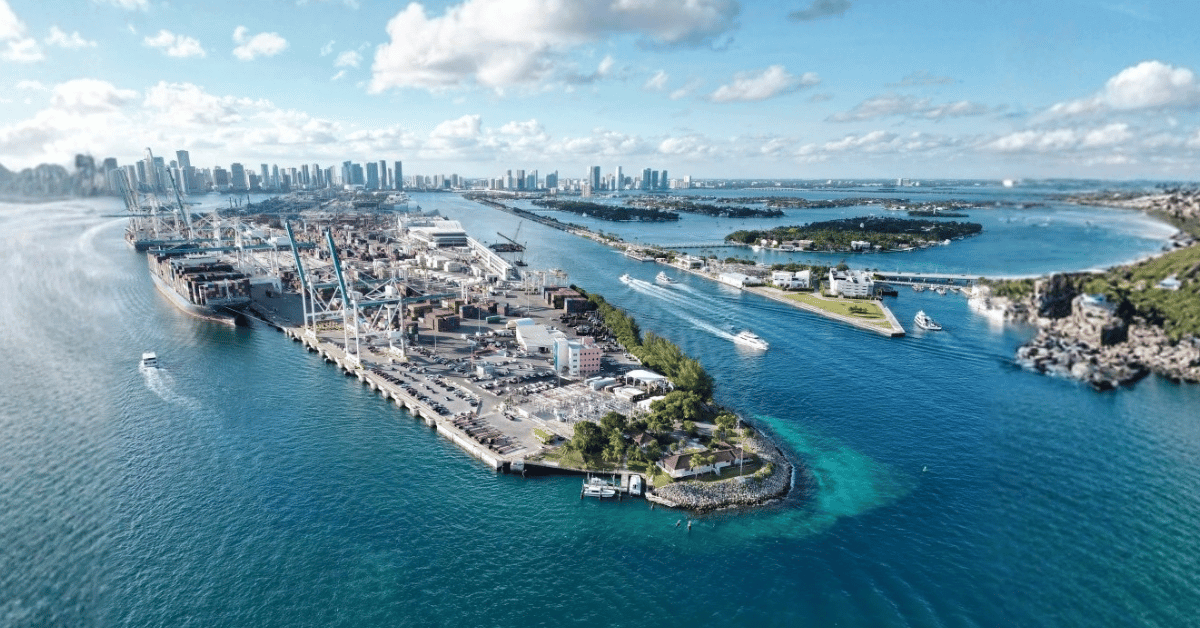
Port Miami has just processed its 10 millionth cruise passenger for fiscal year 2026, a figure that surpasses any previous annual record in the port's history. The milestone arrived on September 14, and while the number is impressive on its own, the more meaningful story is what it represents for the infrastructure that makes such volume possible. We are not surprised that the demand is there. We are more interested in how the system holds together when it is tested at this scale, and what the rest of the maritime industry can learn from the pressure.
The timing is worth noting. This record comes at a moment when the industry is also dealing with very different kinds of maritime operations, from the freeing of a bulk carrier that ran aground near Gladstone, Australia, to the ongoing calibration of Russia's Northern Sea Route icebreaker fleet. Those stories remind us that the ocean is not a single theater, but a set of interlocking systems where a passenger terminal in Miami and a grounded carrier off Queensland are part of the same global logistics web. The Bulk Carrier Freed After Prolonged Grounding Near Gladstone, Australia shows how fragile the system can be when a single vessel blocks a critical route, while Russia Calibrates Export Revenue for Northern Sea Route Icebreaker Fleet demonstrates how much planning and capital lie behind even the most remote shipping lanes. Port Miami's record is not an isolated achievement; it is a stress test that other ports will be watching closely.
What does this mean for our readers in practical terms? For port operators, it signals that passenger volume is no longer a seasonal peak to manage, but a baseline to build around. For researchers and policymakers tracking climate indicators and coastal resilience, it raises questions about carrying capacity, emissions, and the wear on aging infrastructure. We would tell a reader who asked us about this: do not focus on the celebratory number alone. Focus on the fact that this was achieved in under a year, and consider what that implies for the next upgrade cycle, the next dredging project, or the next environmental review. The Integrated Subsea Cables Enhance Data Transmission Across the Indian Ocean article in our own publication points to how much of the world's data moves underwater, and the same logic applies to physical infrastructure: the more we pack into these corridors, the more we need to measure, calibrate, and validate every step.
The specific detail to watch is the rate of acceleration. Ten million passengers is a number, but the time it took to get there is the real data point. If the next million arrives in fewer weeks than the last, then we are not looking at a record year; we are looking at a new operational reality. That is the question we would put to port leadership, and the one that will determine whether this benchmark becomes a foundation or a ceiling.