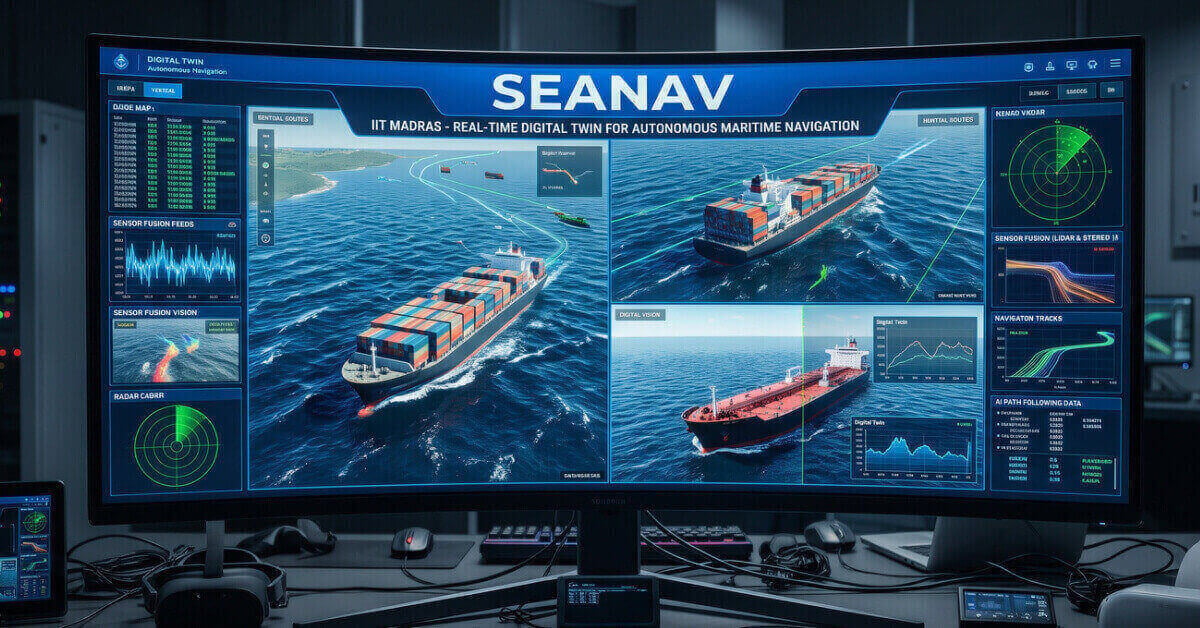
A calibrated virtual ocean is not a simulation, it is a proving ground. The SEANAV platform from IIT Madras represents a measurable step toward making autonomous maritime navigation safe, scalable, and scientifically validated before any vessel leaves the dock. This is what rigorous, peer-reviewed progress looks like: a real-time digital twin that combines AI, multi-sensor fusion, and virtual reality to test navigation systems under conditions that mirror fog, rain, and congested shipping lanes. The team has already demonstrated autonomous path-following and AI-driven collision avoidance that complies with the International Regulations for Preventing Collisions at Sea (COLREGs). That is not a laboratory curiosity; it is an empirical foundation for an industry that carries more than 80 percent of global trade.
For our readers, researchers, policymakers, port operators, the practical meaning is direct. SEANAV replaces expensive, hazardous sea trials with thousands of hours of repeatable, calibrated virtual testing. A calibrated course correction of less than 1% fuel cost protects whale sharks demonstrated how small navigational adjustments can yield outsized environmental benefits; SEANAV extends that logic by enabling those adjustments to be tested exhaustively before they are applied at scale. The platform also aligns with India's Sagarmala Program and Maritime India Vision 2030, which prioritize smart ports and digital systems. And because SEANAV models realistic sensor noise and delays, unlike conventional simulators that assume perfect data, it directly addresses the gap between theoretical autonomy and operational reliability. Edge intelligence and multi-AUV networks advance autonomous hydrographic surveying shows how the underwater side of this data ecosystem is evolving; SEANAV brings the same rigor to the surface.
What sets this work apart is its integration of multi-agent AI. In crowded harbors like Chennai, Mumbai, Visakhapatnam, and Kochi, a single autonomous vessel is not enough. Vessels must negotiate with each other in real time while obeying COLREGs. SEANAV enables multiple autonomous ships to learn and operate together, developing collision-avoidance strategies that account for complex interactions. The platform has been calibrated against a benchmark tanker 320 meters in length, so its outputs are tied to real commercial shipping, not abstract models. The inclusion of an immersive VR interface using Meta Quest headsets also means that human operators can train in bridge-level scenarios for emergency response and port approaches, bridging the gap between digital validation and human judgment.
One concrete point to watch: the team plans to develop digital twins of major Indian ports and validate the technology using physical scale models. That transition from virtual calibration to physical validation will determine whether SEANAV moves from a research platform to an operational standard. If the digital twin can predict real-world vessel behavior within validated error margins, the implications for shipping safety, fuel efficiency, and emissions reduction are direct and measurable. The question is not whether autonomy will come to maritime navigation, but whether it will be tested thoroughly enough to trust. SEANAV is building that trust, one calibrated simulation at a time.