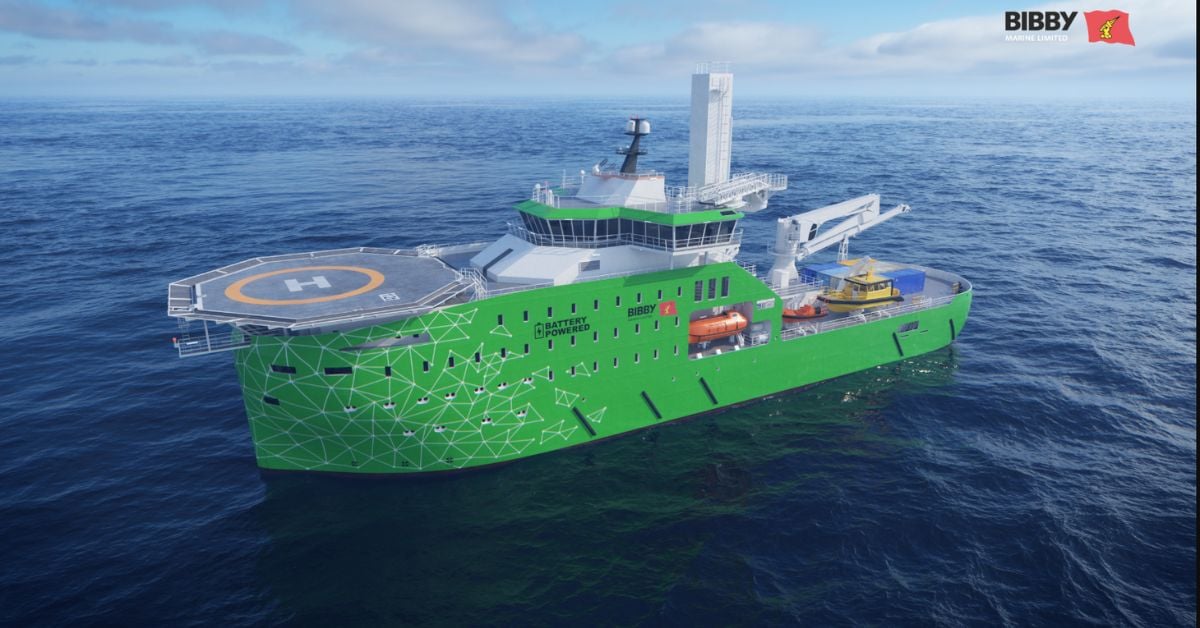
The offshore wind industry has long accepted a certain inefficiency in its service vessel operations: gen-sets running at variable loads, burning fuel at suboptimal rates while waiting on station. A validated, battery-first design now offers a measurable alternative. Bibby Marine's approach, as reported in the article on validated efficiency, decouples the gen-set from the vessel's variable power demand. The generator runs at a consistent, calibrated load to charge onboard batteries, and the batteries handle the peaks. The result is a direct reduction in operational expenditure, not a theoretical one.
This is not an isolated innovation. We have seen similar principles validated elsewhere. A Hydrogen-Hybrid Propulsion Validates 24% Fuel Reduction on Transoceanic Voyage on a bulk carrier, using a different energy source but the same empirical logic: stabilize the prime mover, cut the waste. The Bibby Marine case applies that logic to the offshore wind sector, where vessel idling and transit between turbines create precisely the kind of variable load that undermines combustion efficiency. What makes this development worth attention is the specificity of the validation. The article reports that the battery-first design is not a prototype or a pilot; it is an integrated, real-world configuration with measurable OPEX savings. For operators managing a fleet of service vessels, that is a number they can take to procurement.
Our take is that this represents a practical, near-term lever for reducing the carbon intensity of offshore wind logistics. The industry has spent considerable effort on turbine-level efficiency and grid integration. Vessel operations, by comparison, have been a slower-moving target. A battery-first architecture that lets a gen-set run at its sweet spot, rather than chasing every throttle change, is a straightforward engineering solution that does not require new fuel infrastructure or crew retraining on complex systems. It is a calibrated improvement, not a revolution. That is precisely what makes it credible. The reader should ask: if this design can cut OPEX while lowering emissions, what is preventing broader adoption? The answer likely lies in upfront capital costs and the inertia of existing fleet procurement cycles.
One specific detail to watch is the charging strategy. The article emphasizes that the gen-set operates at a consistent load to charge the batteries. That means the system's total efficiency depends on how well the battery capacity matches the vessel's duty cycle. If the batteries are undersized, the gen-set will still need to cover peak loads directly. If they are oversized, the weight and space penalty could erode the gains. The validation data must show where that balance point sits for a typical offshore wind service route. That is the empirical question that will determine whether this design scales from a single vessel to an entire fleet.