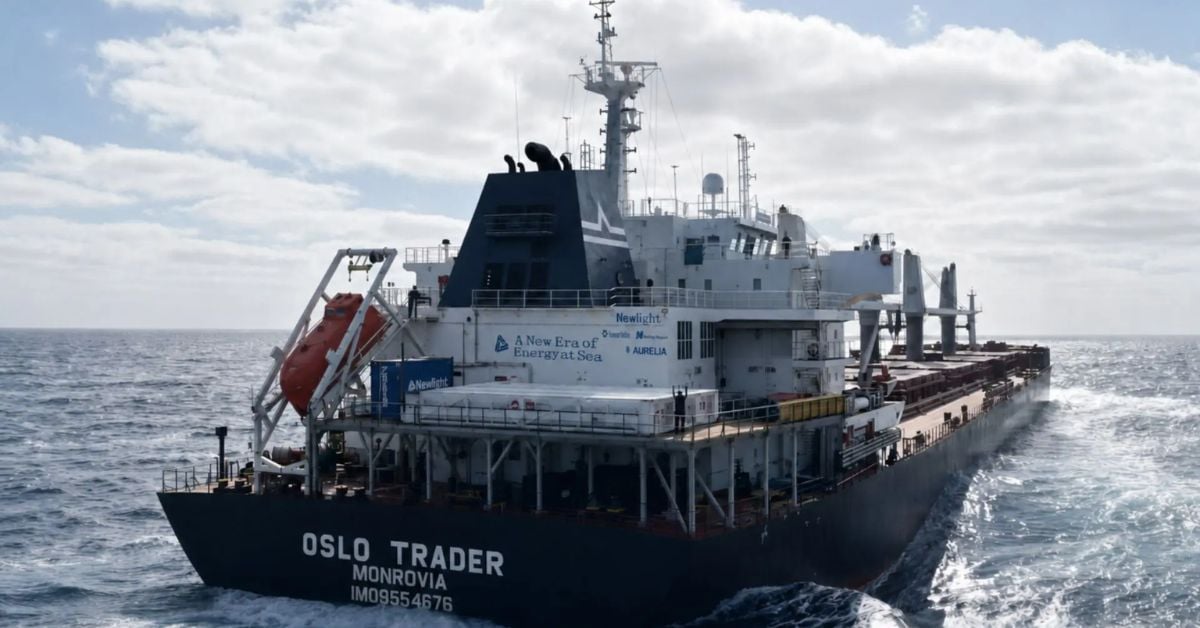
The numbers are quiet, but they are not small. Newlight's hydrogen-hybrid system, fitted to a bulk carrier's diesel engine for a voyage from Singapore to Ghana, delivered a 24% fuel reduction across 8,500 nautical miles. That is not a lab result or a simulation. That is a real ship, on a real ocean, burning less heavy fuel because someone integrated a hydrogen stream into the combustion process without waiting for a newbuild hull or a global fuel standard. We should read that number twice, because it is the kind of validated, measurable outcome that the maritime sector has been promising for years but rarely delivering at this scale.
The achievement sits in sharp contrast to the risks that still dominate shipping news. Consider the Bulk Carrier Freed After Prolonged Grounding Near Gladstone, Australia, where a ship's operational vulnerability became a six-day incident. Or the Fatal Attack on Cargo Ship Highlights Black Sea Shipping Risks, a brutal reminder that the most efficient propulsion system in the world means nothing if a vessel cannot transit safely. And while Cochin Shipyard Expands Design Capabilities with Conoship Equity Stake points toward future design innovation, retrofits like Newlight's are solving for the fleet that exists now. The point is not that hydrogen-hybrid retrofits solve every problem. The point is that they do not require the industry to wait for a perfect, zero-emission future before making measurable progress.
Our take is direct: this is the kind of incremental, empirical progress that should be funded, scaled, and stress-tested. A 24% reduction in fuel consumption is not a silver bullet. It is a calibrated step that reduces emissions, lowers operating costs, and, critically, builds operational data on how hydrogen behaves aboard a working vessel. The maritime sector does not need more alarmist messaging about the ocean dying; it needs more voyages like this one, where a technology is tested against real distances, real weather, and real schedules. We would tell a reader who asked us about this voyage to watch what happens next: will the system degrade over multiple voyages, or does the fuel saving hold? That is the question that turns a promising trial into a commercial decision.
The open question is not whether hydrogen can play a role in marine propulsion. It can. The question is whether the industry will treat this as a curiosity or as a template. If Newlight's system can be replicated across the bulk carrier fleet, the cumulative fuel savings become a climate indicator worth tracking. The concrete point to watch is the next deployment: a single successful voyage proves a concept, but a second and third will prove a pattern. We are not looking for a headline here. We are looking for repeatable, peer-reviewed performance data. That is what turns a 24% reduction on one ship into a practical answer for the hundreds of hulls still burning diesel.