U.S. & Philippine Marines Simulate Attacks Against Chinese Warships Using Drones & BrahMos Anti-Ship Missiles
Our take
The recent joint U.S. and Philippine military exercise simulating attacks against Chinese Navy (PLAN) warships using drones and BrahMos anti-ship missiles underscores a significant shift in regional security dynamics. This isn't merely a routine training event; it represents a tangible escalation in efforts to deter potential aggression in the South China Sea and bolster the Philippines’ defensive capabilities. The simulation, incorporating realistic scenarios involving the defense of Manila's territorial waters against a simulated PLAN naval formation, highlights the growing concern over China’s assertive actions in the region. Such exercises are increasingly common, as evidenced by the recent disruption of a Russian training exercise aimed at disabling subsea cables, NATO Allies Disrupt Secret Russian Training To Disable Critical Subsea Cables Without Leaving A Trace. The parallel between protecting critical underwater infrastructure, be it cables or maritime territories, reveals a shared vulnerability and the escalating need for robust defense strategies.
The inclusion of the BrahMos missile, a joint Indian-Russian development, is particularly noteworthy. It signals a diversification of defense procurement for the Philippines and potentially a broadening of strategic partnerships beyond the traditional U.S. alliance. This move is likely a response to concerns about reliance on a single supplier and a desire to enhance interoperability with a wider range of military forces. The U.S. Navy’s recent upgrades to its own defensive systems, such as the equipping of the USS Mustin with a new point-defense system, U.S Navy Equips USS Mustin with New Dual-Gun Mk 38 Mod 4 Point-Defense System, further illustrates the regional arms race and the increasing emphasis on layered defense strategies against advanced threats. The ongoing trial in Finland involving a Russian ship accused of damaging subsea cables Russian Captain And Senior Crew Of Ship On Trial In Finland Over Subsea Cable Damage serves as a stark reminder of the potential consequences of aggressive actions and the complexities of international maritime law.
The broader significance of this exercise extends beyond the immediate geopolitical context of the South China Sea. It reflects a growing trend of multilateral security cooperation aimed at countering perceived threats from revisionist powers. The willingness of the U.S. to engage in such exercises with regional partners demonstrates a commitment to maintaining freedom of navigation and upholding international law in the face of increasing pressure. Moreover, the focus on drone warfare and advanced missile systems highlights the evolving nature of modern conflict, where asymmetric capabilities and precision strikes are becoming increasingly important. This shift necessitates a re-evaluation of traditional military doctrines and a greater emphasis on technological innovation and integrated data ecosystems to ensure effective defense. The simulation itself is a valuable data point, providing measurable empirical insights into the effectiveness of various defensive strategies against contemporary naval threats.
Looking ahead, the key question will be whether these exercises serve as a genuine deterrent or merely escalate tensions in the region. The increased militarization of the South China Sea creates a complex and potentially unstable environment, where miscalculation or accidental escalation could have far-reaching consequences. Longitudinal monitoring of these exercises, alongside analysis of China's naval deployments and diplomatic statements, will be critical to assessing the long-term impact on regional security and the prospects for peaceful resolution of territorial disputes. The integrated data ecosystem required to analyze these developments – incorporating real-time sensor data, intelligence reports, and validated predictive models – will be crucial for informed decision-making and effective ocean intelligence.
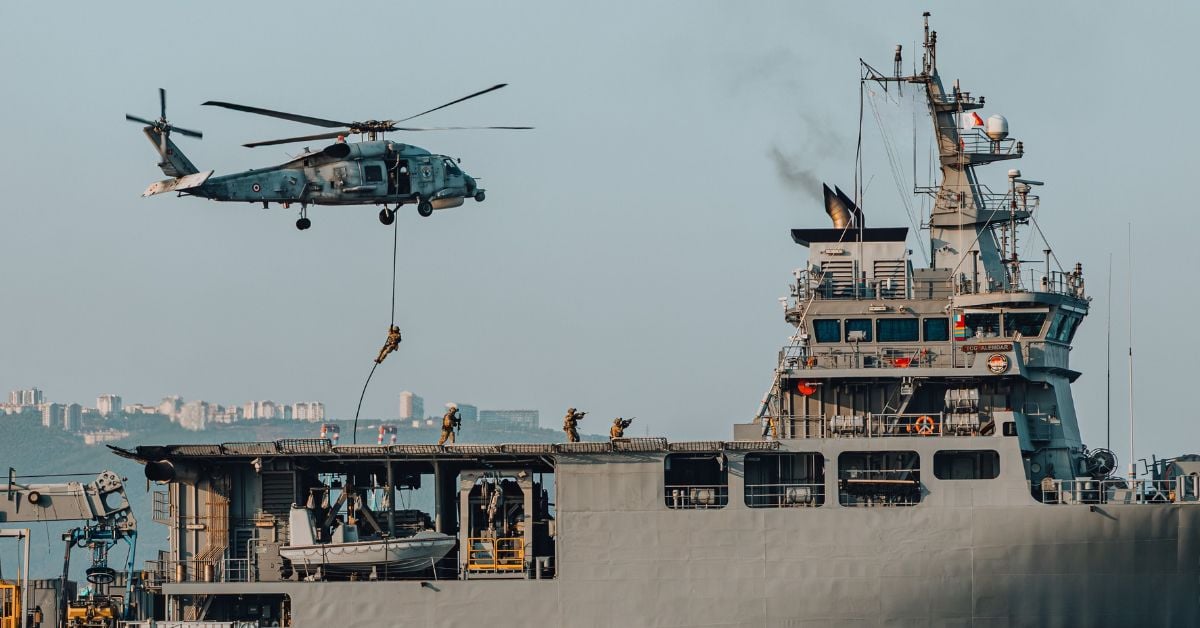
United States and the Philippines recently conducted a naval exercise under the Archipelagic Coastal Defence Continuum 26.4 in the Luzon Marine Base, wherein they used drones and BrahMos missiles to target simulated Chinese warships, including 2 Type 052D destroyers, a Type 901 support ship, and a Type 054A frigate.
In order to make the training challenging and as realistic as possible, both countries used a naval formation of the Chinese Navy (PLAN) to defend the territorial waters of Manila.
During the exercise, the Marine teams made use of the Hermes drones of the Philippines’ Armed Forces to identify and track the targets, with the goal of making a complete ‘kill chain’, which in maritime naval terminology means the complete procedure involving the targeting, tracking and attacking the enemy.
The joint drill also enabled the Philippine Navy to test its new weapons and integrate them into a single defence system.
Philippines purchased India’s BrahMos supersonic cruise missiles for 375 million USD in 2022, which can travel 3 times faster than the speed of sound and deliver a warhead weighing four hundred pounds. In this exercise, these missiles were used to target the simulated enemy targets.
According to naval experts, anti-ship missiles with a long range can prove useful only when the intelligence that is fed into them is accurate. If it is not supported by real-time data, it loses the tactical benefit.
During the drill, the drones were integrated with the BrahMos to increase the precision of the strike, thereby proving that smaller naval units can also be lethal to sophisticated naval groups armed with weapons.
The development comes amidst growing diplomatic strain between Beijing and Manila over the South China Sea, which the former claims in its entirety, despite international rulings.
Hence, the Philippines is preparing itself to face and counter China in the contested waters by investing in new types of drones, missiles and weapon systems.
Manila has built the first BrahMos facility in a western Luzon base which is close to the Scarborough Shoal, a disputed island between China and the Philippines, where skirmishes between the vessels of both countries are often reported.
The Philippines is also planning to establish missile detachments in the northern part of Luzon as well as in Palawan.
Read on the original site
Open the publisher's page for the full experience