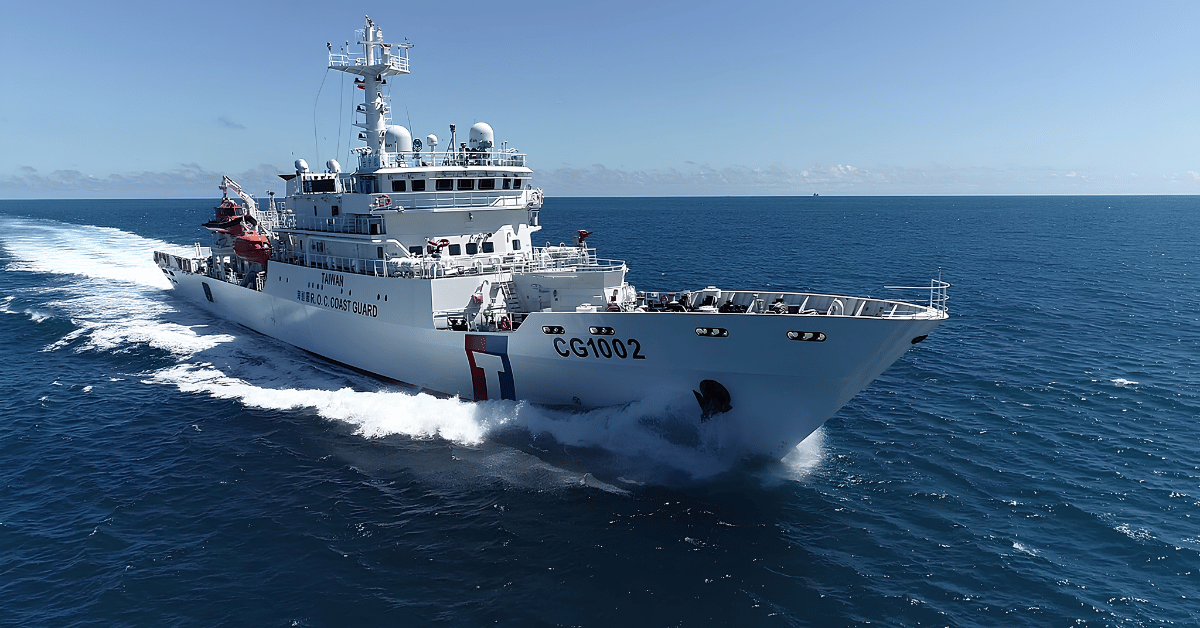
Taiwan's Coast Guard now has eyes in the sky that do not require a runway, and that changes the calculus for maritime domain awareness in a contested region. The deployment of Shield AI's V-BAT drones represents a measured, capability-driven step toward persistent surveillance, not a rhetorical gesture. For readers tracking the intersection of uncrewed systems and ocean governance, this is a concrete validation of what vertical take-off and landing (VTOL) platforms can deliver when paired with local maintenance and training infrastructure. The V-BAT's ducted-fan design and 12-hour endurance mean the Coast Guard can maintain coverage over patrol zones without the logistical tail of larger aircraft, and its heavy-fuel engine reduces the operational risk of refueling at sea. That is not a marketing claim; it is a demonstrated fact from U.S. Coast Guard operations, where the same platform helped intercept over 100,000 pounds of narcotics last year. The practical consequence for Taiwan is a calibrated, scalable surveillance layer that integrates with existing shipborne operations.
This announcement arrives alongside other developments in regional maritime security, and the contrasts are instructive. The recent First Sightings of Chinese Militia Vessel Near Taiwan's Eastern Coast underscores why persistent, validated intelligence is not optional; it is the baseline for distinguishing routine traffic from hostile activity. Meanwhile, the Indigenous Multipurpose Vessel Samarthak Joins Indian Navy at Karwar shows a parallel commitment to building sovereign maritime capability through indigenous production. Taiwan's approach with the V-BAT is a hybrid model: foreign technology adapted and sustained through a local partnership with AIDC, which trains operators and builds localized support infrastructure. That model reduces dependence on external logistics while retaining access to a system already proven in electronic warfare environments. The V-BAT was designed for contested spectrum conditions, meaning its sensors and data links are hardened against jamming, a feature that matters when operating near the Taiwan Strait.
What makes this deployment noteworthy is not the drone itself but the ecosystem being built around it. Shield AI and AIDC have committed to sustainment, autonomy integration, and technical training, not just delivery. The Coast Guard's "Shipborne UAV" program selected the V-BAT competitively in July 2026, and the public demonstration at the Port of Taipei showed aircraft setup within minutes, a practical indicator of operational readiness. For our readers, the takeaway is this: the V-BAT program is a test case for how small, ship-deployed uncrewed systems can close the gap between satellite-level awareness and on-water reality. The specific detail to watch is how the CGA integrates V-BAT data into its existing command-and-control architecture, and whether the 12-unit fleet scales to cover the eastern approaches where militia vessels have been sighted. That integration will determine whether this capability remains a tactical tool or becomes a strategic asset for ocean intelligence across Taiwan's maritime borders.