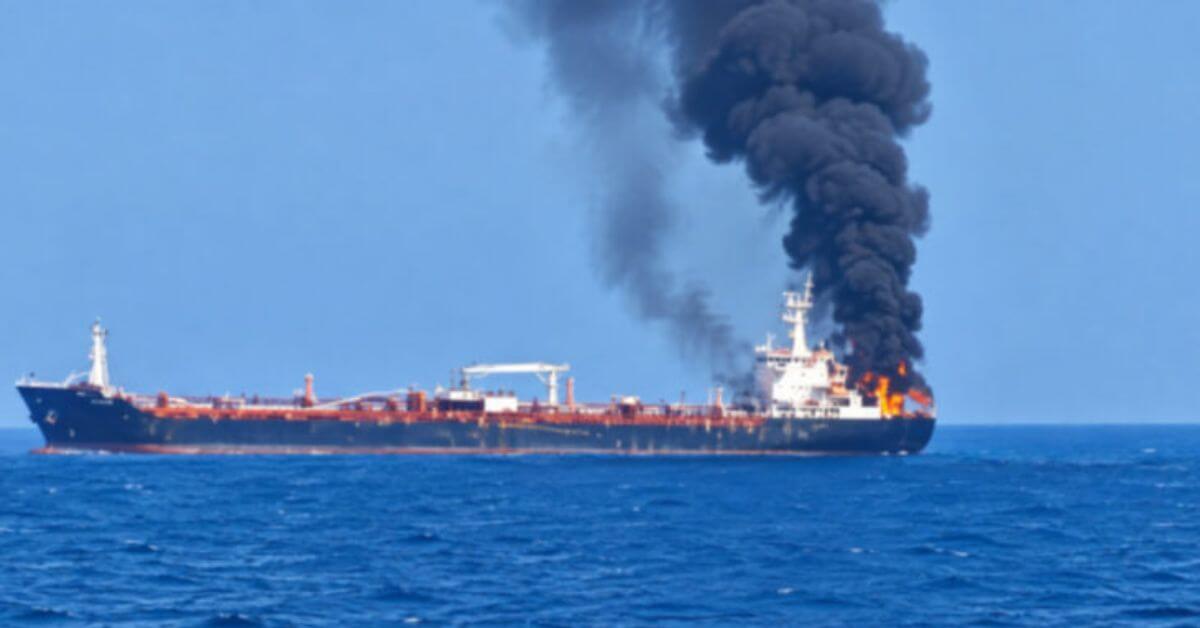
Thirteen crew members are safe. One Indian seafarer remains missing after an attack on a vessel off the Oman coast, according to India's Ministry of External Affairs. The incident unfolds in waters that have become a pressure point for global energy logistics. This is not an isolated maritime misfortune; it is a symptom of a region where commercial traffic and geopolitical friction increasingly share the same crowded lanes. For every tanker that moves Saudi crude to market, for every sanctioned vessel testing its luck, there is a human crew exposed to a threat model that shifts faster than official navigational warnings update.
The Gulf of Oman is not a passive backdrop here. As Gulf of Oman STS Transfers Max Out Amid Rising Saudi Oil Exports makes clear, ship-to-ship transfers are running at full capacity to keep barrels flowing. More transfers mean more rendezvous points, more slow-moving vessels, and more windows for interdiction or attack. Meanwhile, Phased Negotiations Aim to Ease Restrictions on Strait of Hormuz suggest that diplomatic channels are trying to walk back the brinkmanship. But diplomacy operates on a different clock than a crew in distress. The missing seafarer's fate is being resolved in hours, not negotiation cycles. What the negotiation track offers is a reason to watch the Strait closely; what this attack offers is a reason to ask whether the current rules of engagement are calibrated to protect the people moving the payloads.
Our read on this is direct: the maritime industry has spent years perfecting the measurement of tonnies, charter rates, and emissions profiles, yet the human cost of instability in this corridor remains understated in operational risk models. The related case of Puntland Forces Intercept Hijacked, US-Sanctioned Oil Tanker After 48 Hours shows that responses can be effective when the will exists and the location is within reach. But that success also highlights the asymmetry: a 48-hour rescue is possible in Somali waters; an attack near Oman may not offer the same timeline or the same visibility. The practical takeaway for our readers is not alarmist. It is that the integrated data ecosystem we advocate for must extend beyond weather routing and fuel optimization. It must include real-time threat correlation, crew welfare triggers, and a protocol that treats an attack on a merchant vessel as a logistics disruption with a human count, not just an insurance claim.
The open question we are left with is simple: what happens to the remaining seafarer, and what will the industry change before the next incident? The answer will tell us whether the sector's stated commitment to safety is measured in validated outcomes or in press releases. We would tell any operator, insurer, or policy maker who asks that the data exists to build better guardrails. The missing piece is not the technology; it is the willingness to treat every missing crew member as a metric that matters. Watch the next 48 hours, and watch whether the response is measured in rescue operations or in risk assessments. That will be the real indicator.