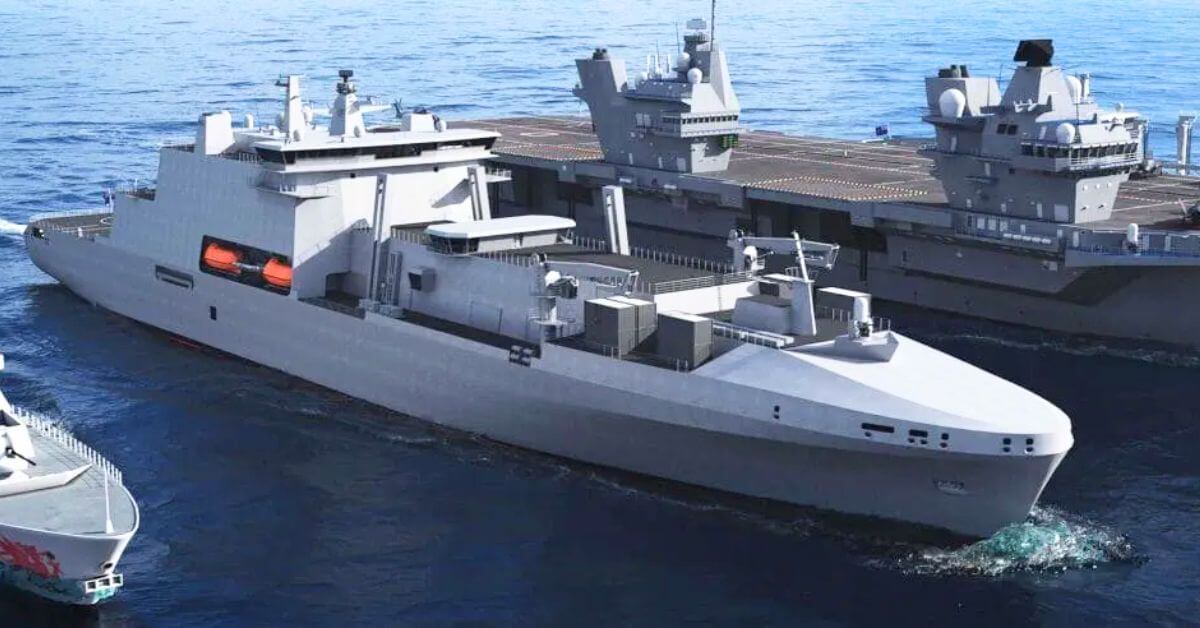
The first block of RFA *Resurgent* has been lowered onto the Seahorse barge in Appledore, marking the start of construction for the Royal Navy's newest Fleet Solid Support Ship. This is not a ribbon-cutting moment; it is the physical beginning of a vessel designed to sustain operations far from shore. For those who track naval logistics, this is where abstract capability becomes steel in the water.
The milestone arrives alongside related developments that underline how maritime power is being reshaped by industrial collaboration. The recent Collaborative Shipbuilding Initiative Advances Ocean Data Capabilities in India between Synergy Marine Group and Cochin Shipyard signals that shipbuilding is no longer a purely national exercise. Meanwhile, the test-firing of a torpedo from an uncrewed underwater vessel, reported in Autonomous Vessel Demonstrates Advanced Torpedo Deployment Capability, shows that the platforms themselves are becoming part of a wider, networked system. These are not isolated projects; they are indicators of a shift toward integrated maritime ecosystems where data, logistics, and deterrence overlap.
What stands out about *Resurgent* is not just the hull taking shape, but what it represents for operational endurance. A Fleet Solid Support Ship is not a warship in the traditional sense. It carries ammunition, food, and stores, the quiet enablers that determine whether a task group can stay on station. In an era of peer competition, the ability to sustain forces without relying on shore bases is a strategic advantage, not a convenience. The construction at Appledore, a yard with a deep shipbuilding heritage, also speaks to the value of retaining industrial skills in a sector that has seen its share of closures and consolidations. This is not about sentimentality; it is about capacity that cannot be quickly rebuilt once lost.
For our readers, the practical takeaway is this: watch how the build progresses, but also watch how the support ecosystem evolves around it. The MoU in India and the autonomous torpedo test point to a future where logistics, uncrewed systems, and allied industrial cooperation are inseparable. A single ship is a data point; the pattern of how these capabilities are being stitched together is the real story. The question worth tracking is whether the Royal Navy's support architecture will keep pace with the speed at which its operational environment is changing. That is not a rhetorical question. It is a metric for the next several years of shipbuilding decisions.