Philippine Navy & Chinese Warship Exchange Radio Challenges Near Disputed Sabina Shoal During Naval Exercise With U.S & Australia
Our take
The recent exchange of radio challenges between the Philippine Navy and a Chinese warship near Sabina Shoal, occurring during a joint naval exercise with the United States and Australia, underscores the escalating tensions in the West Philippine Sea. This incident, where Chinese vessels shadowed the participating allied forces, highlights a pattern of assertive behavior aimed at contesting maritime claims and disrupting regional stability. The broader context is one of increasing geopolitical competition, with the South China Sea serving as a critical flashpoint. Related concerns regarding freedom of navigation are evident in commitments made by littoral states to maintain open trade routes, as highlighted in Littoral States Pledge To Keep Straits Of Malacca And Singapore Open For Global Shipping. Similarly, the implementation of service fees by Iran for ships transiting the Strait of Hormuz, as detailed in Iran Approves Service Fees For ‘Authorised’ Ships Transiting Strait Of Hormuz, demonstrates the global implications of controlling strategic maritime chokepoints. These events, and Russia's naval exercises near the Kuril Islands—a situation prompting a protest from Japan, as reported in Japan Protests Russian Naval Exercise Near Contested Kuril Islands Close To Hokkaido, illustrate a worldwide trend of nations asserting sovereignty and influence over vital waterways.
The radio challenges themselves, while potentially escalatory, are a relatively common occurrence in contested maritime zones. However, the timing—during a multilateral exercise designed to demonstrate commitment to international law and freedom of navigation—is significant. It signals a deliberate attempt by China to signal its disregard for the exercise and its continued claims over areas within the Philippines' exclusive economic zone (EEZ). This action is not simply about Sabina Shoal; it’s about establishing a broader narrative of dominance and challenging the legitimacy of international norms. The presence of U.S. and Australian naval assets further complicates the situation, raising the potential for miscalculation and unintended consequences. The calibrated response from the Philippine Navy, likely coordinated with its allies, is crucial in managing the risk of escalation while upholding its sovereign rights. Data from maritime monitoring systems, if shared openly and validated through peer-reviewed analysis, could provide a more complete picture of vessel movements and intentions, contributing to a more informed understanding of the dynamics at play.
The long-term implications of this incident extend beyond the immediate territorial dispute. It reinforces the need for robust and transparent maritime domain awareness capabilities across the region. Integrated data ecosystems, incorporating real-time sensor data from satellites, surface vessels, and underwater platforms, are essential for accurately tracking vessel activity and identifying potential threats. Furthermore, it highlights the importance of international collaboration in upholding the rule of law at sea. The joint exercises involving the Philippines, U.S., and Australia demonstrate a commitment to collective security and a willingness to push back against unilateral actions that undermine regional stability. Empirical data, gathered through longitudinal monitoring programs, will be critical in assessing the long-term impact of these actions on the marine environment and the livelihoods of coastal communities.
Looking ahead, the frequency and intensity of such incidents are likely to increase. The need for clear communication protocols and de-escalation mechanisms becomes paramount. The question remains: Can a framework for managing these disputes be established that prioritizes diplomacy and adheres to international law, or will the West Philippine Sea continue to be a source of heightened tension and potential conflict? The ongoing development and calibration of ocean intelligence systems, providing validated and measurable data on maritime activity, will be a crucial element in navigating this complex and evolving landscape.
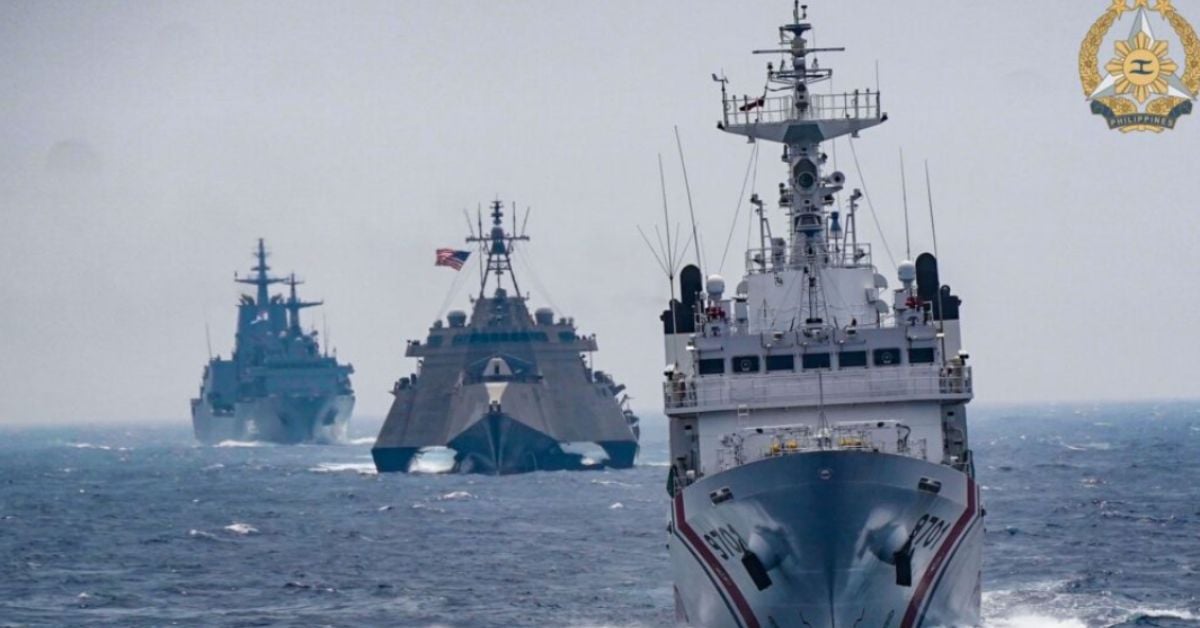
Chinese warships trailed behind Australian, Philippine and U.S naval vessels during a naval exercise which was conducted recently in the West Philippine Sea.
However, Chinese ships maintained a safe distance of 2 to 4.5 nm from the vessels participating in the exercise, and everything went as planned, sources suggest.
The Chinese naval ships and coast guard vessels also entered into a radio conversation with a Philippine vessel, over claims of sovereignty near the disputed Sabina Shoal.
Chinese warship 536 communicated with Philippine naval vessel 07, saying that the Sabina Shoal, which China refers to as Xianbin Jiao, belonged to Beijing and asked the Philippine vessel to leave the area.
The Philippine naval vessel responded by announcing that it was the Chinese vessel which was in Manila’s Exclusive Economic Zone and the Kalayaan Islands which were part of the Philippines’ territory.
It also reminded China of the United Nations Convention on the Law Of The Sea, or UNCLOS, according to which Beijing’s claims of sovereignty over the shoal and the neighbouring islands like Nanshan Shintao and others were baseless, illegal and not recognised by international law.
The entire exchange was heard by the Philippines’ BRP Diego Silang, which was also participating in the 19th 19th Multilateral Maritime Cooperative Activity (MMCA) held between August 21-25, 2026.
The commanding officer of the warship, Captain John Percie Alcos, said that a Philippine frigate was being followed by a Chinese destroyer of the Luyang class missile boat of the Hubei-class, two coast guard ships and a frigate of the Jiankai II-class.
U.S warship Santa Barbara was being shadowed by a Chinese corvette while Philippine Coast Guard’s BRP Teresa Magbanua was being monitored by a Chinese coast guard ship.
Alcos also highlighted that Chinese naval warships had been present during many naval drills conducted by the Philippines in 2026.
In the exercise, the vessels identified, tracked and took down the threats and worked together towards achieving greater maritime domain awareness and focused on enhancing their capabilities to conduct joint operations.
West Philippine Sea is a highly contested area between China and the Philippines, which also explains the presence of the Chinese Navy in the waters when the Philippines was engaging in a multinational maritime exercise with the U.S and Australia.
China has time and again expressed its dislike for Western countries’ interference in Asia and matters concerning Beijing.
Read on the original site
Open the publisher's page for the full experience